

The Great Tokenization Shift: 2025 and the Road Ahead
Keyrock, in collaboration with Centrifuge, has released a comprehensive report exploring the current landscape of Real-World Asset Tokenization.
Download here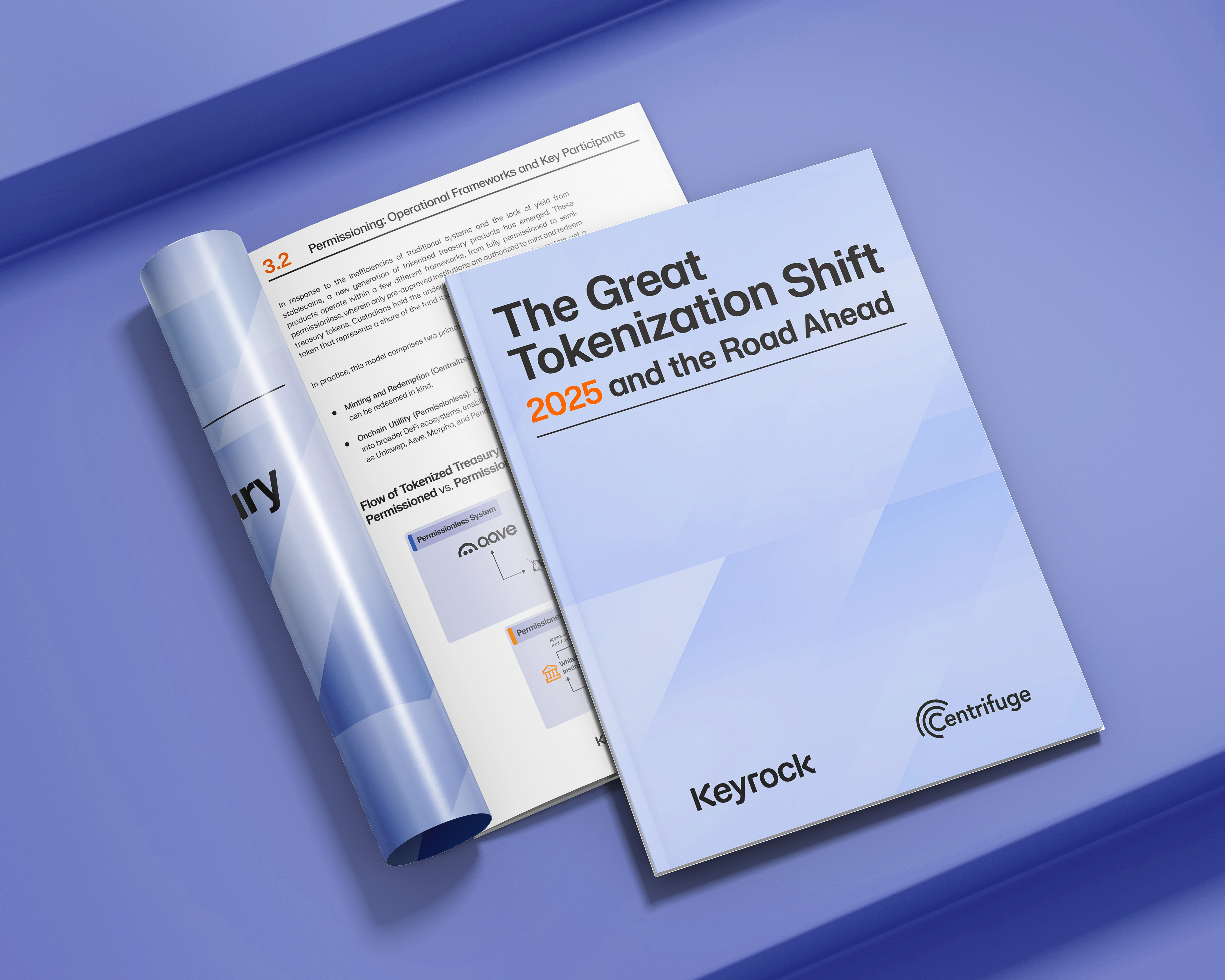
Preface
Originally presented exclusively to select institutions, projects, and policymakers at our recent RWA Summit in NYC, this report provides a detailed overview of tokenization across key asset classes, including U.S. Treasuries, private credit, equities, and commodities. It offers an insightful perspective on the historical developments, current state, and future direction of asset tokenization.
Recognizing the significant value of this resource, we’ve decided to make our full 75+ page report publicly accessible. The report features expert contributions from industry leaders such as Backed, Ondo Finance, Maple Finance, Tradable, Paxos, Chainlink Labs, Plume, Securitize, and Ostium Lab, providing deep analysis, data-driven insights, and forward-looking projections.
You can access the full report below and gain a comprehensive understanding of the evolving RWA tokenization ecosystem.
The Great Tokenization Shift: 2025 and the Road Ahead
Financial markets stand at an inflection point comparable to the ETF revolution that reshaped investing after 2009. The World Economic Forum projects tokenization could represent 10% of global GDP by 2027, while Boston Consulting Group forecasts up to $16 trillion in tokenized assets by 2030.
Tokenization directly addresses core inefficiencies in traditional markets: settlement delays, excessive intermediation, limited access, and operational complexity. With stablecoins already circulating at $210+ billion, the foundation for this transformation is firmly established. As RWA value has grown ~85% year-on-year to reach $15.2 billion in 2025, tokenized assets are moving beyond theoretical potential to demonstrate market impact across Treasuries, equities, commodities, and private credit.
Tokenized U.S. Treasuries: Leading the Digital Shift
Tokenized U.S. Treasuries: Leading the Digital Shift
The $28 trillion U.S. Treasury market, despite its critical role in global finance, still struggles with outdated T+1/T+2 settlements, costly intermediaries, and fragmented liquidity. Tokenization addresses these inefficiencies by enabling immediate settlement, reducing intermediation costs, and streamlining liquidity management. Currently, tokenized Treasuries total only $4 billion (2% of the $210 billion stablecoin market), yet they doubled from $1 billion to $2 billion in just five months during 2024. Given that stablecoin holders currently forgo approximately $8 billion annually by holding non-yield-bearing tokens, tokenized Treasuries present a compelling yield-generating alternative.
Circle’s strategic acquisition of Hashnote, the issuer of USYC, highlights this shift, allowing Circle to integrate yield-bearing Treasuries seamlessly into its stablecoin ecosystem. Centrifuge further demonstrates market potential through its Janus Henderson Anemoy Treasury Fund, significantly reducing securitization costs (up to 97%) and enabling instant redemptions of up to $125 million. Additionally, Securitize, as the transfer agent for BlackRock’s rapidly growing BUIDL Fund ($630 million in assets within 40 days), provides essential regulatory compliance infrastructure, unlocking broader institutional adoption.
Market Outlook Scenarios (2025 projections, based on % of growing stablecoin market):
- Bull Case (10%, ~$28B): Rapid institutional adoption driven by clear regulatory frameworks, extensive DeFi integration, and accelerated onboarding from industry leaders such as Circle, Centrifuge, and Securitize.
- Base Case (5%, ~$14B): Consistent, organic growth supported by yield-seeking stablecoin holders, steady institutional engagement, and incremental regulatory progress.
- Bear Case (2.5%, ~$7B): Moderate growth amid regulatory uncertainty or slower institutional uptake, with adoption primarily consolidating around trusted issuers like Circle and Securitize.

Tokenized Equities: Extending Capital Market Access
Tokenized Equities: Extending Capital Market Access
Traditional equity markets continue to suffer from structural inefficiencies such as slow T+2 settlement cycles, costly intermediaries, and limited accessibility. Tokenization offers immediate settlement, reduced operational complexity, 24/7 trading, and broader market access. However, regulatory complexities have historically constrained adoption: securities laws in the U.S. (Securities Act of 1933, Exchange Act of 1934) and Europe (MiFID II, Prospectus Regulation) demand extensive disclosures, registration, and strict trading protocols, complicating tokenization efforts.
Historically, crypto-native solutions like Mirror Protocol and Synthetix offered synthetic equity exposure but faced critical flaws such as collateral instability (UST collapse) and regulatory scrutiny from the SEC. Centralized initiatives by Binance and FTX similarly faltered due to regulatory and trust issues. Emerging regulated, asset-backed solutions now offer a clear path forward: Backed Finance leverages Europe’s MiFID II framework and Swiss DLT regulations for permissionless tokenized equities, while Ondo Chain provides institutional-grade infrastructure designed explicitly for compliant, onchain equity issuance, including built-in corporate actions and transparent proof-of-reserves. These regulatory advancements have become feasible due to increasing policymaker recognition of blockchain’s potential for market efficiency, combined with a more crypto-friendly political environment anticipated under the Trump administration starting in 2025. Still, Current Stock TVL is 300x less than Synthetix and Mirror at their peak, indicating significant room to grow.
Outlook for 2025:
- Bull Case (~$1B): Rapid growth driven by regulatory clarity, global retail adoption via permissionless platforms, and integration with leading DeFi protocols.
- Base Case (~$500M): Steady growth supported by incremental regulatory developments and institutional adoption.
- Bear Case (~$100M): Modest growth constrained by regulatory uncertainty, primarily concentrated among trusted platforms like Backed and Ondo.

Tokenized Commodities: Progress and Limitations
Tokenized Commodities: Progress and Limitations
Commodities markets, encompassing metals (gold, silver), energy (oil, gas), and agriculture, typically operate with less stringent regulations than equities, making tokenization more straightforward. Tokenized commodities, primarily gold tokens like PAX Gold (PAXG) and Tether Gold (XAUT), currently represent around $1.2 billion in market size. Despite regulatory simplicity and transparent ownership via audited custodians like Paxos, these products have struggled with limited liquidity, premium pricing (up to 5% above spot), and minimal DeFi adoption (~$3 million). Moreover, oracle risks can exacerbate liquidity mismatches and market inefficiencies.
Alternatively, synthetic commodity platforms like Ostium Labs provide leveraged, non-redeemable commodity exposure, directly catering to traders preferring speculative positions rather than physical delivery. By offering decentralized CFDs referencing reliable offchain price feeds, Ostium addresses liquidity and accessibility constraints faced by physical tokens, potentially capturing retail demand more effectively.
Outlook for 2025:
- Bull Case (~$2B): Driven by better redemption systems, increased DeFi integration, and broader adoption of synthetic protocols for leveraged commodity speculation.
- Base Case (~$1.5B): Limited growth; gold remains dominant, with moderate synthetic market adoption.
- Bear Case (~$1.25B): Stagnation or slight contraction amid ongoing liquidity challenges and muted retail interest, especially if synthetic protocols face regulatory uncertainty.

Tokenized Private Credit: Unlocking Illiquid Markets
Tokenized Private Credit: Unlocking Illiquid Markets
The $2 trillion private credit market, historically limited by illiquidity, large investment minimums ($5–10 million), and multi-year lockups, is rapidly embracing tokenization. With current tokenized private credit totaling around $12.2 billion, on-chain securitization reduces costs by up to 97%, expands investor access beyond traditional institutional minimums, and provides transparent, real-time loan performance tracking.
Looking forward, clearer regulatory frameworks, growing institutional participation, and further integration with DeFi markets are expected to drive adoption. Leading platforms such as Centrifuge, Maple, and Tradable have pioneered tokenizing a wide variety of credit instruments, from institutional private loans and structured credit products to consumer mortgages and real estate-backed debt, significantly broadening on-chain use cases.
Outlook for 2025:
- Bull Case (~$17.5B): Accelerated adoption with strong regulatory clarity and institutional onboarding.
- Base Case (~$15B): Steady growth driven by continued institutional interest and incremental regulatory progress.
- Bear Case (~$12B): Modest growth constrained by regulatory or market headwinds, yet sustained by inherent efficiency advantages.

Conclusion
Conclusion
Combining our 2025 projections across all tokenized asset classes:
- Bull Case: $50 billion – Regulatory clarity driving institutional adoption and DeFi integration
- Base Case: $30 billion – Steady growth from existing infrastructure improvements
- Bear Case: $20 billion – Conservative growth despite potential regulatory headwinds

The transformation of global finance through tokenization is not merely theoretical—it’s already underway.

Download our full RWA Report
Our 75+ page industry report includes detailed analyses and strategic insights from leading market players such as Centrifuge, Chainlink, Securitize, Ondo, Maple, and others.
This site is protected by reCAPTCHA and the Google Privacy Policy and Terms of Service apply.