
Prediction Markets. A guide
Keyrock, in collaboration with Dune, has released a comprehensive report exploring Prediction Markets
Read the Full ReportKey Insights on Prediction Markets
- Since early 2024, monthly notional volume on prediction markets has surged from under $100 million to over $13 billion, a 130x increase that places prediction markets among the fastest-growing sectors in the world.
- In 2025 volume and open interest growth is being led by non-sports categories. Economics (10x) and Tech & Science (17x) show the strongest volume gains, while Economics (7x) and Social & Culture (6x) lead the expansion in open interest.
- On Kalshi, Politics, Elections, and Economics combined hold 2.5x the open interest of Sports, while on Polymarket, Politics outpaced Sports by 400% in 2025.
- Polymarket correctly prices outcomes 90-95% of the time, and its accuracy improves with deeper liquidity. Across Polymarket and Kalshi, Brier scores cluster around 0.09, outperforming polls, expert judgment, and even weather models.
- Prediction markets function as leading indicators for macro risk, repricing in real time and anticipating macro shifts before reactive models like the Cleveland FedNow, which is 4.3x more volatile than Kalshi’s inflation market.
- Traders on Kalshi show strong risk aversion, with high-probability markets drawing over 35% of volume despite being just 14% of listings, while long shots make up 31% of markets but capture only 3% of trading; Polymarket shows a similar pattern.
- Adoption is not only accelerating, it is proving durable. Polymarket outperforms +85% of crypto protocols on user retention across a sample of over 275 projects.
What is a Prediction Market?
Prediction markets are information-based exchanges where participants trade contracts whose payoff depends on the outcomes of future events. By buying and selling contracts or shares, traders reveal what they believe different outcomes are worth. In practical terms, they let people back their views on real world events, from elections and economic data to sports or the weather. They aggregate dispersed knowledge and make it tradable, measurable and economically meaningful.
For example, on a prediction market a trader might buy or sell contracts on “Will candidate X win the election” or “Will inflation exceed five percent this quarter.” Any clear and well specified question can become a market.
Traders buy and sell these claims, and the prevailing price reflects the crowd’s aggregated knowledge of how likely that outcome is. Prices usually sit between $0 and $1, so a contract trading at 70¢ can be read as an implied probability of 70% that the event will occur.
Like other exchanges, they rely on incentives to discover prices, but what is traded here is the probability of any discrete event. Markets can be created for almost any well defined outcome, and participants with better information arbitrage opportunities tend to buy contracts that look cheap or sell those that look expensive, nudging prices toward more accurate probabilities.
This aligns with James Surowiecki’s concept of the ‘wisdom of crowds,’ where diverse participants, motivated by conviction and profit, often outperform individual experts. It also echoes Ethereum co-founder Vitalik Buterin’s idea of “info finance,” where information flows and incentives for truth are economically aligned. Robin Hanson’s concept of futarchy similarly imagines governance systems guided by market-driven forecasts.
Prediction markets stand apart from existing mechanisms:
- Sports betting is entertainment-driven, zero-sum, and structurally adversarial. The house earns by setting lines that embed a margin against the player. There is a conflict of interest between the house and the player. Prediction markets, by contrast, are exchanges where incentives are aligned around accurate pricing rather than defeating a bookmaker.
- Polls measure sentiment, not commitment; without financial stakes, they’re prone to bias and low engagement.
Seen through this lens, prediction markets aren’t simply places to wager on events, they’re prototypes of a broader information infrastructure, one that organizes knowledge into tradeable signals.
Historical Context of Prediction Markets
Prediction markets resemble the early origins of modern finance. While today’s leading prediction markets feel novel, they trace their roots back centuries.

One of the first recorded prediction markets appeared in Renaissance Italy. During the 1503 papal conclave, nobles and merchants reportedly placed wagers on who would become the next pope. These early information markets allowed people with insider knowledge or strong beliefs to put money behind their predictions. The markets became so influential that Pope Gregory XIV banned them in 1591, threatening excommunication for participants not out of moral opposition but because public betting exposed collective expectations about a supposedly divine decision.
By the 18th century, organized prediction markets reemerged in London’s coffeehouses, which had become gathering spots for merchants, journalists, and aristocrats. At Jonathan’s Coffeehouse, later the site of the London Stock Exchange, patrons actively traded bets on parliamentary votes, ministerial appointments, and maritime risk. In fact, those wagers eventually evolved into a structured system for underwriting maritime risk and became the foundation of modern insurance, one of the pillars of today’s financial system.
Newspapers published these odds, and betting became so embedded in British political culture that the saying “Bet or be silent” captured how conviction was proven only through wager.
In the young United States, election betting gained momentum in the 19th century. Americans routinely wagered on presidential and local elections, and newspapers reported betting odds alongside political coverage. At its peak, the sums wagered on political contracts on the New York Curb Exchange, a precursor to the NYSE, sometimes exceeded the volume of trade in stocks and bonds.
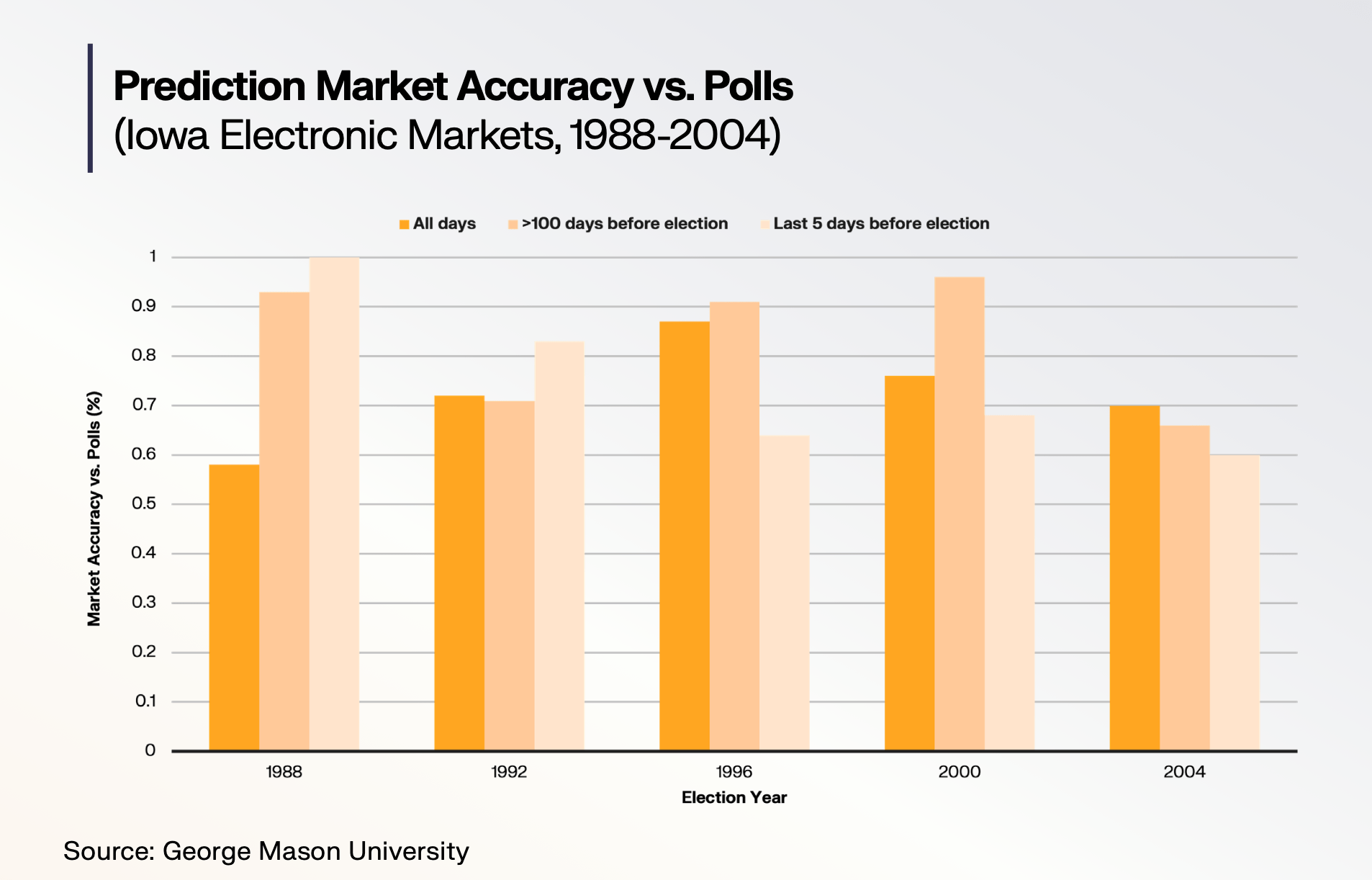
The modern revival of prediction markets began in 1988 when economists at the University of Iowa launched the Iowa Electronic Markets, a real-money exchange created to forecast political events. Over several election cycles, IEM demonstrated impressive accuracy. A study covering five United States presidential races from 1988 to 2004 found that IEM forecasts beat traditional polls in roughly three quarters of all observations, including far in advance of election day and in the final week.
As interest in predictive forecasting grew, developers eventually turned to blockchain as a way to build globally accessible markets. Augur, which held Ethereum’s first initial coin offering (ICO) in 2015, launched its mainnet in 2018 as the first fully onchain prediction market. It aimed to remove intermediaries and broaden access to prediction markets through smart contracts. In practice, however, Augur struggled with controversy over so-called death pool markets, gas costs, poor user-experience, and slow multi-step settlement.
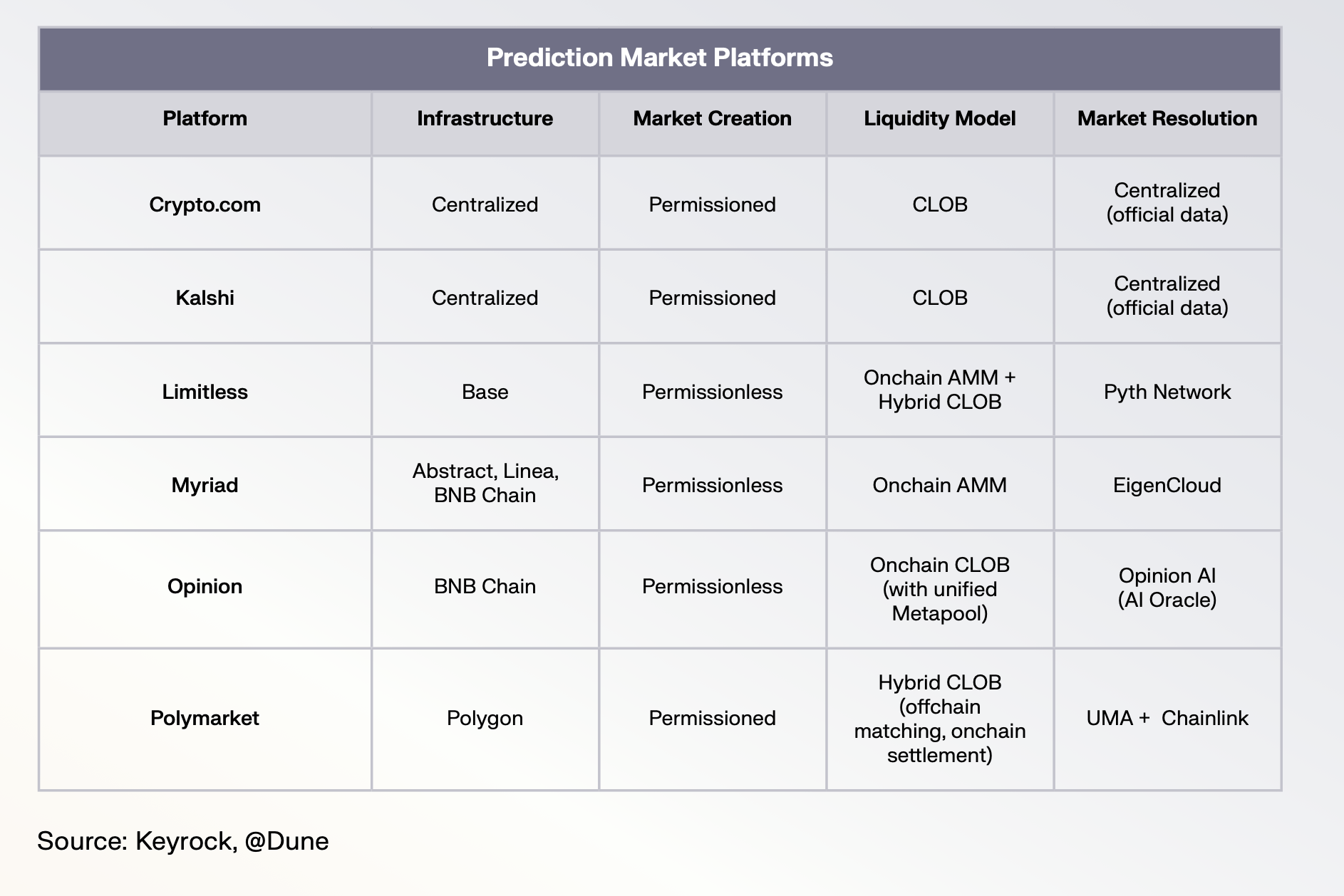
By the early 2020s, Polymarket, Kalshi, Crypto.com, Limitless, and MYRIAD led a new generation of platforms that finally overcame the bottlenecks of the first wave. Their architectures can differ, but together they mark an industry reaching real product–market fit and pursuing the same centuries-old goal: aggregating dispersed information into a single, tradable signal. Regulatory progress, broader distribution, and blockchain’s naturally global access, now supported by more reliable oracles, have made today’s markets far more scalable than earlier versions.
With that foundation now firmly established, a newer wave of entrants is now experimenting with novel mechanics and user experiences. Opinion, built on BNB Chain, is experimenting with AI for oracle design and markets resolution; XO is pairing user-generated “conviction markets” and liquidity with an AI oracle for instant resolution, reviving the spirit of early projects like Augur, but with modern usability and automation; Melee merges the viral simplicity of memecoins with the structure of prediction markets, using bonding curves to reward early bettors, blurring the line between speculation and social coordination, and Trepa reimagines prediction as a game of precision forecasting rather than binary bets, rewarding how close you are to the value, not just which side you picked.
The prediction-market sector is entering its most creative and competitive phase yet. The infrastructure is in place, cultural awareness is rising, and demand is broadening from retail to institutions. Prediction markets have reached a point of real momentum.
Learn more about: Keyrock Onchain Asset Management Strategies
Prediction Markets Platforms Overview
Before turning to individual platforms, it’s helpful to outline the basic structure shared across most prediction markets. Regardless of venue, these exchanges rely on four architectural layers: a market-creation layer that can be either permissioned or permissionless, a trading layer where users price risk, a custody and settlement layer that escrows collateral, and a resolution layer that determines the final outcome. Together, these layers govern how markets are created and traded, how positions are held, and how event contracts are ultimately resolved.
Polymarket
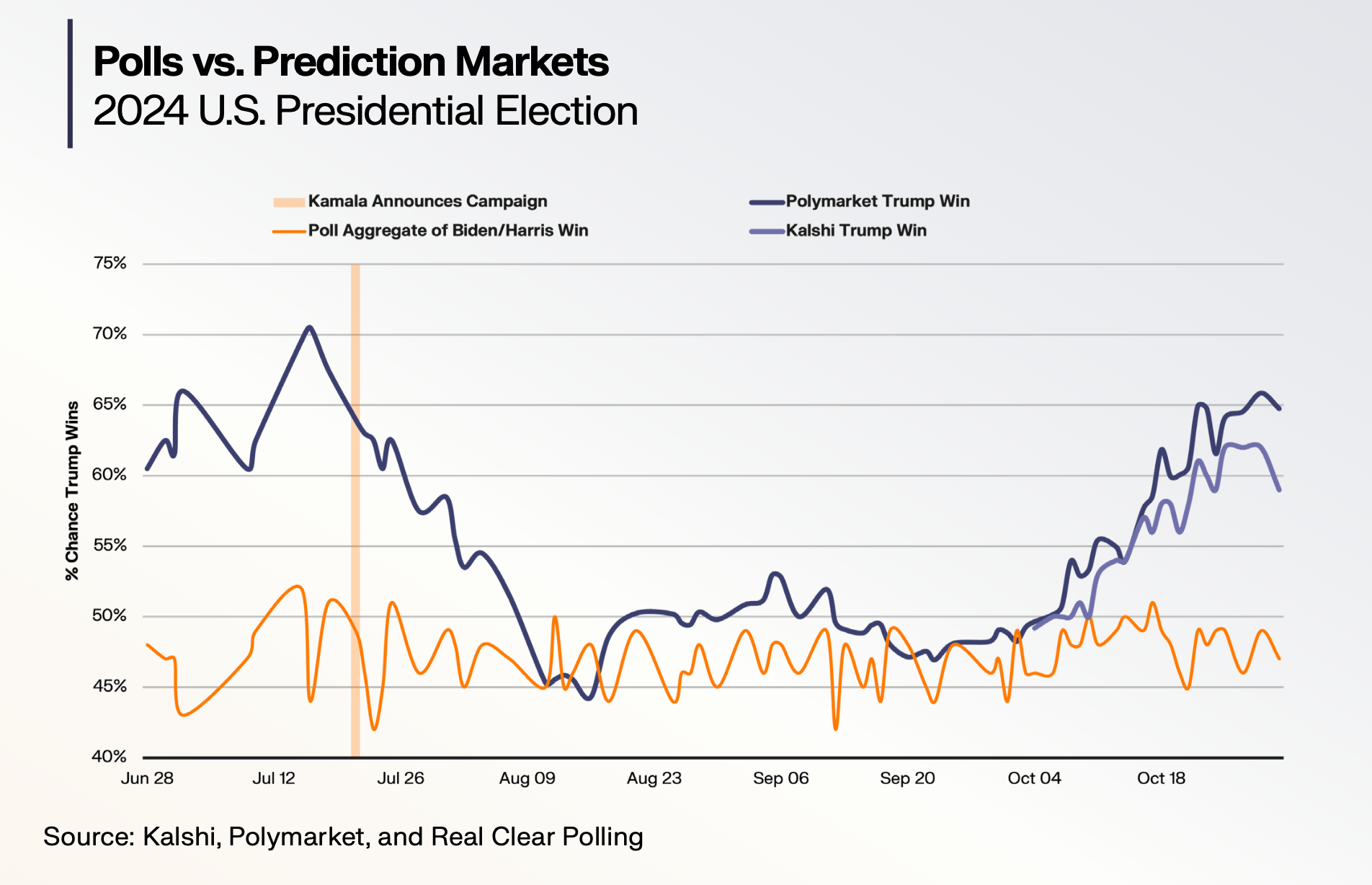
Built on Polygon, Polymarket allows users to trade shares in real-world events where each share resolves to $1 (true) or $0 (false). It rose to prominence during the 2024 U.S. presidential election, where it proved far more reactive to shifting dynamics than traditional polls, which broadly held a 45–50% forecast for a Kamala/Biden win throughout much of the race.
When Harris announced her campaign, Polymarket odds on a Trump win fell sharply before recovering by October and settling near 65% in the final days before the vote. For many, this was the first moment they visibly saw prediction markets outperform the polling tools they had long relied on.
This surge brought its 2024 volume to over $6 billion, catalyzing mainstream recognition of prediction markets as a serious forecasting tool. Its success is particularly remarkable given that it is the first onchain protocol to achieve mass-market scale, matching the performance of centralized exchanges while preserving transparent, verifiable settlement.
“Polymarket has spent years building the world’s largest prediction market. Now we’re just getting started bringing that power to the mainstream. More to come.”
— Matthew Modabber, CMO, Polymarket
“For most users, the main value of prediction markets isn’t placing a bet, it’s consuming information. People visit Polymarket to see probabilities. That distilled insight, a single number representing the market’s belief, is incredibly powerful.”
— Stefan George, Co-Founder, Gnosis
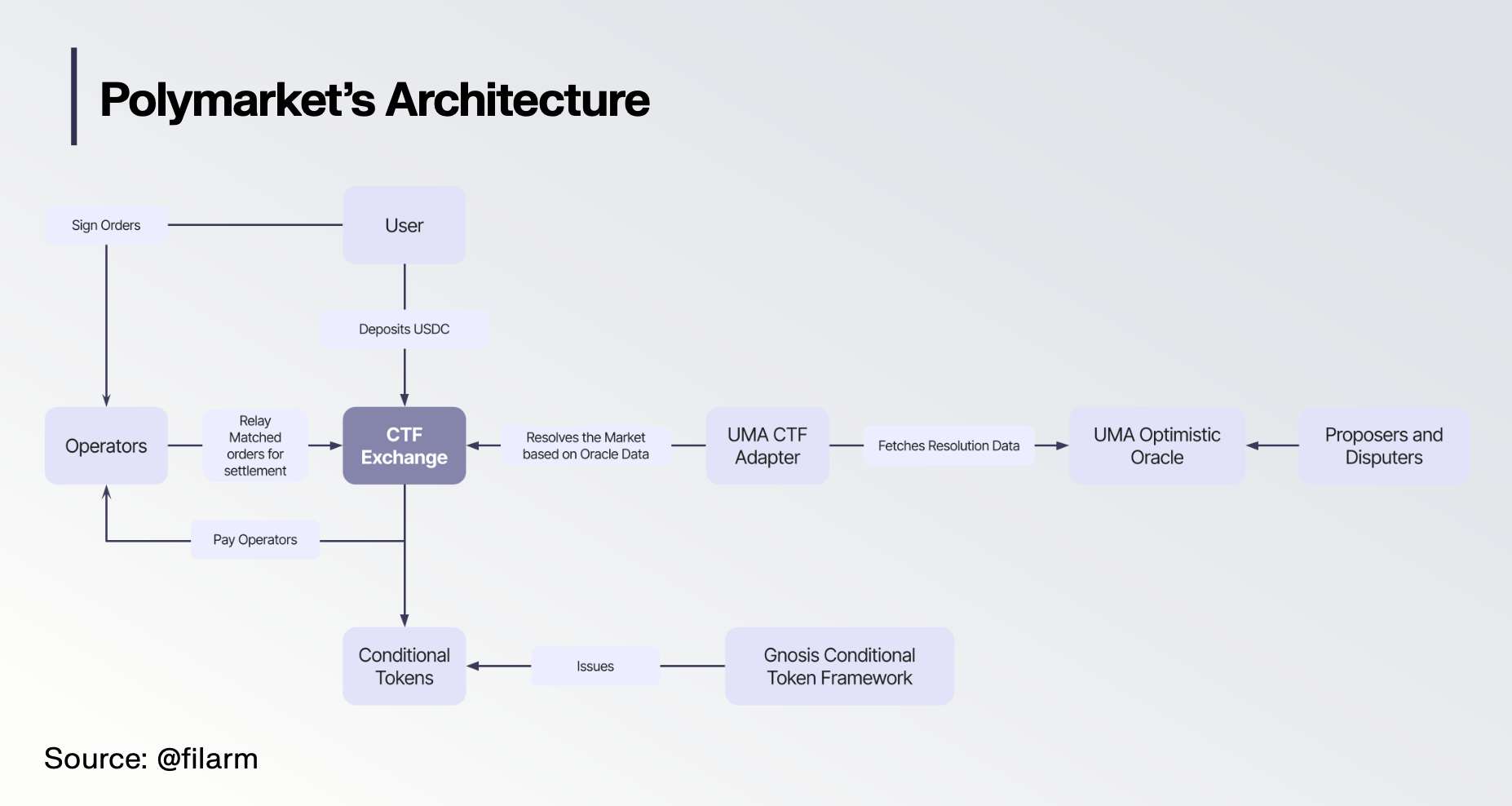
Polymarket operates as a non custodial platform built on the Gnosis Conditional Token Framework (CTF), where each yes or no outcome is tokenized into fungible ERC-1155 tokens. Each market (“Will X happen?”) creates outcome tokens (YES/NO), tradable like any asset and enables composability, supporting multi-outcome and conditional markets.
In its early design, Polymarket used an automated market maker (AMM) that set prices along a bonding curve; however, by 2022 the platform shifted to a Central Limit Order Book (CLOB) model that pairs offchain order matching for speed with onchain settlement through signed orders for transparency, keeping custody with users while improving capital efficiency.
With the move to a CLOB, Polymarket introduced programs to encourage liquidity. Any user who posts limit orders is a market maker and earns rewards based on how close their prices sit to the mid price and how much volume they facilitate. This liquidity incentivization scheme, inspired by earlier models on derivatives venues such as dYdX, pays daily USDC rewards to encourage deep order books and tighter spreads.
Polymarket’s resolution layer is handled primarily by UMA’s Optimistic Oracle, which secures ~80% of Polymarket’s markets, and Chainlink for rapid crypto price markets (e.g., 15-minute windows). Out of 197 million total transactions and $54 billion in value processed by UMA, Polymarket accounts for 88% of its transactions and 39% of the value processed. It also represents over 106,000 assertions and 1,500 disputes out of UMA’s total 127,000+ assertions and 1,500 disputes.
“At UMA, our focus is twofold. First, scaling alongside Polymarket’s rapid growth: markets have increased 10x this year, so we’re pushing for higher efficiency by lowering dispute rates and cutting infrastructure costs. Second, we’re building differentiated resolution pathways on top of the Optimistic Oracle. Because topics, objectivity, and timelines vary widely, resolution can’t stay one-size-fits-all. We’re tailoring pathways to fit specific market types and sizes.”
— Lee Poettcker, Product Manager, UMA
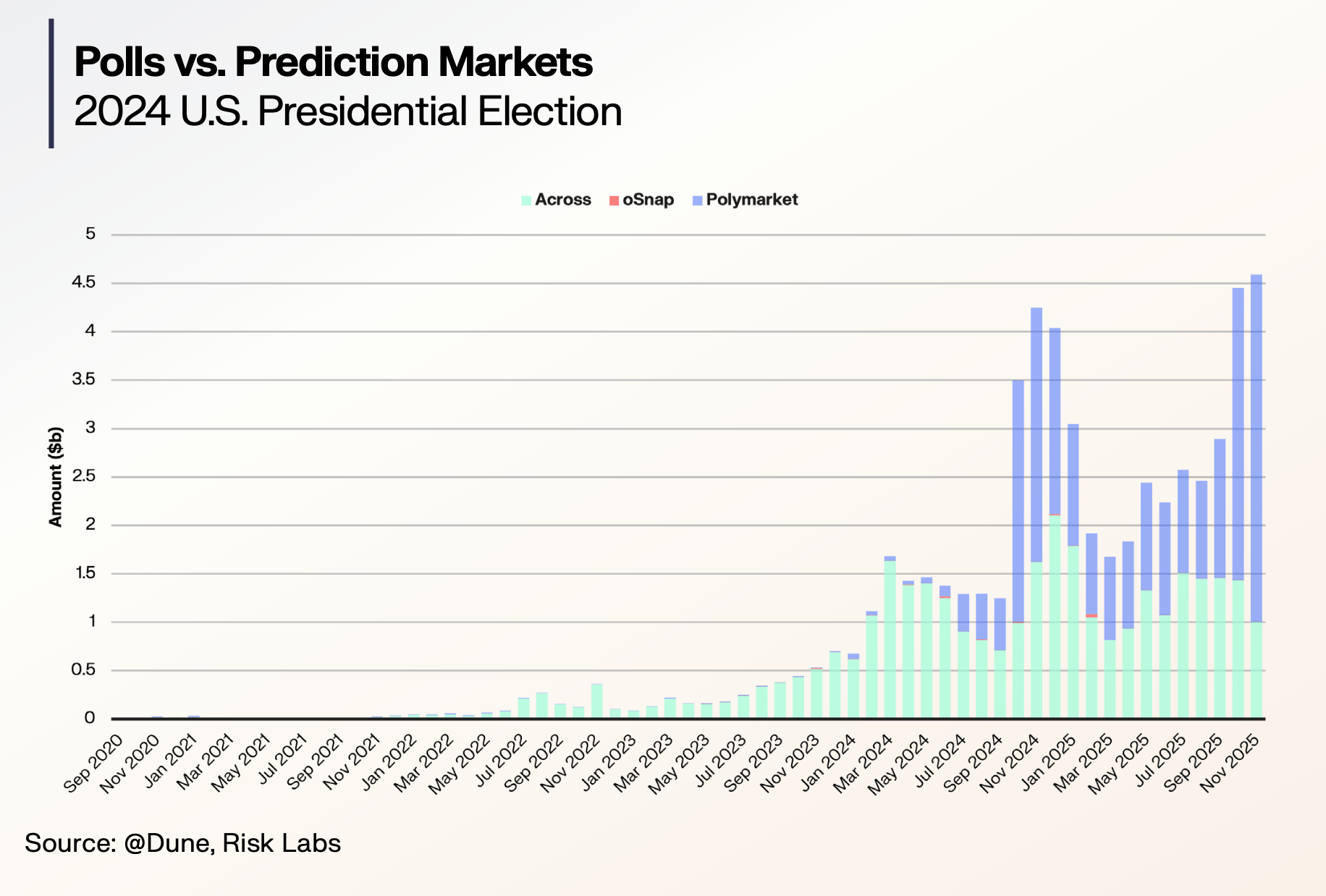
UMA brings real-world results onchain so markets can settle and acts as the source of truth for the outcome of the event. When a market closes, Polymarket’s adapter submits a query to UMA that effectively asks, “What was the real outcome?”
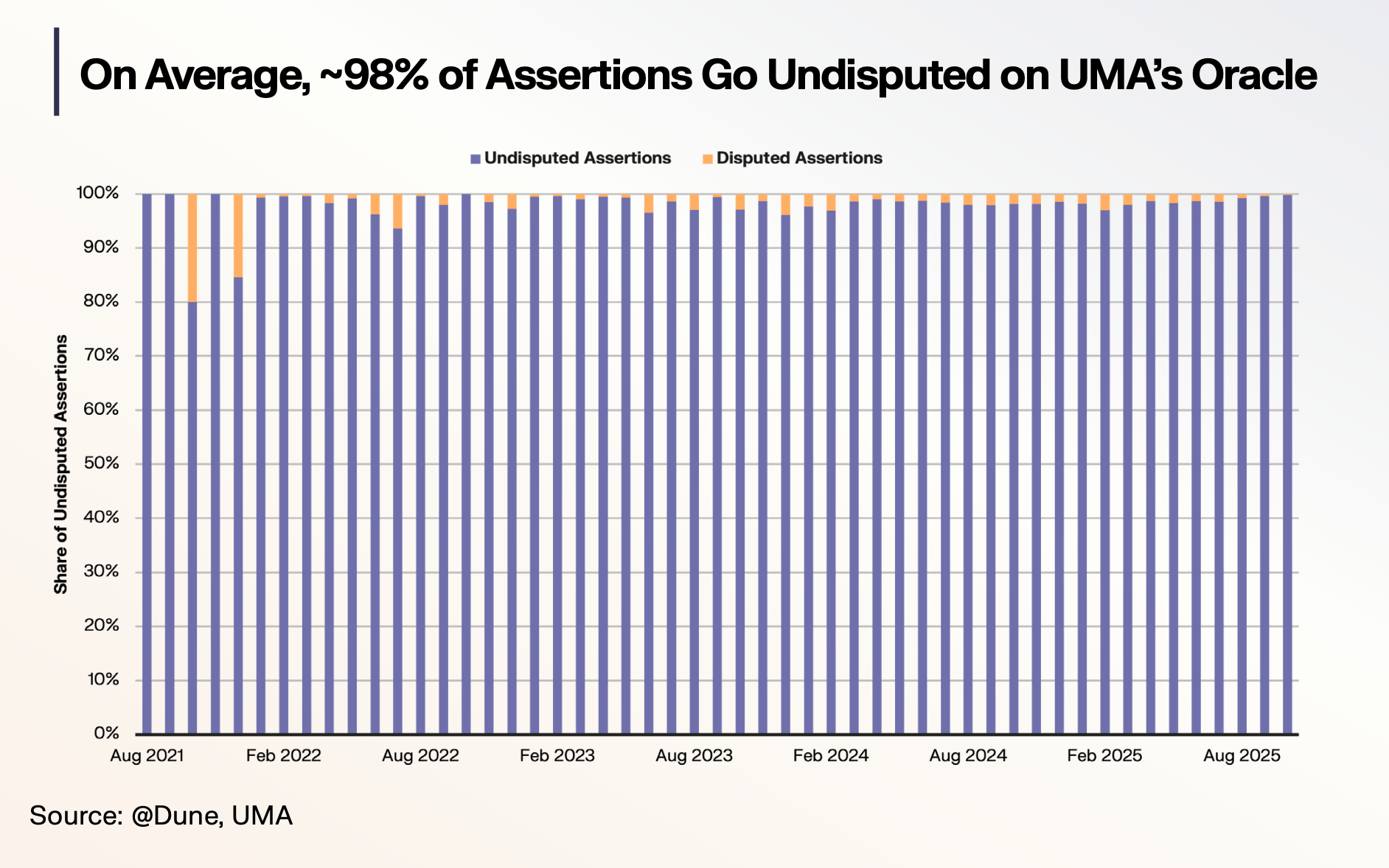
If a dispute does occur, UMA’s wider community of tokenholders step in to vote on which side is correct. Dispute votes must reach 65% consensus based on the staked tokens at the start of the commit round. This threshold helps prevent unclear outcomes when voters are split. Historical data from UMA reveals that since 2021, about 98% of >11,000 market assertions go undisputed.
“The dispute rate on UMA resolutions has been steadily declining over the past year. In Q3 2025, we introduced a proposer whitelist made up of historically accurate proposer addresses, which reduced incorrect proposals by 60% while keeping disputes fully permissionless. This also cut the overall dispute rate by 50%. We also shipped LLM summaries in the oracle app to aid in voter research of disputes.”
— Lee Poettcker, Product Manager, UMA
The graph shows that 98% assertions of UMAs oracles go undisputed
Because participants earn rewards for accurate votes and lose stake for incorrect ones, the system strongly encourages honest behavior. This “optimistic” design assumes most actors will act truthfully, which allows for fast resolution with a robust backstop when disagreements arise. UMA’s design, which relies on human proposers and disputers, allows Polymarket to support a broad range of subjective event types, including nuanced questions that purely automated systems can’t easily verify.
This design becomes more powerful as participation grows. Participation in UMA’s oracle network has expanded sharply since 2024, with unique voters up more than 600% to around 4,500. This growth matters for prediction markets like Polymarket because as its markets increasingly proliferate, a larger and more active voter base improves the oracle’s capacity and resilience, enabling it to handle a wider set of markets with quicker settlement times.
The graph shows a 4x increase in number of voters on UMA between August 2024 to august 2025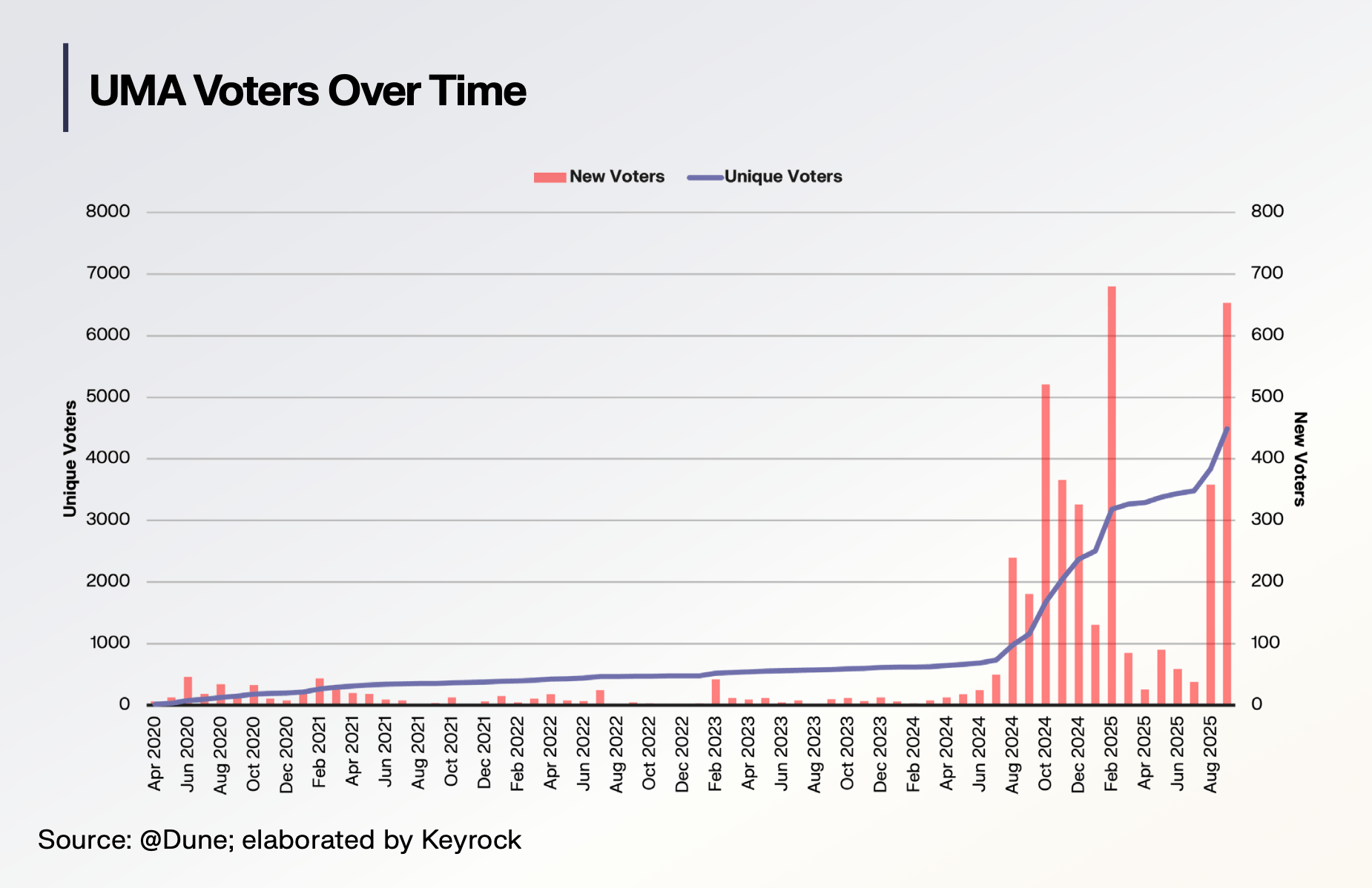
Oracles, whether centralized or decentralized, are ultimately the backbone of prediction markets. Improvements in resolution frameworks and settlement logic will make markets feel more responsive and trustworthy, which in turn pulls in more liquidity and keeps traders active.
This is especially important for long-tail and fast-resolution markets, where the experience hinges on outcomes being settled quickly, cleanly, and without ambiguity, even when the underlying rules are more nuanced. This is one of the key areas where prediction markets will meaningfully evolve in the coming years.
Separate from its market architecture, Polymarket has advanced on the regulatory and institutional front. A more crypto-friendly U.S. administration in 2025 helped accelerate this progress, during which Polymarket resolved its CFTC case and acquired QCEX to strengthen compliance, enabling its re-entry into the U.S. market.
Building on this foundation, Polymarket has rapidly expanded its mainstream footprint. In early November 2025, Google Finance integrated prediction market data from Polymarket (alongside Kalshi), allowing users to track event-based probabilities like election outcomes directly within the platform. Yahoo Finance soon followed, naming Polymarket its exclusive crypto prediction market provider, featuring a dedicated hub for real-time, event-driven data and insights.
In the sports arena, Polymarket became the official prediction market partner of the UFC through a multi-year agreement with TKO Group, bringing real-time odds into broadcasts, in-arena displays, and fan experiences, with planned extensions to Zuffa Boxing. These milestones add to earlier collaborations, including its integration with X, embedding real-time odds and Grok AI sentiment into posts; and partnerships with Stocktwits for earnings markets.
“Polymarket has become one of the first crypto-native apps to break into mainstream culture, influencing how people follow and interpret global events. We’re proud that it runs on the speed, reliability, and low fees of the Polygon network, which consistently supports high volumes at scale.”
— Marc Boiron, CEO, Polygon Labs
Kalshi
In contrast to Polymarket, Kalshi was founded in 2018 and launched in 2020 as the first CFTC-approved financial exchange for event contracts, registered as a Designated Contract Market (DCM) under U.S. derivatives law. In 2024, Kalshi reached a milestone by becoming the first fully regulated platform to offer legal election trading in the U.S., following a landmark federal appeals court ruling. The decision overturned the CFTC’s earlier denial and affirmed Kalshi’s right to list contracts on political outcomes. This ruling not only legitimized election markets but also set a precedent for event-based financial instruments under U.S. law.
Traders are routed through Kalshi’s exchange infrastructure, which manages custody, matching, and clearing internally. Once a trade is executed, Kalshi Klear, the clearinghouse, novates the position and stands as a buyer to every seller and a seller to every buyer, with all positions fully collateralized and held in segregated U.S. bank accounts.
Kalshi, like Polymarket, also runs on a Central Limit Order Book (CLOB) where traders post bids and offers for “Yes” and “No” contracts, with each matched pair representing $1 of total risk. Unlike traditional futures exchanges that rely on margin and default funds, Kalshi clears only fully funded trades, which eliminates counterparty exposure.
Each Kalshi event specifies a verifiable data source or publication, such as a government report or certified election result, that the exchange uses to settle outcomes. In this sense, Kalshi effectively functions as its own oracle, with settlement governed by pre-approved rulebooks rather than external networks. This structure has enabled Kalshi to operate reliably while expanding market scope and reach.
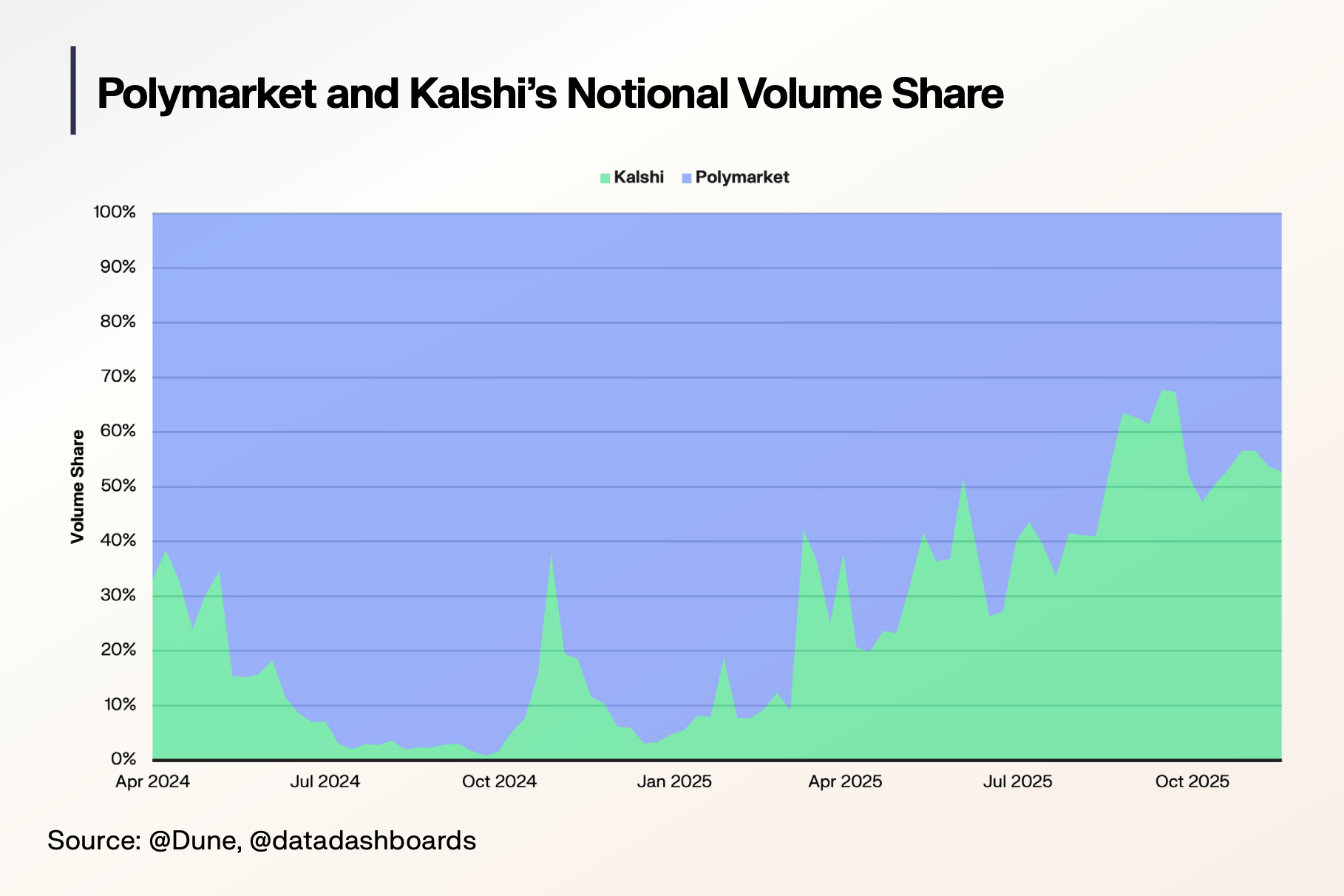
As that core infrastructure matured, Kalshi’s momentum accelerated further in 2025, marked by a multi-year NHL partnership that made it one of the league’s official prediction market partners alongside Polymarket, granting them access to official NHL data, marks, and broadcast placements. In October, Jupiter launched its prediction market product powered by Kalshi. The integration allows Jupiter to tap into Kalshi’s liquidity, verified event data, and settlement infrastructure, enabling sports and macro event trading with greater depth and efficiency.
In a major move in December 2025, Kalshi expanded its offering by launching tokenized versions of its event-contracts on Solana, meaning users can hold and trade prediction positions as onchain tokens via DeFi-native platforms. This move gives onchain traders access to Kalshi’s CFTC-regulated liquidity with the benefits of onchain composability, pseudonymity, and permissionless trading.
Together, these developments carry out Kalshi’s ambition to become a global liquidity layer for prediction markets, creating a hybrid off/onchain ecosystem that connects crypto-native platforms to regulated market infrastructure. It is the first prediction market in the world that aggregates onchain and offchain, US and international into one liquidity pool.
“Kalshi is becoming the de facto liquidity layer for onchain prediction markets, starting with Jupiter on Solana. Every major crypto app will have native prediction markets powered by Kalshi within the next 12 months. We want to grow a thriving crypto ecosystem of builders, Dune wizards, and creators.“
— John Wang, Head of Crypto, Kalshi
Combined with its Robinhood FCM integration, which opens regulated event trading to tens of millions of retail users, and its KalshiEco Hub an initiative linking the exchange to Solana and Base to bridge traditional finance with onchain participation, Kalshi has evolved into the first convergence point between traditional finance, regulation, and crypto innovation.
All of this expansion rests on the infrastructure Kalshi built. Kalshi took the hard path in its early years, spending several yields building its compliant infrastructure and securing CFTC approval before launching a single product. By laying that foundation first, it made prediction markets legally viable in the United States and paved an easier path for those that followed.
The resulting clarity validated Kalshi and helped shift how event contracts are legally viewed in the U.S. Alongside parallel efforts from other platforms pursuing regulated or globally accessible models, prediction markets are now establishing themselves as legitimate financial instruments.
Crypto.com
Crypto.com has positioned itself as one of the main providers powering prediction market functionality for social, gaming, and entertainment platforms. Through its affiliate Crypto.com Derivatives North America (CNDA), the firm runs a fully centralized stack that includes a CLOB based exchange, permissioned market creation, and real time settlement sourced from official data feeds. CDNA serves as both the exchange and the clearinghouse for all partners, which allows the same regulated liquidity pool to support Crypto.com’s native interface as well as any third party front end that integrates its rails.
In 2025, Crypto.com expanded this infrastructure through a series of partnerships that embedded prediction markets directly into platforms people already use. Truth Social became the first social media platform to offer event contracts through Truth Predict, which lets users trade politics, macro events, and cultural narratives inside their feed. MyPrize followed on the social gaming side with MyPrize Markets, which merges gaming, livestreaming, and prediction markets into a single environment. Hollywood.com adopted CDNA’s rails to introduce entertainment focused markets tied to film, television, celebrity activity, and other cultural moments.
This dynamic gives rise to what can be understood as Entertainment Finance, a model in which media and markets share the same interface and where financial services live inside non-financial products.
As this model spreads across media and gaming, sports platforms are also adopting it in ways that fit their own risk and engagement needs. Underdog integrated CDNA powered sports markets alongside its fantasy and wagering products while using event contracts as a hedging tool for managing exposure. This marked the first time a major sports gaming operator incorporated prediction markets into its core experience. Fanatics has also begun incorporating CDNA functionality into its broader fan and commerce ecosystem, using the infrastructure to test new forms of engagement without building its own market stack.
Prediction markets can price almost any measurable outcome, and this makes any platform with culture or news reach a potential surface for prediction market infrastructure. Social media apps, gaming hubs, entertainment portals, news outlets, and sports platforms all fit that profile. As prediction markets spread across everyday consumer interfaces, prediction markets are in a strong position to expand with them and to embed markets directly into the ways people watch, read, and interact with content.
“Partnering with innovative platforms enables us to reach a diverse group of consumers beyond our own users. For example, with Underdog, we are reaching a group who are interested in sports. With Hollywood.com, we are reaching an audience interested in cultural events, broadway, movies, music, etc. With Truth Social, we are reaching an audience interested in news and current events, and with Myprize, we are bringing prediction markets to social gamers. As the demand and interest in prediction markets increases, we will see more collaboration and partnerships”
— Travis McGhee, Global Head of Predictions, Crypto.com
MYRIAD
Crypto.com represents the centralized path to embedding markets inside sports and consumer experiences. Another group of builders is pursuing the same trend through fully onchain, permissionless systems. MYRIAD is one of the clearest examples of that approach. Launched by DASTAN (parent of Decrypt and Rug Radio), MYRIAD is a multichain, decentralized prediction-market protocol live on Abstract, Linea, and BNB Chain.
Unlike other prediction markets, MYRIAD’s core approach is content-native integration, embedding prediction markets directly into media, turning news and discussions into tradable opportunities. Users can participate seamlessly while reading or watching content.
Markets are powered by AMMs for liquidity, with support for both points-based and USDC-settled systems. Protocol operations, from market creation to resolution, are being progressively decentralized. More recently, MYRIAD launched its Sentiment markets and Automated Markets. Unlike traditional prediction market event contracts that expire, sentiment markets never resolve. Instead, they track the live pulse of public mood onchain and remain perpetually liquid. The rise and fall of confidence around people, tokens, or ideas are expressed and financialized in real time.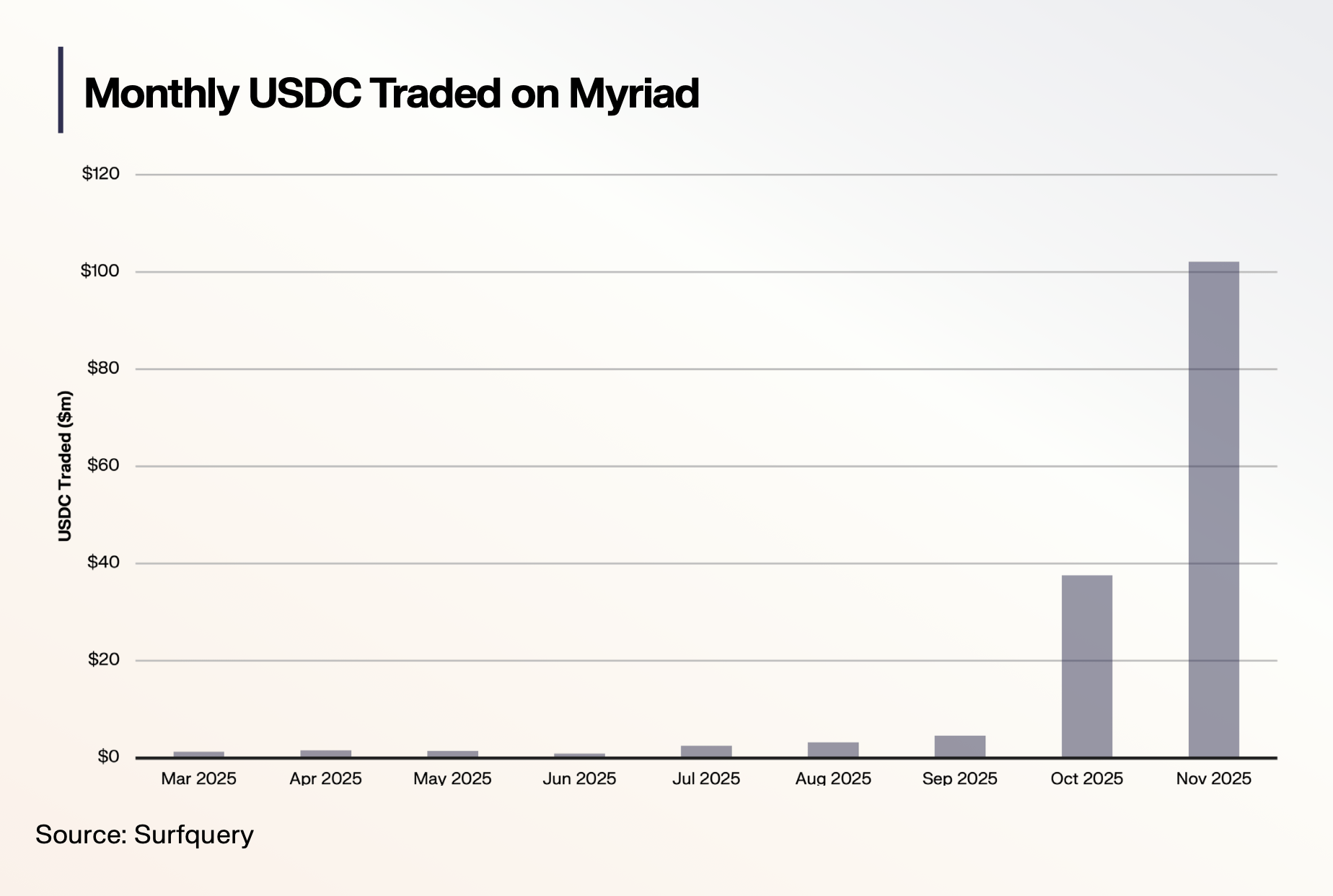
“For us, the future is embedding MYRIAD as a protocol, prediction markets at a protocol layer, everywhere we can. MoonPay got big because they started embedding crypto on-ramp/off-ramp, everywhere they could, and that’s our goal. The day you see prediction markets odds live on national television, on CNBC, on Fox, in The Washington Post while you’re reading it, that’s where we are headed. What we’re doing is getting our prediction markets into the faces and hands of everyone, and it’s seamless, that’s where prediction markets are going to go.”
— Farokh Sarmad, President & Co-Founder, DASTAN
Beyond the technical integration, MYRIAD’s launch on BNB Chain forms part of a broader expansion into Asian markets, with a Mandarin-language version of MYRIAD scheduled for release in the coming weeks, along with localized markets designed specifically for those audiences. On top of this, MYRIAD also launched 5-minute, recurring Automated Markets, designed around auto-resolution, short timeframes, and continuous flow, making it easier for users to participate in fast-paced prediction or trading environments without waiting for long settlement cycles.
Its go-to-market leverages DASTAN’s crypto native media and creator network, Decrypt, Rug Radio, Lucky Trader, to drive organic discovery and participation.
“Prediction markets are simple to use and a whole lot of fun, which is why they’re one of the first clear winners to break out of the consumer crypto segment. With the technical details of blockchain abstracted away from the end user, prediction markets are a clear wedge for tens of millions of net new consumers to come onchain without even realizing it. We’ve been thrilled to work with MYRIAD and others building in the prediction market space on Abstract, and we can’t wait to see what else will be unlocked by building consumer-friendly crypto rails.”
— cygaar, Abstract
Limitless
While MYRIAD focuses on cultural and sentiment-driven markets, other builders are targeting different slices of the prediction-market spectrum. One of the fastest-growing niches sits at the opposite end of the design space: ultra-short-term, high-frequency crypto price markets. Limitless, built on Base, represents that category.
Trades are executed fully onchain through smart contracts with adaptive fees (0.03% opening → 3% closing), blending prediction markets with bonding curve dynamics similar to memecoin launchpads.
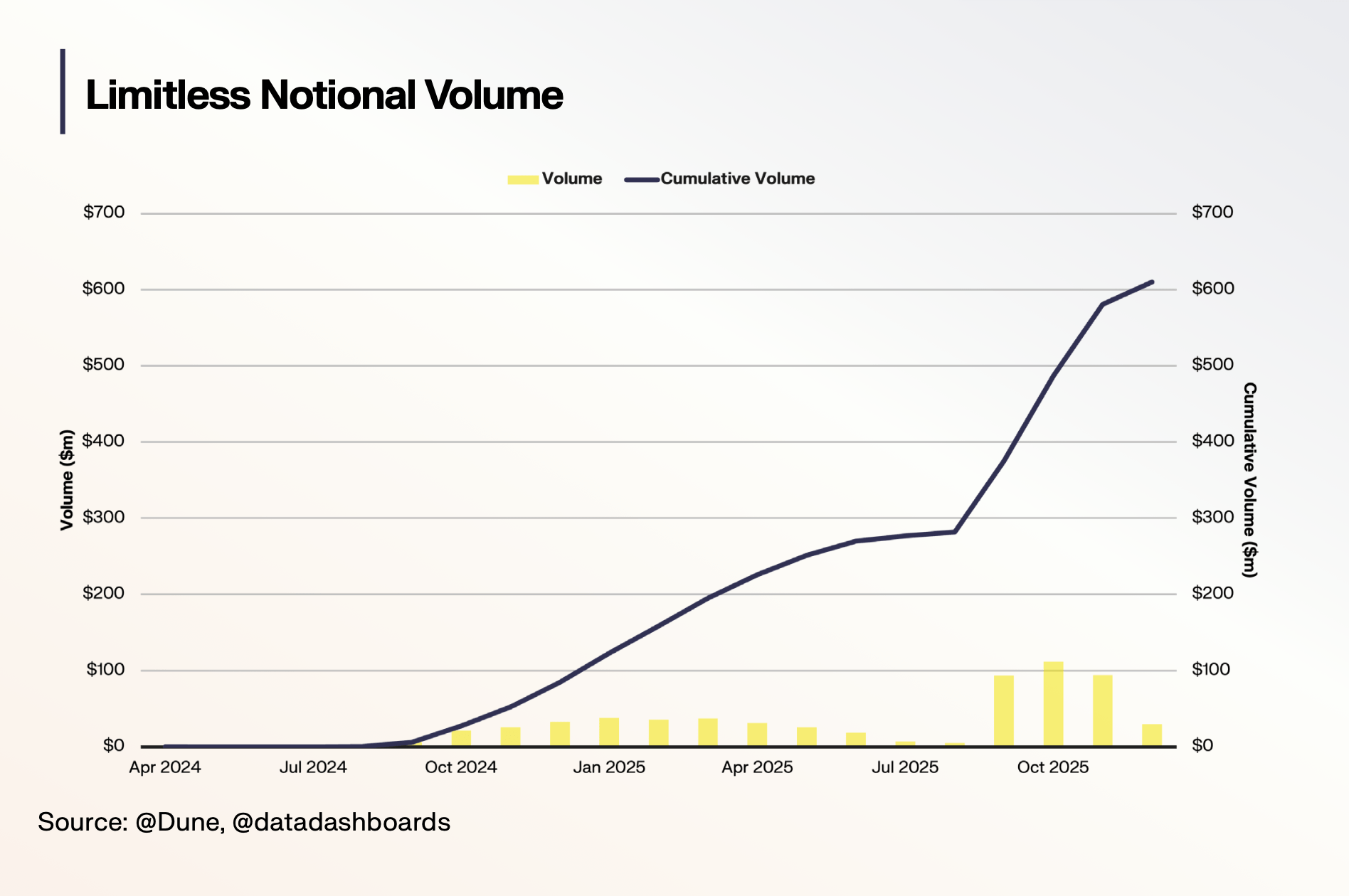
Settlement is instant and oracle-driven via Pyth Network, which aggregates institutional-grade price feeds from firms like Jane Street, Jump, and Cboe. Each market (e.g., “BTC > $65K at 14:00 UTC”) resolves to Pyth’s verified price at that exact timestamp, ensuring accuracy and resistance to manipulation. With millisecond-level updates and <100ms latency, Pyth allows Limitless to maintain continuous, high-frequency market cycles. Limitless’s growth has picked up sharply since September 2025, including multiple peaks above $90 million in monthly volume.
Opinion
Beyond entertainment, culture, and short-term crypto markets, another prediction market frontier is emerging around macroeconomic data itself. Rather than predicting sentiment or minute-level price ticks, this category turns core economic indicators into standardized onchain assets. Opinion is the leading example of this macro-focused approach.
Built on BNB Chain and backed by YZi Labs, Opinion introduces a high-performance, fully onchain prediction exchange centered on macroeconomic data, policy decisions, and real-time events. It aims to turn economic indicators, like inflation, interest rates, or employment figures, into standardized, tradable assets. Rather than speculating through indirect proxies such as gold or crypto, traders can directly express and monetize their views on upcoming CPI releases, FOMC decisions, or GDP growth outcomes.
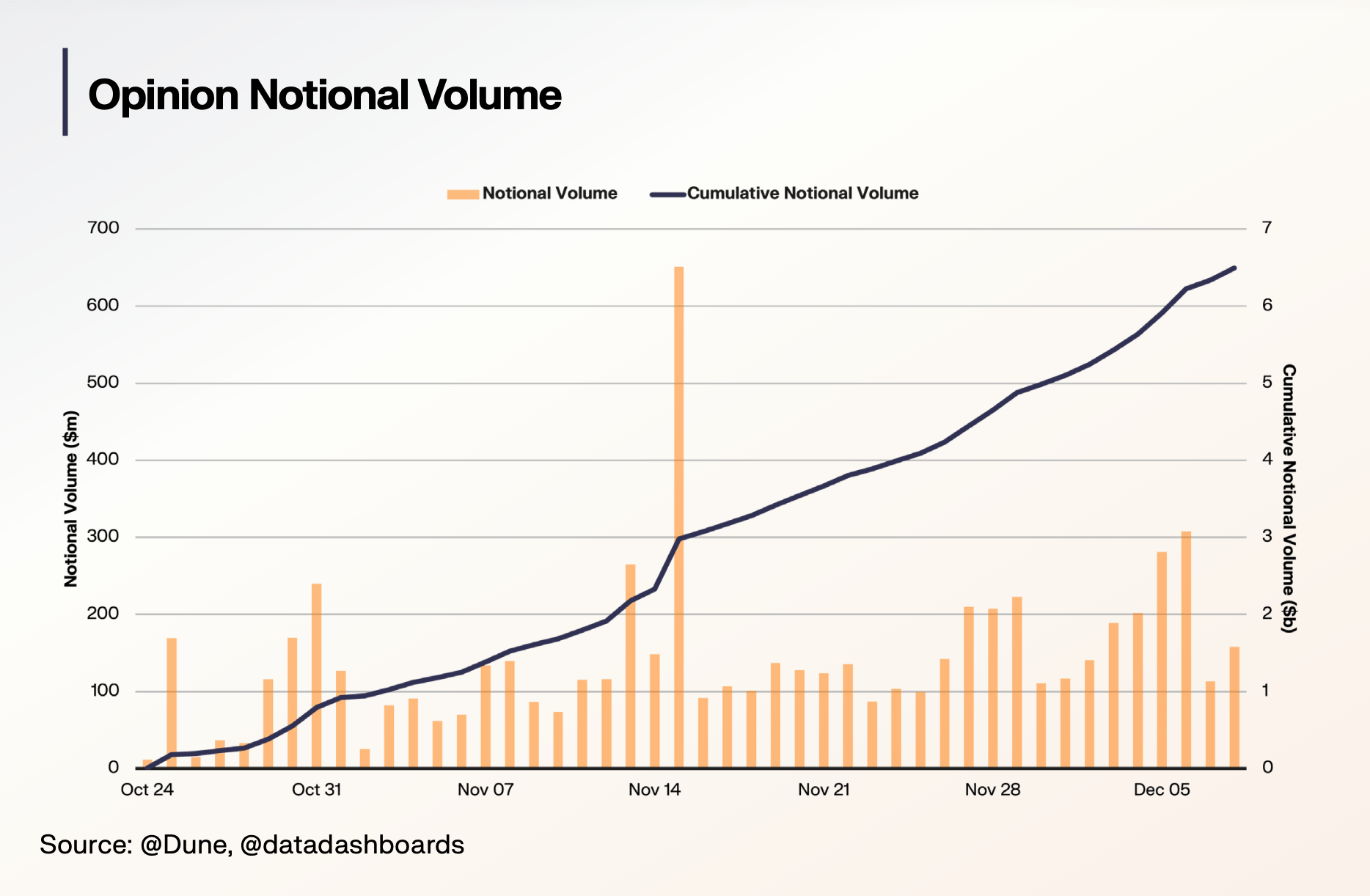
At its core lies the Opinion Stack, a four-layer infrastructure combining the Opinion.Trade exchange, Opinion AI (a decentralized multi-agent oracle for resolving complex, unstructured data), the Opinion Metapool for unified cross-market liquidity, and the Opinion Protocol, a universal token standard for interoperability. This architecture enables continuous, trust-minimized resolution of markets and composability with DeFi protocols, allowing prediction tokens to serve as collateral or inputs for automated strategies. Opinion’s activity accelerated rapidly from late October 2025, surpassing $6.4 billion in cumulative notional volume by early December and recording multiple daily peaks above $200 million.