

The Great Tokenization Shift: 2025 and the Road Ahead
The Great Tokenization Shift: How 2025 Reshaped Capital Markets
ETFs revolutionised investing by stripping away barriers to access. Tokenisation is doing the same to capital markets — only faster, deeper, and with fewer intermediaries standing in the way.
That is not a metaphor. It is a structural transformation already underway across Treasuries, private credit, equities, and commodities. The shift from analogue infrastructure to programmable, blockchain-native rails is compressing settlement times, dismantling layers of middlemen, and opening markets that were once gated behind institutional minimums and geographic borders.
We partnered with Centrifuge — pioneers in real-world asset tokenisation since 2017 — to map this shift. This is what we found.
Why 2025 Marks a Turning Point
Capital markets have operated on roughly the same plumbing for decades. Custodians, clearinghouses, transfer agents, and settlement windows measured in days. That architecture made sense in a pre-digital era. It no longer does.
Three forces converged in 2025 to accelerate the transition:
- Regulatory clarity: Jurisdictions from the EU to Singapore moved from consultation to codified frameworks for tokenised securities, giving institutions the green light to deploy capital onchain.
- Institutional adoption: BlackRock, Franklin Templeton, and other asset managers launched tokenised fund products, pulling billions in AUM onto blockchain rails.
- Infrastructure maturity: Standards like ERC-7540 brought composability and interoperability to tokenised fund architecture, solving the fragmentation problem that had slowed earlier waves.
The result is a market crossing from experimentation into production.
The Four Asset Classes Driving Tokenisation
U.S. Treasuries: The $29 Trillion Proving Ground
The U.S. Treasury market — over $29 trillion in outstanding securities — is the world’s deepest and most liquid. It also runs on legacy infrastructure plagued by T+1 settlement delays, excessive intermediation, and fragmented access.
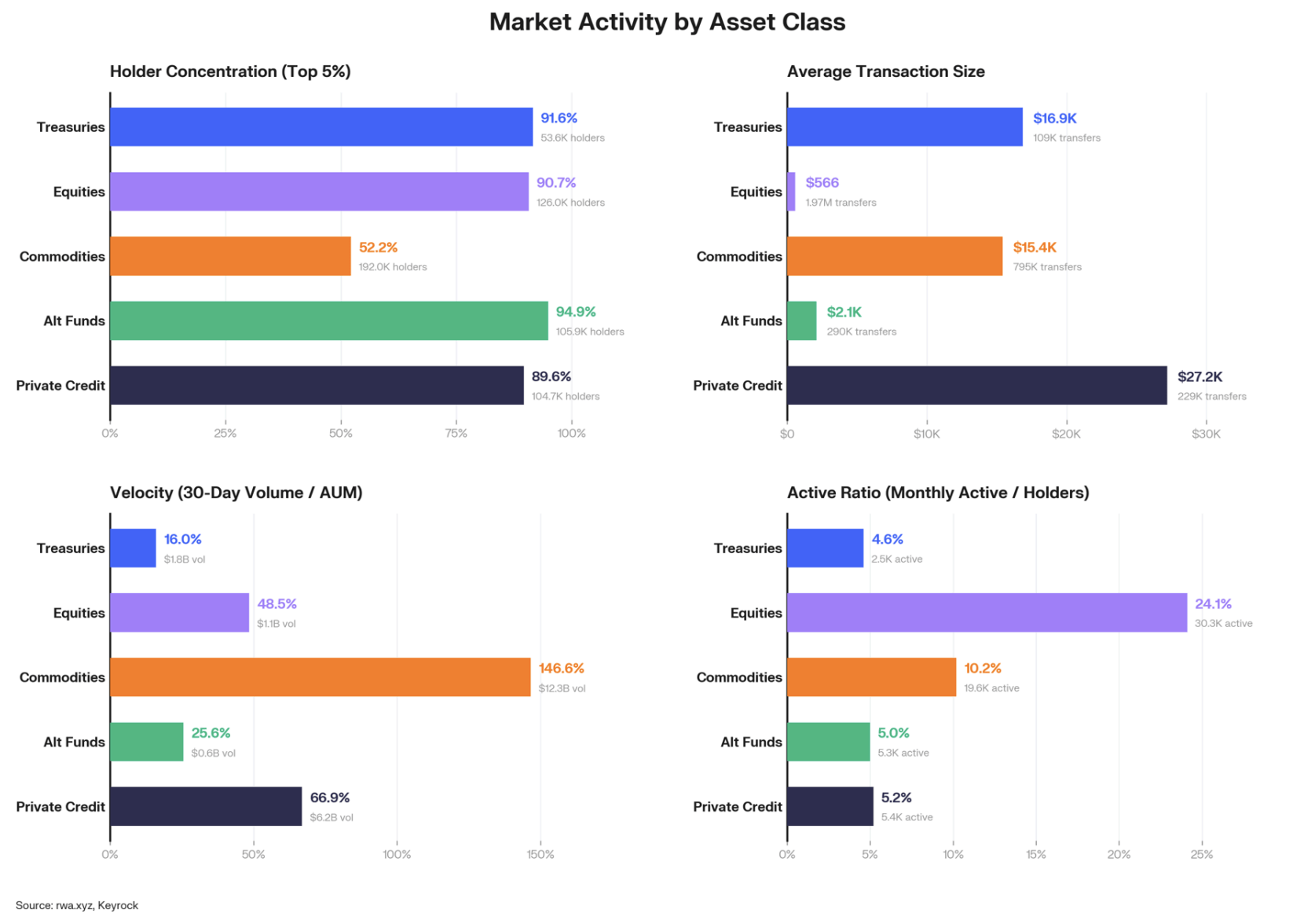
Tokenisation fixes each of these pain points. Instant settlement. Direct access. 24/7 trading. Programmable compliance baked into the asset itself rather than bolted on through layers of post-trade infrastructure. The tokenised Treasuries market has become the clearest proof that blockchain rails can handle institutional-grade volume without compromising on regulatory rigour.
Private Credit: Lending Without Gatekeepers
Private credit is a $1.7 trillion market that has historically been opaque, illiquid, and reserved for institutional allocators with deep pockets. Tokenisation changes the economics entirely.
By bringing lending structures onchain, platforms like Centrifuge enable transparent underwriting, automated servicing, and fractional participation. The mechanics of tokenised private credit shift power from intermediaries to capital allocators — and the data shows that shift is accelerating.
Equities: From Synthetic Assets to Fully-Backed Securities
Tokenised equities have evolved through distinct phases. Early models relied on synthetic exposure — derivative contracts that tracked equity prices without conferring ownership. The next generation is different. Fully-backed tokenised securities carry the same legal rights as their traditional counterparts, settled on blockchain rails.
The regulatory environment remains the binding constraint. But the trajectory is clear: jurisdictions that build workable frameworks will attract the next wave of equity issuance and trading infrastructure.
Commodities: Physical Assets on Programmable Rails
Commodity tokenisation connects physical assets — gold, oil, carbon credits — to blockchain infrastructure. Token holders gain exposure to real underlying assets with transparent reserve attestation and 24/7 transferability.
The market impact extends beyond trading. Programmable settlement and collateral management reshape how commodity-backed instruments interact with the broader DeFi ecosystem, creating composable building blocks for structured products.
Keyrock and Centrifuge: Why We Built This Together
This report brings together two perspectives that rarely sit in the same room.
Centrifuge has been building tokenised real-world asset infrastructure since 2017. They co-founded the Tokenized Asset Coalition, launched the Real-World Asset Summit, and shaped the ERC-7540 standard that is becoming the backbone of tokenised fund architecture. Bhaji Illuminati, Centrifuge’s CEO, brings the protocol-layer lens.
We bring the market-making lens. Keyrock operates across 85+ venues in 37 countries with a 170-strong team. We see where liquidity flows, where it stalls, and what infrastructure gaps prevent tokenised assets from scaling to their potential.
Kevin de Patoul, our CEO, put it directly: the question is no longer whether tokenisation will reshape capital markets. The question is how fast — and who builds the rails.
The Vision: Open, Efficient, Accessible
A financial system that is open, efficient, and accessible to all. That is the destination both Keyrock and Centrifuge are building toward.
Getting there demands more than technology. It requires regulatory engagement, institutional trust, and infrastructure that meets the compliance bar without sacrificing the composability that makes blockchain-native finance powerful. Security and transparency are not tradeoffs — they are prerequisites.
The balance between innovation and regulation defines this era. Move too fast without guardrails and you erode trust. Move too slowly and the infrastructure calcifies around legacy inefficiencies. The organisations shaping tokenisation today are the ones navigating that tension with precision.
The Liquidity Layer: Where Tokenisation Meets Markets
A tokenised asset without liquidity is a spreadsheet entry. You can issue it. You can hold it. But you cannot trade it efficiently, use it as collateral, or build structured products around it. Liquidity transforms tokenised instruments from static representations into dynamic market participants.
That is where our work at Keyrock sits within this shift. We provide continuous market-making across 85+ venues, ensuring that tokenised Treasuries, credit products, and securities have the order book depth and tight spreads that institutional allocators demand. The infrastructure connecting issuance to liquid markets is as critical as the issuance infrastructure itself.
Stablecoins serve as the settlement currency for much of this ecosystem, and their payment rails are evolving in parallel with the tokenised asset stack. The convergence of these two infrastructure layers — tokenised assets and stablecoin settlement — is accelerating the shift from analogue to programmable markets.
What Comes Next
The great tokenization shift is not a single event. It is a migration — asset class by asset class, jurisdiction by jurisdiction, standard by standard.
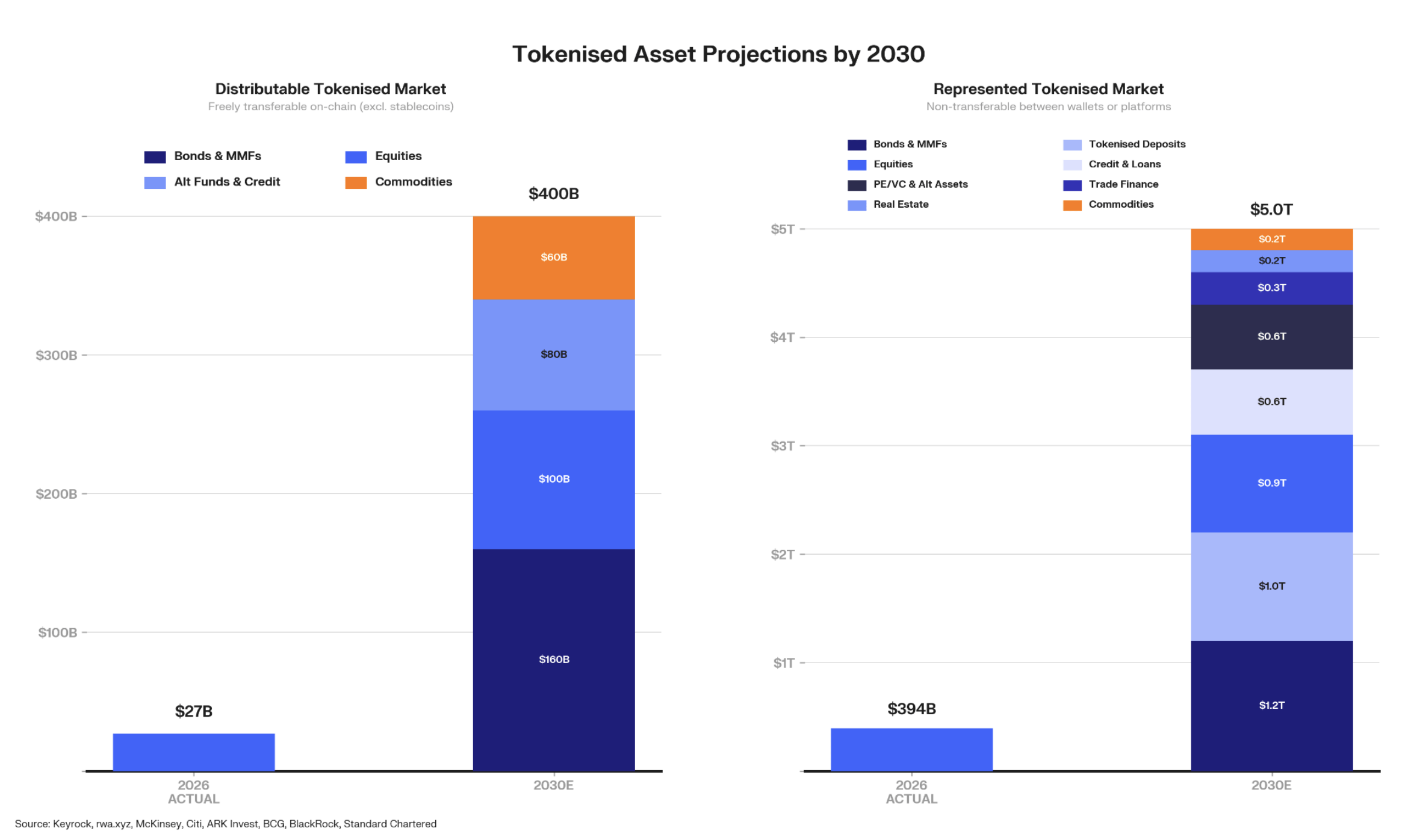
The trajectory points toward a market measured in trillions, not billions. Cross-chain interoperability, institutional-grade custody, and programmable compliance frameworks will determine how quickly we get there. The foundations are set. The capital is moving.
We are not watching this transformation from the sidelines. We are building the liquidity infrastructure that powers it.
Frequently Asked Questions
What is the tokenization shift in capital markets?
The tokenization shift refers to the structural migration of traditional financial assets — Treasuries, private credit, equities, commodities — from legacy infrastructure to blockchain-native rails. This transition compresses settlement from days to seconds, removes intermediaries, enables 24/7 market access, and embeds compliance directly into the asset layer. Think of it as the next evolution after ETFs democratised investing.
Why did tokenisation accelerate in 2025?
Three forces converged: regulatory clarity from major jurisdictions codifying frameworks for tokenised securities, institutional adoption as asset managers like BlackRock launched tokenised fund products, and infrastructure maturity through standards like ERC-7540 that solved composability and interoperability challenges. Together, these moved tokenisation from pilot stage to production deployment.
Which asset classes are most affected by tokenisation?
U.S. Treasuries lead the charge given their $29 trillion market size and acute legacy inefficiencies. Private credit follows closely, with onchain lending structures opening access to a historically opaque $1.7 trillion market. Equities are transitioning from synthetic exposure to fully-backed tokenised securities. Commodities round out the picture with physical-asset-backed tokens gaining traction in gold, energy, and carbon markets.
What roles do Keyrock and Centrifuge play in tokenisation?
Centrifuge builds real-world asset infrastructure at the protocol level — they co-founded the Tokenized Asset Coalition, shaped the ERC-7540 standard, and have been pioneering onchain credit since 2017. Keyrock provides liquidity infrastructure, operating as a market maker across 85+ venues in 37 countries. Together, we cover the full stack from asset issuance to liquid, tradeable markets.