

9th June 2025
Key Insights, All Eyes on Eth
Wall Street’s New Collateral
Every Monday, we deliver a concise yet comprehensive briefing to help you navigate the week ahead.
Our weekly market dashboard brings together key insights across Macro, Crypto, and Onchain activity, distilled into a clear, actionable format. Whether you’re managing risk or spotting opportunity, start the week informed and aligned.
Join our Telegram Channel to get it delivered directly to your phone.
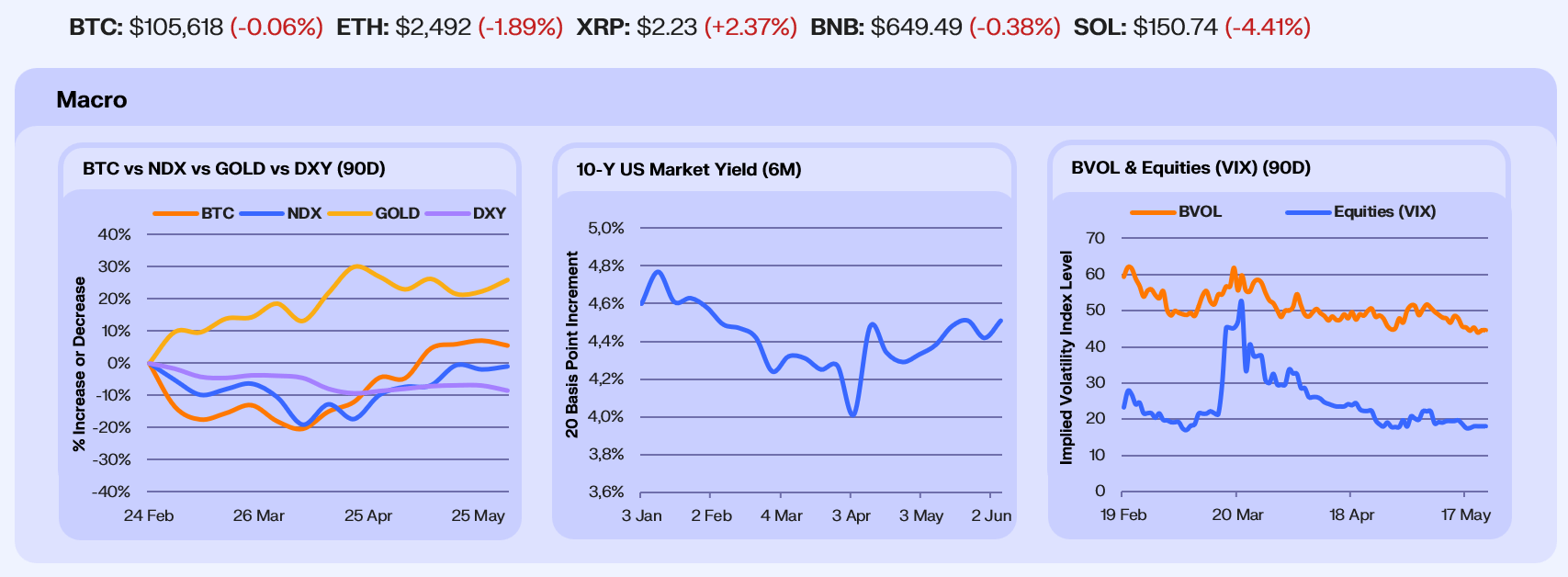
Last week, markets reacted cautiously amid poor economic data, tariff concerns, and deficit worries. Rising geopolitical tensions between Russia and Ukraine, combined with U.S. deficit concerns stemming from Trump’s ‘Big Beautiful Bill,’ drove Bitcoin up 0.83% while Gold lagged at -0.18%. Despite the climb in price, Bitcoin ETFs experienced net outflows of -$131.6m for the week.
Weak economic data, including U.S. jobless claims surging to an 8-month high, along with a fragile U.S.-China tariff trade truce, sent the U.S. Dollar Index (-0.20%) lower; however, the U.S. 10-Year Treasury gained (2.31%) as market expectations for rate cuts remain mixed. The U.S. Dollar Index is now down -9% YTD, marking its worst YTD performance in 30 years. While the ECB has cut interest rates for the eighth time since mid-December 2024, the U.S. Fed has remained on hold, with Federal Reserve Chair Powell showing no urgency to cut rates. Despite the poor economic data, the Nasdaq remained relatively muted (+0.97%), with both BVOL and VIX volatility staying suppressed below their yearly and historical averages. Meanwhile, hedge funds’ long/short ratio on Magnificent 7 stocks reached its lowest level in five years
Our Take: Amid U.S. deficit concerns, geopolitical tensions, and weak economic data, risk assets are navigating fragile macro signals and deeper structural shifts. Bitcoin’s slight outperformance, despite ETF outflows, highlights growing focus on institutional adoption and onchain capital efficiency over short-term flows. With policy uncertainty and pressured real yields, the ability to unlock liquidity from idle crypto may establish a new demand floor. This week’s news of J.P. Morgan accepting Bitcoin as collateral is pivotal, enabling holders to borrow without selling and reviving the reflexive buying cycle that fueled the 2020–2021 surge.
The Stakes Keep Rising
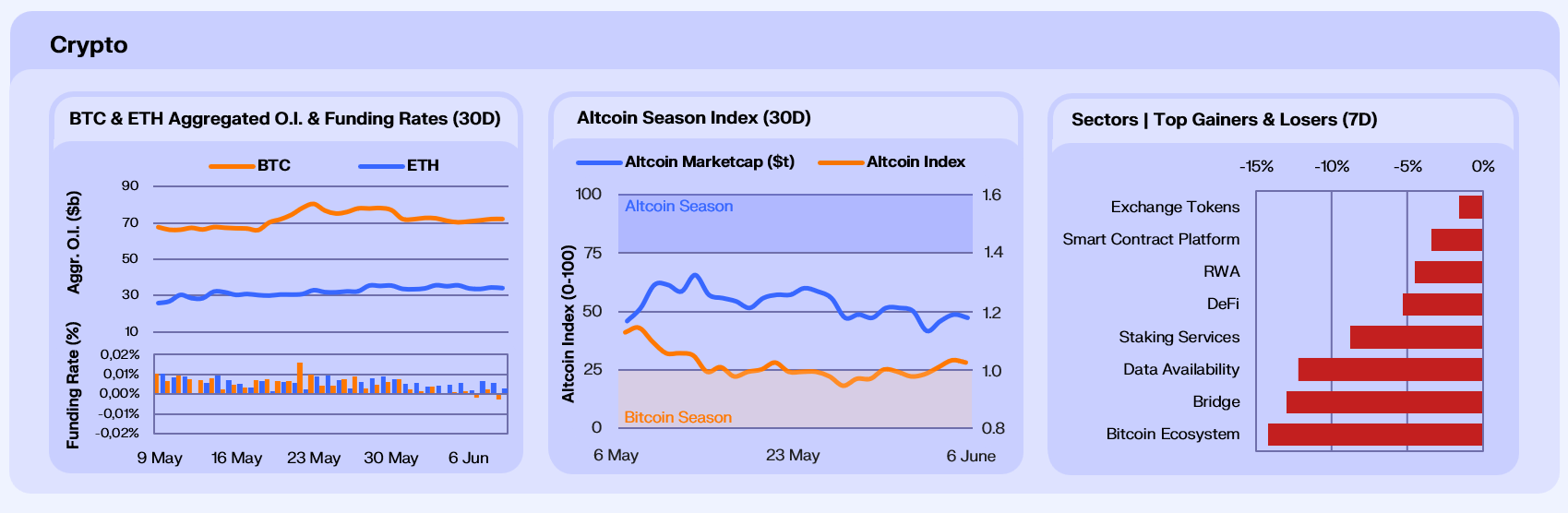
Crypto markets declined early this week before rebounding by Friday, with Bitcoin’s dominance continuing to drive the broader market narrative. After recovering from May lows of 62.1%, Bitcoin dominance now sits less than 1% away from its yearly high of approximately 65.5%, underscoring its outsized influence on market sentiment. However, Bitcoin’s relative strength didn’t extend to Bitcoin ecosystem tokens, which continued their recent decline (-14.2%). Staking service tokens also declined (-8.8%), despite increased demand evidenced by approximately 325,000 Ethereum waiting in the validator activation queue, the highest level in over a year. The altcoin market continues to lack conviction as momentum wanes quickly, driven by narrow market breadth and individual token narratives.
In derivatives markets, activity remained elevated. While Bitcoin open interest remained muted at $71.9 billion, Ethereum open interest remained near all-time highs of $36 billion. Both assets generally maintained slightly positive funding rates during the week, reflecting tepid sentiment that still proved vulnerable when Thursday delivered the largest long liquidation event since February 25th. Despite this volatility, traders remain positioned for potential upside, with Deribit’s Bitcoin $120k June calls holding the highest open interest, a bet on upward momentum even amid the current uncertainty.
Our Take: Despite the fragmented altcoin landscape driven by isolated token stories, Ethereum is decoupling from this weakness—underpinning our optimism on Ethereum while remaining cautious on other altcoins. Last week, the Ethereum Foundation outlined three strategic priorities for protocol restructuring: scaling L1, scaling L2, and improving UX. Combined with continued institutional adoption through ETFs and dominance in tokenized assets, these developments suggest Ethereum may break away from broader altcoin weakness.
Following the Money Trail
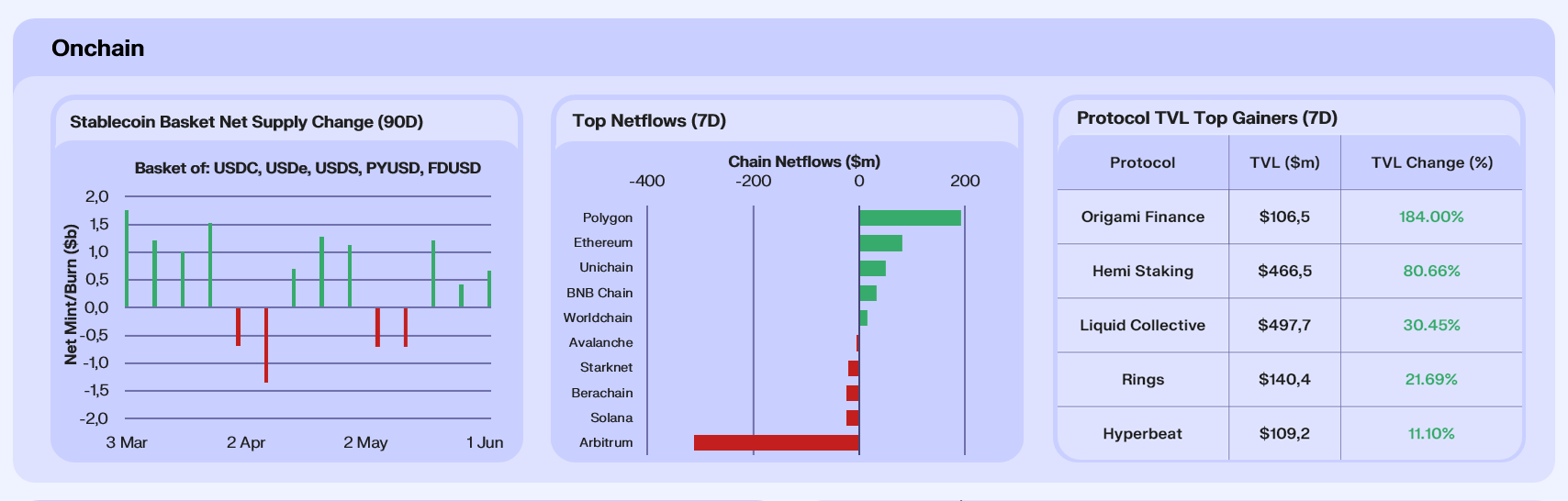
Stablecoin issuance continued its upward climb this week, led by net mints in USDS, USDe, and PYUSD. Altogether, total stablecoin supply rose by 0.89% to $74.95b, marking the third consecutive week of growth. The rebound has been gradual, but consistent, suggesting a steady restoration of liquidity across DeFi ecosystems.
Polygon led ecosystem net inflows this week ($193m), driven by renewed interest following X’s selection of Polymarket as its official prediction market and growing tokenized asset activity, including Franklin Templeton’s expansion of on-chain tokenized funds. Ethereum followed behind, extending its multi-week run as the preferred chain for both retail and institutional capital. Arbitrum posted outflows (-$312m), likely tied to continued capital exits from Hyperliquid following recent high-profile trade liquidations. Traders appear to be rotating capital to lower-cost, less congested alternatives while also chasing trusted DeFi primitives by bridging back to mainnet.
Protocol-level data confirms the rotation narrative. Capital continues to chase elevated yields and new primitives, with Origami Finance (184%), Hemi Staking (81%), and Liquid Collective (30%) all posting sharp TVL gains. These aren’t just retail flows, Liquid Collective benefited from institutional appetite, likely boosted by rising optimism around ETH staking ETF clarity, while Hyperbeat shows early signs of traction in the HyperEVM ecosystem, something we’ve previously highlighted as a potential airdrop narrative.
Our Take: The steady rebound in stablecoin supply, paired with chain-level outflows from Arbitrum points to a more tactical, yield-driven market. Ethereum is benefiting from institutional alignment, while protocols like Hemi Staking and Origami are riding the wave of niche, high-return strategies. This isn’t broad-based risk-on just yet, but it’s a sign that capital is being productively deployed again. If this tempo holds, the next re-risking cycle will be more selective, and more protocol-driven than the last.
Ethereum’s Institutional Ascent
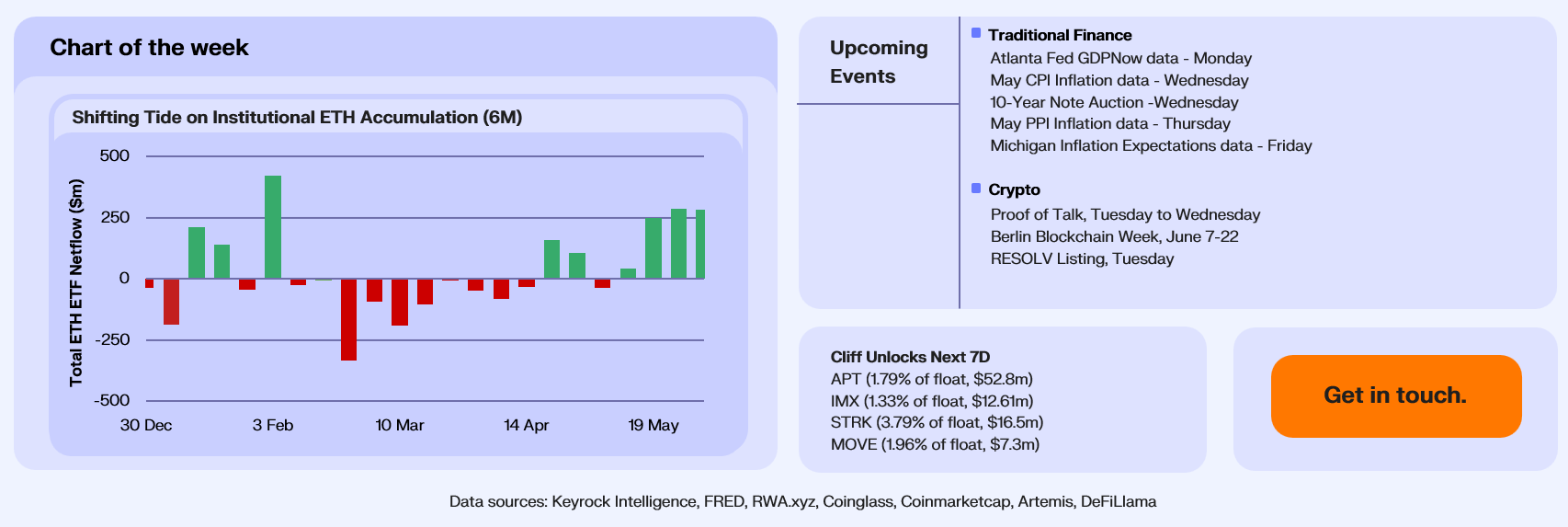
Ethereum’s price resurgence over the past two months has been impressive, but we’ve been paying attention to another monumental shift of momentum for Ethereum; institutional accumulation heating up. This is shown in netflows for ETH ETFs printing their longest stretch of accumulation YTD, with four consecutive weeks in the green.
The inflows follow a rather dire stretch of ten consecutive weeks of outflows between February and April, highlighting a rapid reversal in sentiment surrounding Ethereum. But what’s driven this renewed appetite? Not only have we seen an improvement in onchain fundamentals over the past six weeks, with DEX volumes (+95%), daily transactions (+24%) and daily active addresses (+22%) all up, there have been material developments in regulatory clarity. SEC Commissioner Hester Peirce recently confirmed that Ethereum’s PoS mechanism is not considered a security, removing a key overhang. This opens the door for staking to be incorporated into ETH ETFs, a major unlock for institutional investors chasing yield.
In addition to these positive developments both on and offchain, Consensys’ Joe Lubin has announced he’ll be leading a new ETH treasury vehicle, SharpLink, sparking comparisons to Michael Saylor and Strategy. By routing capital markets demand into direct ETH purchases, SharpLink has the potential to create a persistent structural bid under Ethereum. This marks a monumental shift in the developing landscape of institutional ETH exposure vehicles.
Our Take: Ethereum is about to enter its institutional period, in much the same way Bitcoin did in 2024. Within twelve months, we expect staking ETFs to be approved, transforming ETH from a speculative asset into yield-generating institutional allocation. This is something Bitcoin can’t offer. SharpLink-style entities will proliferate, bringing ETH onto corporate balance sheets just as MicroStrategy did for Bitcoin.
Join our Telegram Channel to get it delivered directly to your phone.

Follow our Telegram Channel
Get the edge before markets move. Join our Telegram channel to receive our market update straight in your inbox.