

20 July 2026
Key Insights: Bitcoin Breaks Its Beta
Bitcoin Breaks Its Beta
Every Monday, we deliver a concise yet comprehensive briefing to help you navigate the week ahead.
Our weekly market dashboard brings together key insights across Macro, Crypto, and Onchain activity, distilled into a clear, actionable format. Whether you’re managing risk or spotting opportunity, start the week informed and aligned.
Join our Telegram Channel to get it delivered directly to your phone.
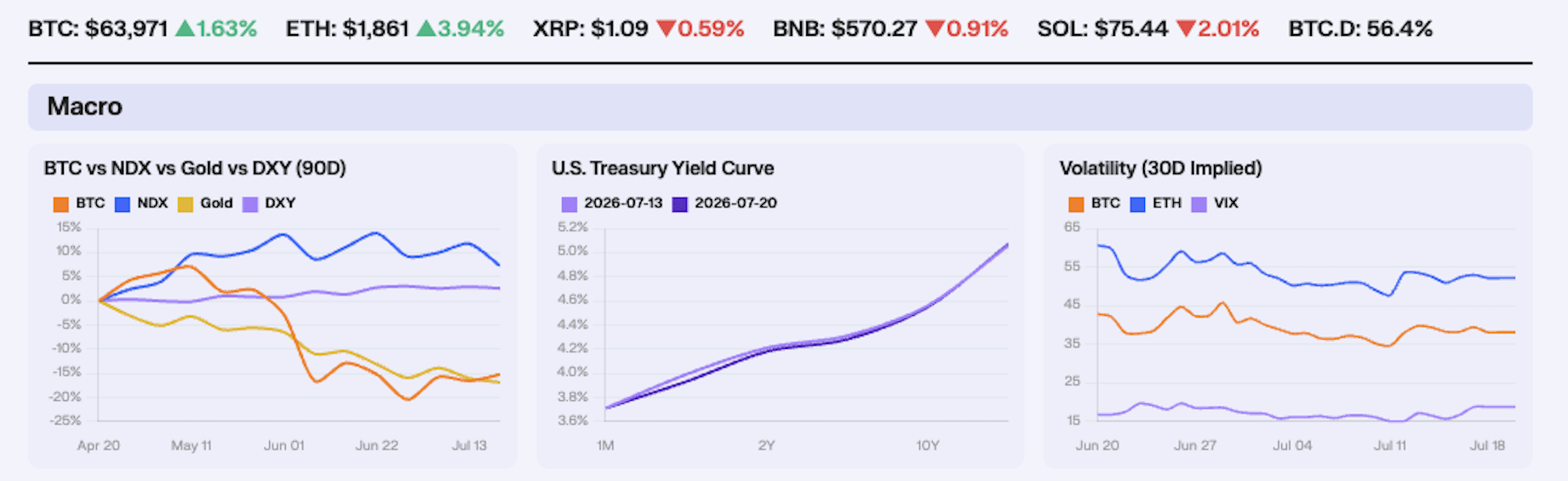
Bitcoin pulled away from equities this week, closing +1.63% while the NASDAQ 100 fell −4.13%. Gold slipped -0.99% and the dollar drifted −0.32%. A soft June inflation week that should have lifted risk across the board instead saw duration sensitive tech sell off while Bitcoin firmed, the divergence being what our desk is paying attention to. Some of it was geopolitical, with BTC washing out to roughly $61,900 on Monday’s Iran headlines before clawing the entire move back by Friday, but the deeper driver was rates. With the 30Y pinned above 5% and the market still carrying a September hike, equities couldn’t hold a relief rally on cooling prints, and Bitcoin, for once, was the cleaner read on the soft landing.
The June data came in cool almost everywhere, with headline CPI printing 3.5% YoY against a ~3.8% consensus, prices actually falling -0.4% on the month as energy rolled over, the steepest monthly drop since April 2020. Core held flat MoM and eased to 2.6% YoY. PPI told the same story, down -0.3% MoM and 5.5% YoY versus 6.2% expected. Retail sales rose a modest +0.2% and jobless claims fell to 208,000, a two-month low. Treasuries barely rallied on any of it. The 2Y slipped just −3bp and the 5Y -3bp, while the 30Y actually rose +1bp. Credit Governor Waller opened the week warning the Fed should “consider tightening in the near term” if inflation ran hot. The data disarmed the July hike, with Polymarket odds collapsing to roughly 8%, but the curve kept a September move partly priced and the long end refused to budge, steepening 2s30s to 89bp.
Volatility carried the same split, with the VIX jumping +9.38%, most of it built Thursday and Friday as equities leaked lower, while Bitcoin’s 30-day ATM implied vol fell -4.20% and ETH’s dropped -2.47%. Crypto vol compressing into a rising equity VIX is unusual, and it shows how far the two complexes traded apart. Positioning made the equity side look fragile, with index put/call ratios climbing toward 1.10 on thinning volume, and dealers sat short gamma near the SPX flip level, the setup that amplifies intraday swings rather than dampening them. Crypto was the mirror image, with BTC skew repairing from Monday’s panic back toward neutral as spot reclaimed the mid-$63,000s.
Our Take: The tension into the 28-29 July FOMC is the long-end not confirming the unambiguously cooling inflation data. A 30Y above 5% and a curve still pricing a September hike tell you the market’s worry has moved from prices to supply and term premium, and that is exactly the regime that punishes long duration tech no matter what the CPI headline does. The more interesting development is Bitcoin. For the first time in months it broke its beta to the NASDAQ, absorbing a geopolitical shock on Monday and closing green in a week the tech index fell over four percent.
Ether's Turn
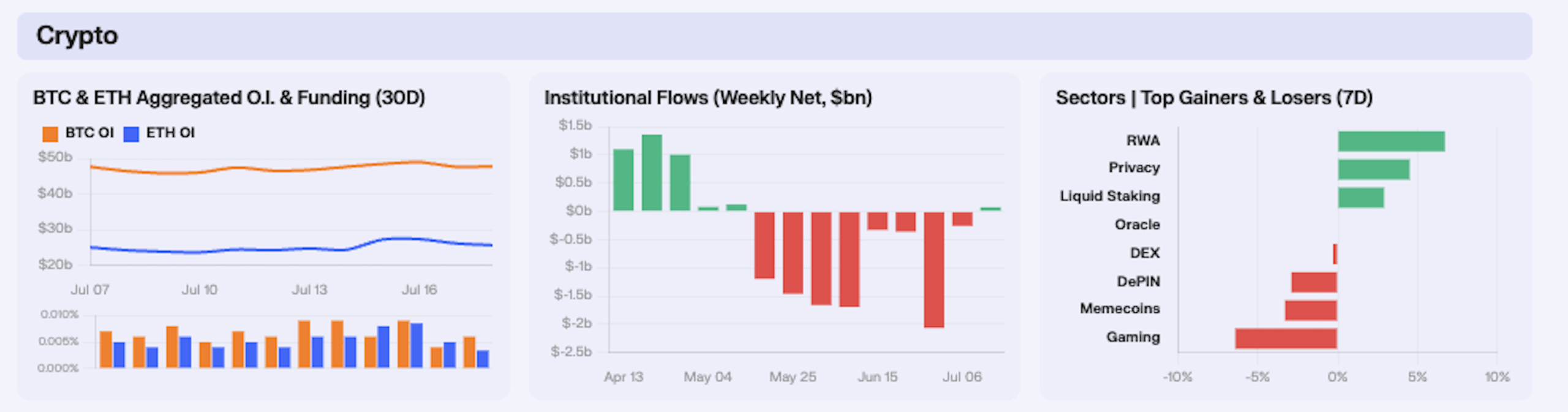
Bitcoin open interest ground higher from $46.7B on Monday to a $48.9B peak on 16 July before easing to $47.6B into the weekend, a controlled build and fade around the rejection at $65,000. Ether was where the leverage really built, its OI spiking from $24.8B to $27.4B by 16 July, a +10% surge that included a single-day jump near +12%, before unwinding to $25.8B. Funding stayed positive across both all week without ever flashing stress. Longs were paying, but nobody was reaching.
Spot Bitcoin ETFs netted just +$75.5M on the week, and even that came the hard way, clawing back a brutal -$424.7M Monday outflow on the Iran-headline washout with four straight green days worth roughly +$500M, closing AUM near $79.82B. Spot Ether ETFs, sitting on barely a sixth of that asset base at $13.72B, pulled +$105.5M net and outdrew Bitcoin in absolute dollars. The marginal institutional dollar went to ETH, absorbing far more relative demand than BTC on a comparable basis, and doing it alongside the heavier leverage build. The altcoin wrappers stayed an afterthought, with Solana funds taking ~$1.0M and XRP $6.78M, rounding errors against the majors.
Underneath the majors, dispersion was wide and a mid-week bout of risk aversion sorted the winners from the losers. RWA led at +6.7%, almost single-handedly on Ondo (+19.1%) after it unveiled a partnership with Japan’s SBI Group to tokenise Japanese equities and expanded its lineup of tokenised US stocks. Privacy came next at roughly +4.5%, essentially a Zcash (+10.3%) move as traders positioned themselves into the Ironwood upgrade, with a ~25% surge on the 16th alone. Liquid staking rounded out the top three near +2.9%, led by Lido (+17.5%) into the LIP-33 and LIP-35 governance votes and a wave of ETF filings that would let holders stake ETH. The bottom was all high beta. Gaming fell -6.4%, and DePIN dropped -2.9%.
Our Take: The ETH-over-BTC rotation, visible in both the ETF tape and the OI build, is the cleanest signal in the week’s data. Treasury vehicles like BitMine are now hoovering up ether at scale, holding near 5.77m ETH, roughly 4.8% of supply. That’s a structurally different bid from the BTC treasury trade, and it is only getting going. The bigger catalyst sits in Washington. The CLARITY Act market-structure bill is in its endgame, with a Senate floor vote flagged for the week of 20 July and a hard August recess deadline behind it. Pass it and the SEC-CFTC jurisdiction question that has capped US altcoin risk for years finally clears. Stall it and our desk sees the ETH rotation losing its regulatory tailwind just as the leverage that built this week needs a reason to stay.
Retail's Onchain Funnel
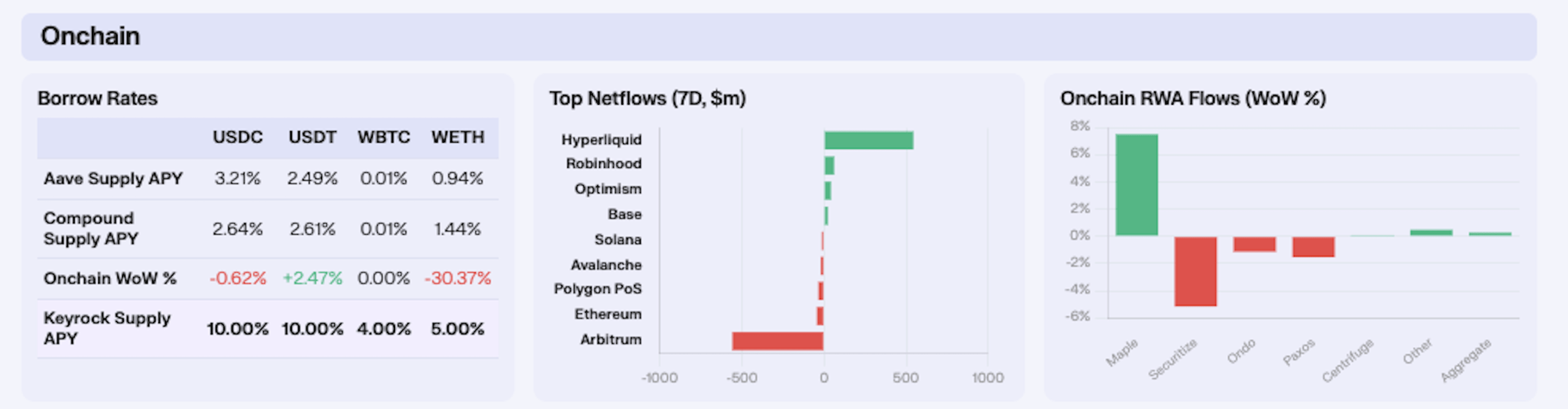
WETH’s Aave supply APY collapsed -30.37% WoW, and deposits fell alongside the yield decline. That was the week’s clearest onchain signal, both sides of the market shrank at once, the textbook mark of deleveraging rather than a hunt for yield, and it maps cleanly onto the week’s ETH story. With open interest spiking, ETF demand building and staking the best performing sector, holders pulled WETH out of passive lending and toward staking and directional exposure. Stablecoin rates barely moved next to that.
Hyperliquid pulled +$543.8M of net inflows while Arbitrum bled -$557.3M, a near perfect mirror and two sides of the same trade. Hyperliquid’s open interest hit a 2026 record near $11.07B on Monday, its RWA and HIP-3 markets reached an all-time high around $3.6B, and its bridge logged its largest USDC inflow in roughly ten months. Arbitrum extended a slide that has run since May, when its stablecoin supply peaked near $7.7B before falling to $4.4B by early July as its role as the main route into Hyperliquid faded. One wrinkle stops this being a clean defection, which is Robinhood’s new chain, which took +$61.6M, is itself built on the Arbitrum stack, so some of what looks like Arbitrum losing ground is really its own Orbit chain pulling deposits onto a dedicated venue.
Aggregate RWA AUM went nowhere, up just +0.27% on the week, but the flat headline hid the most interesting institutional activity onchain in months. Maple was the standout at +7.50%, driven by syrupUSDG going live on Robinhood’s chain and being wired into Robinhood Earn, the neobank’s first in-app lending product. The token pulled in over $200M in days, a pace its predecessor syrupUSDT took more than 18 months to match. Securitize fell -5.16% with no reported catalyst, and Ondo’s protocol AUM actually slipped -1.13% even as its token ripped, a reminder that the RWA rally this week was priced in equity, not deposits. The real signal was the calibre of new entrants. Ondo launched DTCC-backed tokenised stocks alongside BlackRock and Nasdaq and partnered with Japan’s SBI Group, while Centrifuge onboarded New York Life Investment Management, an $807B insurer, for its first tokenised fund. A cluster of exploits ran underneath it all, with Ostium’s $24M oracle drain and Across Protocol’s first incident in four years reminding desks that bridge and oracle risk hasn’t gone anywhere.
Our Take: The connective tissue this week was Robinhood’s chain, and almost nobody is pricing it because the signal is split across three different data series. It took nine figures of net inflows, it is where Maple’s syrupUSDG did its $200M sprint, and it is the settlement layer for Paxos’s new stablecoin routing. Two weeks after launch, a neobank chain is already the growth vector plumbing retail deposits into institutional onchain credit, a different and stickier flow than the mercenary collateral chasing Hyperliquid’s points. If a chain this young keeps pulling nine-figure weekly inflows, the onchain credit model has found its retail funnel, and the venues that matter in twelve months may be the ones with a consumer app attached, not the ones with the deepest perps book.
The Growth Mode Mirage
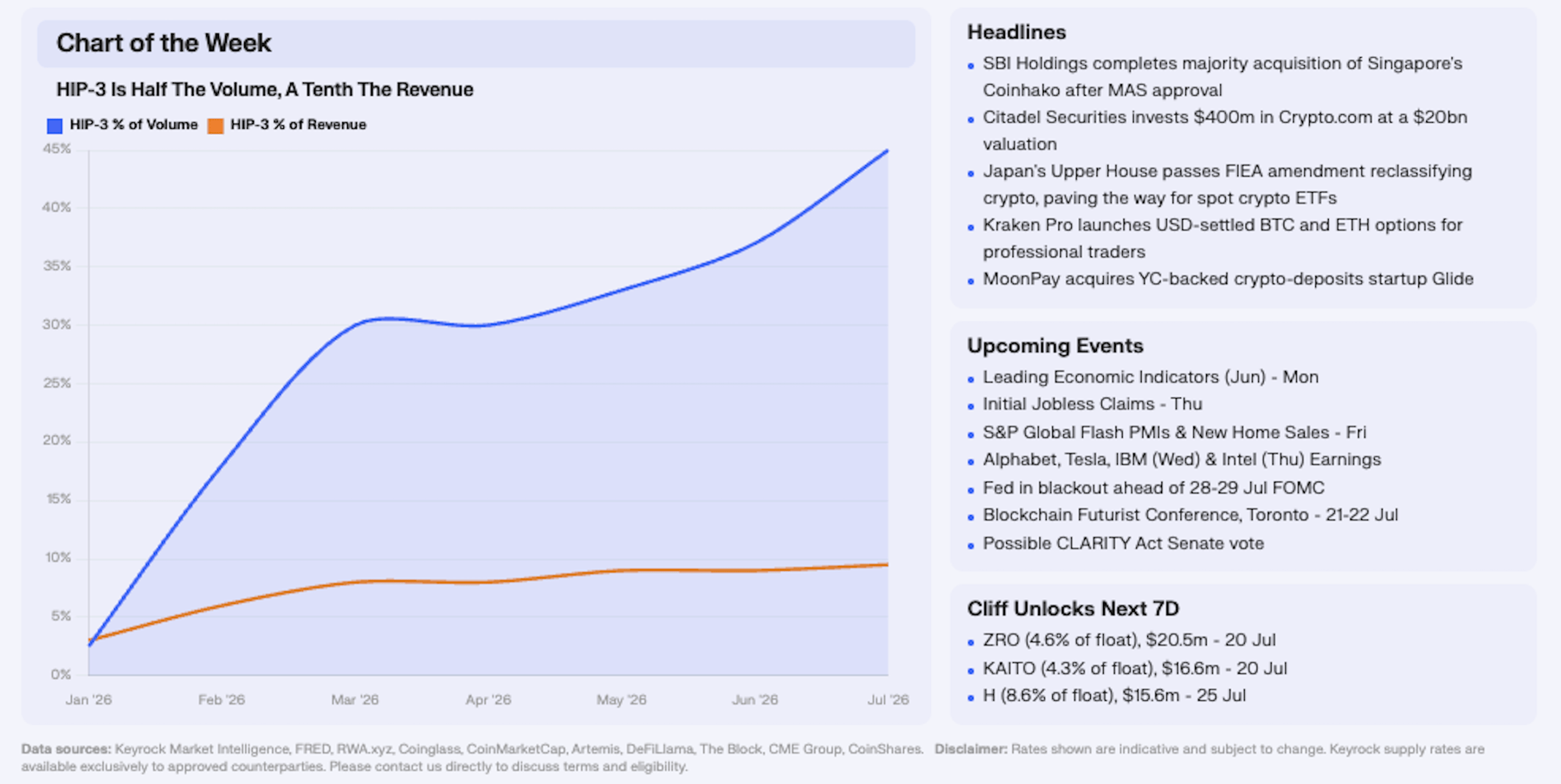
HIP-3’s share of Hyperliquid’s total perpetuals volume has climbed from barely 2-3% in January to nearly 45% in the latest weekly print. Its share of revenue, though, has barely budged off 9-10%. Open interest sits in between, with HIP-3 hitting a mid-July record near $3.6B, roughly a third of Hyperliquid’s $11.07B total. One product is now nearly half the volume, a third of the positioning, and a tenth of the revenue. And it is essentially one venue, in trade.xyz, which runs 24/7 index and single-stock perps on the Nasdaq-100, Nvidia and Tesla settled in stablecoin, accounts for around 98% of all HIP-3 volume.
Builder deployed markets on Hyperliquid can switch on a setting called Growth Mode that cuts all in fees by 90% or more, and trade.xyz has leaned on it hard, running stock perps at roughly 0.9bp taker against about 4.5bp on the core crypto perps. Cheap, deep markets are how it took share, and it worked, but every dollar of stock-perp volume is monetised at a fraction of a crypto perp dollar. Run our two numbers together and the core book captures roughly eight times more revenue per dollar of volume than HIP-3 does. Gold, which is ineligible for Growth Mode and pays full freight, throws off 23% of all HIP-3 fees on just 4.3% of its volume. Turn the fees back on and the revenue appears instantly. So the 45% volume share is real order flow, but a lot of it exists precisely because it is nearly free, with trade.xyz still pre-token and its traders openly farming an expected airdrop.
Of 136 paid HIP-3 listings, Blockworks found only 44 ever recovered their auction cost, and rival builder Felix shut its HIP-3 operation in June, leaving trade.xyz effectively alone. That concentration is the first reason to doubt the volume is durable. The product design carries its own fault lines. When the underlying equities are closed, overnight and weekend prices hang entirely on oracle and funding mechanics, an anchoring that is still unproven and has already broken twice, a SpaceX pre-IPO perp on a rival builder fell 45% in half an hour on a data error in May, and Hyperliquid’s own gold perp dropped $100 in under a minute over the 4 July holiday.
Our Take: The number everyone is quoting, HIP-3 at nearly half of Hyperliquid’s volume, is the least useful one on the chart. The revenue line is the one to watch. As long as it sits near 10%, onchain stock perps are a marketing funnel that trade.xyz is paying for through Growth Mode, not a business, and the volume is only worth what it converts to once fees normalise. When trade.xyz turns fees back on or launches its token, holding volume proves the demand was real and evaporating volume proves it was airdrop farming. And a break in the revenue share above the 10% band into month-end would be the first hard evidence that 24/7 equity exposure can pay for itself rather than being bought. Either way, HYPE holders are insulated, since the protocol’s cut still routes to buybacks.
Join our Telegram Channel to get it delivered directly to your phone.

Stay up to date
Get the latest industry insights, in-house research and Keyrock updates.
This site is protected by reCAPTCHA and the Google Privacy Policy and Terms of Service apply.