

Stablecoin Payments: The Trillion Dollar Opportunity
What is Onchain FX? A guide
Introduction
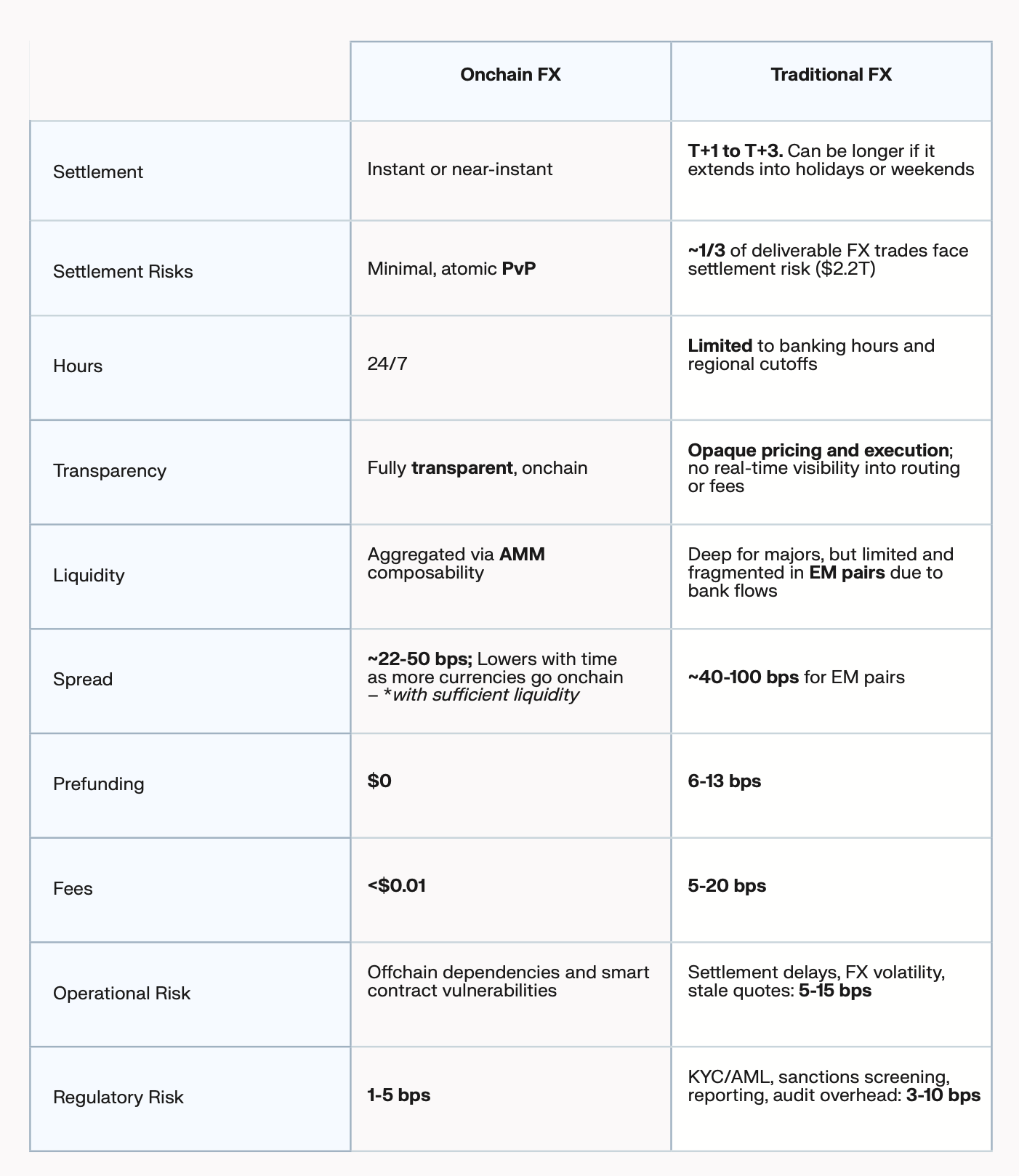
Onchain FX refers to foreign exchange conducted directly on blockchain rails, where currencies are swapped as stablecoins or tokenized assets in real time. Unlike traditional FX, which depends on correspondent banks, prefunding, and multi-day settlement, Onchain FX enables atomic Payment-versus-Payment (PvP) transactions, both sides of a trade settle instantly or not at all. This removes counterparty risk, reduces costs, and compresses what was once a multi-step process into a single programmable layer.
While stablecoins solve many of the inefficiencies baked into legacy payment rails, most implementations still rely on offramps back into fiat, especially when foreign exchange is
involved. The promise of stablecoins as a global value layer remains constrained by fiat
dependencies.
Onchain FX reimagines the traditional stack of correspondent banks, netting engines, and multi-step settlement layers with real-time, programmable swaps. The model is still early-stage, and while some critiques remain, many reflect growing pains rather than fundamental flaws.
“Stablecoin liquidity isn’t just about quoting tight spreads, it’s about managing the invisible plumbing behind them: bank rails, settlement lag, cutoff times, and jurisdiction-specific frictions. Our edge lies in mirroring banking operations internally, so we preempt rebalancing and move funds with surgical precision. You also can’t consistently hold top-of-book without direct access to primary issuance. We’ve built relationships with all major stablecoin issuers, enabling real-time minting, redemption, and arbitrage across venues and chains. Deep liquidity begins with deep infrastructure, and that’s where Keyrock leads.”— Stef Wynendaele, Managing Director of Keyrock
Some stablecoin payment companies lack access to wholesale FX rates. Leading solutions like Bridge have only recently gone live, underscoring how early the ecosystem remains.
As asset tokenization accelerates, FX is undergoing a structural overhaul. A landscape once defined by fragmented liquidity, opaque settlement, and currency incompatibility is being rebuilt into programmable, real-time rails. Legacy currency swaps, reliant on correspondent banks and multi-day settlement, are now being rearchitected from the ground up.
Source: Uniswap, Keyrock
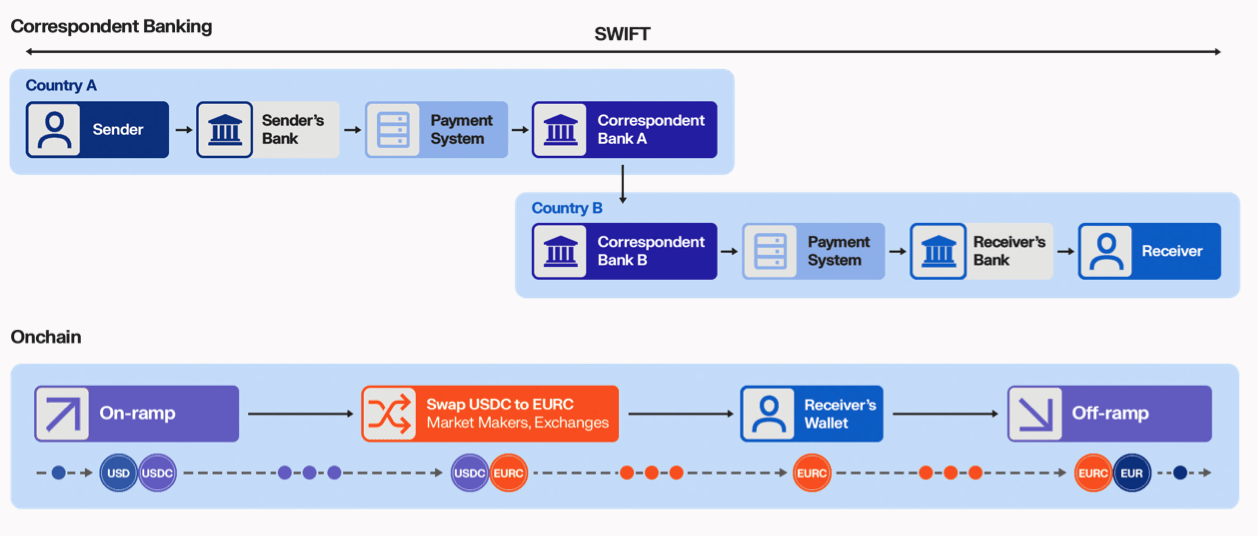
Today’s FX system requires correspondent banks to maintain relationships across multiple national payment networks, each governed by its own currency and central bank rules. This fragmented model forces banks to hold accounts in numerous jurisdictions just to move money internationally.
Onchain FX presents a fundamental alternative. Using blockchain, it enables atomic Payment versus Payment (PvP) transactions, ensuring that both legs of a trade settle simultaneously or not at all, eliminating counterparty credit risk. By combining messaging and settlement into a single layer, it also reduces operational complexity and error. Let’s compare:
Source: Uniswap, Keyrock
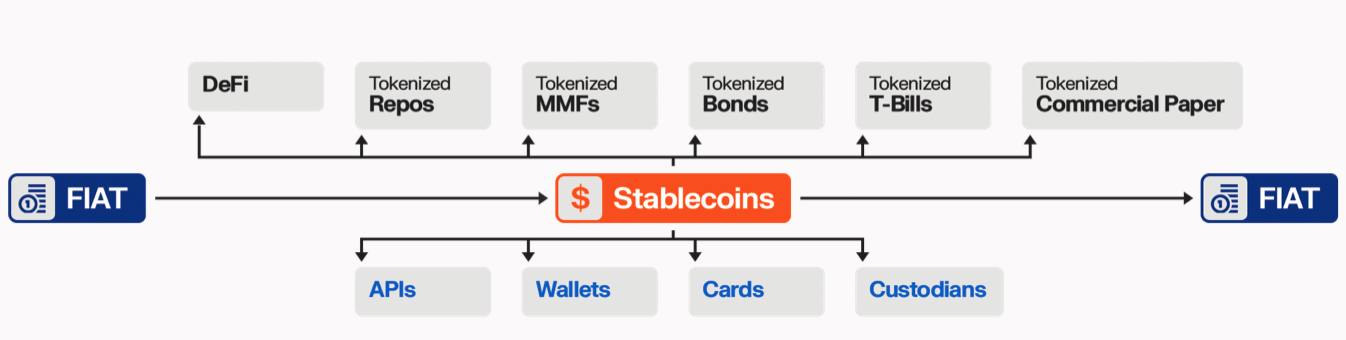
Onchain FX is reshaping the stablecoin sandwich model’s middle layer. Instead of depending on a single global stablecoin to connect every fiat currency, regional stablecoins are emerging, each tailored to a specific corridor. As these tokens become interoperable across onchain ecosystems, businesses can move capital with far greater efficiency and minimal reliance on legacy rails.
“We’re one of the top players in stablecoin FX for Mexico (MXP), and we’ve built solid partnerships to push into tougher Latam, Asian and African markets, where capital controls make conversions tricky. By teaming up with the top stablecoin issuers and local banking partners, we can offer real liquidity in places where most others can’t. That’s a big part of our edge, providing stablecoin liquidity not just in easy-to-access markets, but in the emerging corridors where they’re really needed.” — Robert Valdes-Rodriguez, Chief Commercial Officer of Keyrock
This model streamlines the conversion process. Rather than swapping USD to USDC and then off-ramping to TRY, users can directly exchange USDC for TRYB, bypassing the fiat offramp altogether. This eliminates the need for prefunding, liquidity buffers, and the complex credit lines traditionally required for multi-currency settlement.
Companies that previously needed to liquidate money parked in money market funds, short-term treasuries, or other fixed-income instruments (often subject to cutoff times and multi-day settlement delays) can now instantly convert tokenized equivalents into stablecoins and settle payments onchain.
“Stablecoins give users in emerging markets access to U.S. dollars. USDY takes that one step further, it gives them access to U.S. dollar savings. USDY is backed by U.S. Treasuries and pays yield, but It can also be used as collateral. This allows USDY to be utilized while it steadily accrues yield .” – Ian De Bode, Chief Strategy Officer of Ondo
Source: Keyrock
Tokenization’s Role in Onchain FX
In a standard securities transaction, brokers handle execution while custodians manage settlement, a process that can take up to T+2 days. With blockchain, this sequence collapses into atomic settlement, where value and ownership transfer simultaneously, eliminating operational delays.
Tokenization brings the entire transaction lifecycle, cash, custody, and financial instruments, onto one layer. Smart contracts can execute actions automatically based on preset conditions, eliminating manual processing. This architecture streamlines reconciliation, reduces friction, and unlocks new product design. Like smartphones unifying multiple tools into one interface, tokenization compresses payments, custody, and settlement into a single composable system.
Tokenised Bonds Outperform on Spreads, Match on Costs
Source: BIS
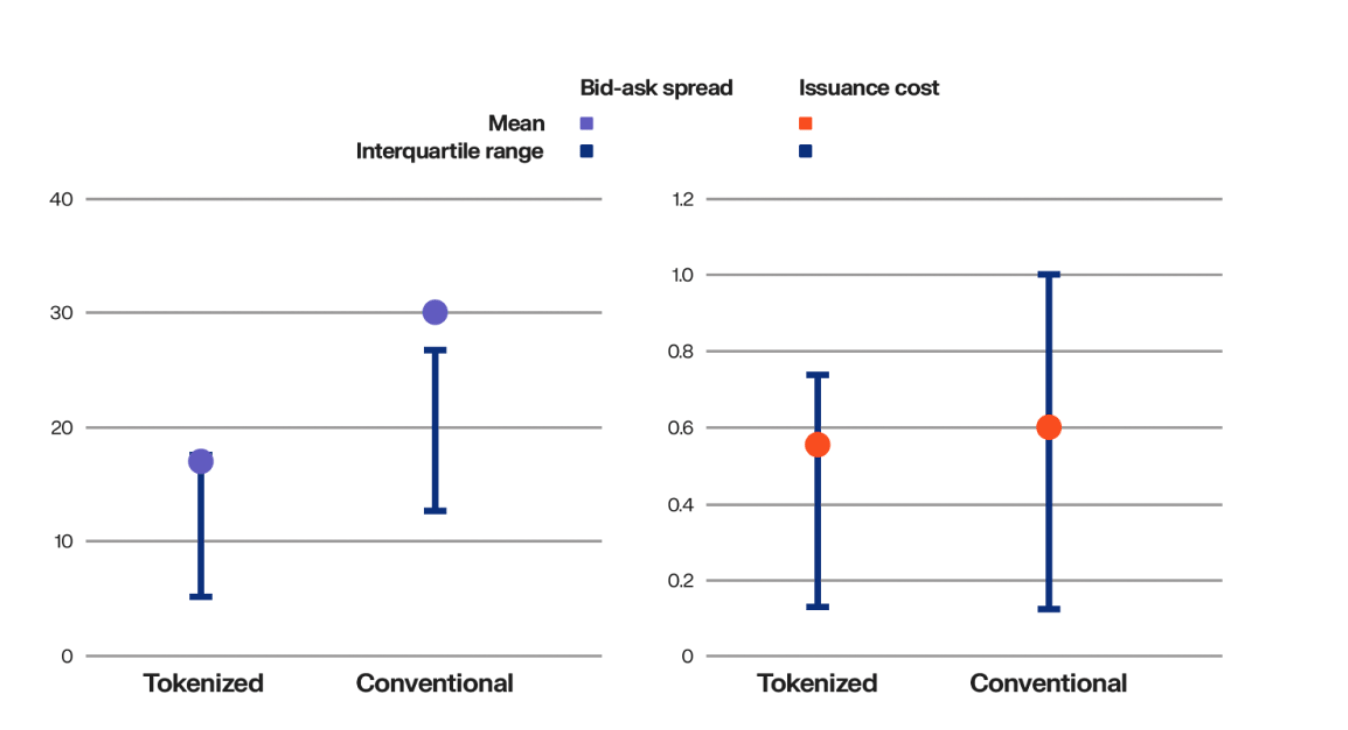
This structural shift is already surfacing in bond markets. According to BIS data, tokenized bonds exhibit materially tighter bid-ask spreads, a mean of ~17 bps compared to ~30 bps for conventional bonds, while issuance costs remain comparable across both formats. This suggests that tokenized markets are not only faster with redemptions, but may also offer superior price efficiency.
Tokenized assets will serve as modular, interoperable building blocks for cross-product collateral and automated corporate actions. Rather than waiting to redeem a money market fund and wire funds manually, a U.S. company could instantly swap tokenized fixed-income holdings (e.g., USDY) for a local stablecoin (e.g., TRYB) to settle supplier payments in Turkey, instantly and at any time.
The New York Fed’s Project Pine illustrates tokenization’s potential to rewire interbank operations. Banks in need of liquidity could post tokenized collateral and receive digital reserves via smart contracts, with no manual steps. The central platform would validate participants, assess collateral, and execute settlement autonomously, while tracking asset values in real time for dynamic margin and automatic repayment.
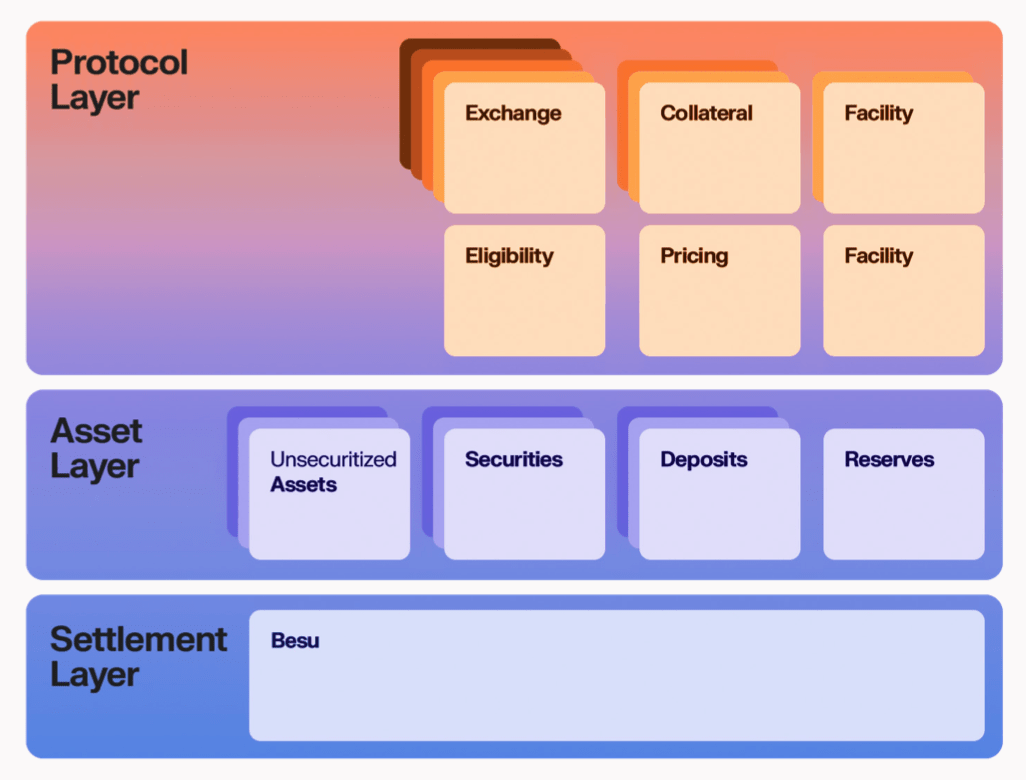
Source: BIS
While Project Pine hints at a central bank-led future, much of the real progress is coming from public firms. These companies are building practical solutions to fragmented liquidity, FX inefficiencies, and cross-border interoperability.
“To support tokenized FX markets, you need to operate in both worlds: traditional FX rails and digital asset markets. We’re one of the few firms that can trade FX globally while also being the first liquidity provider on new onchain pools. That dual capability is what positions us at the center of this evolving market structure” — Kevin de Patoul, CEO of Keyrock
By turning currency conversion into a transparent, programmable function, Onchain FX reimagines one of the most entrenched parts of global finance. It replaces prefunding and settlement risk with real-time liquidity and atomic swaps, setting the stage for cross-currency payments that are as seamless and continuous as sending data across the internet.