

Prediction Markets: The Next Frontier of Financial Markets
What Are Prediction Markets? How They Work, Why They Matter (2026 Guide)
Polls guess. Prediction markets price. That distinction has reshaped how the world forecasts everything from elections to inflation — and the data proves it.
A prediction market is an exchange where you trade contracts tied to real-world outcomes. Buy a contract at 70 cents and you are betting there is a 70% chance the event happens. If it does, you collect $1. If it does not, you lose your stake. Every trade carries conviction. Every price shift reflects new information. What you get is a living probability that adapts in real time.
No panels. No pundits. Just money meeting information.
How Prediction Markets Work: Four Layers
Strip away the branding and every prediction market runs on the same architecture.
- Market Creation — A clearly defined question goes live: “Will inflation exceed 3.5% this quarter?” or “Will candidate X win the election?” Some platforms curate these markets. Others let anyone create them.
- Trading — You buy and sell Yes/No contracts. The price of each contract reflects the crowd’s implied probability. Most major platforms use a Central Limit Order Book (CLOB) where traders post bids and offers, though some use Automated Market Makers (AMMs).
- Custody & Settlement — Collateral stays escrowed while contracts are open. On centralised platforms like Kalshi, funds sit in segregated U.S. bank accounts. On decentralised platforms like Polymarket, contracts are tokenised onchain — you hold your own keys.
- Resolution — When the event occurs, an oracle determines the outcome. Kalshi uses official data sources. Polymarket relies on UMA’s Optimistic Oracle, where human proposers submit outcomes and a dispute mechanism keeps them honest. Across 11,000+ market assertions on UMA, roughly 98% go undisputed.
Why Prediction Markets Outperform Polls and Expert Forecasts
Economist Friedrich Hayek nailed it in 1945: useful knowledge is scattered across millions of people. No single model can capture it all. Prediction markets solve this by giving people a financial reason to reveal what they know.
Each participant brings a different fragment — private models, local intelligence, domain expertise — and expresses it through trades. The resulting price compresses thousands of scattered signals into one probabilistic forecast.
The numbers are decisive:
- Polymarket correctly prices outcomes 90–95% of the time
- Both Kalshi and Polymarket achieve Brier scores near 0.09 — far sharper than polls (0.27–0.31), expert forecasters (0.20–0.25), and even weather models (0.14–0.15)
- A study of the Iowa Electronic Markets covering five U.S. presidential races (1988–2004) found market forecasts beat traditional polls in roughly three-quarters of all observations
Three times more accurate than polls. Better than billion-dollar weather infrastructure. That is not a marginal improvement — it is a different category of tool.
A Brief History: From Papal Elections to Polymarket
Prediction markets are not new. They are older than most financial instruments you use today.
The first recorded instance appeared during the 1503 papal conclave in Renaissance Italy, where nobles and merchants wagered on who would become pope. These markets grew so influential that Pope Gregory XIV banned them in 1591 — not on moral grounds, but because public betting exposed collective expectations about a supposedly divine decision.
By the 18th century, organised prediction markets resurfaced in London’s coffeehouses. At Jonathan’s Coffeehouse — later the site of the London Stock Exchange — patrons traded bets on parliamentary votes, ministerial appointments, and maritime risk. Those wagers evolved into the foundation of modern insurance.
The digital era began in 1988 with the Iowa Electronic Markets, continued through Augur’s launch as Ethereum’s first ICO in 2015, and reached product-market fit with today’s generation: Polymarket, Kalshi, Crypto.com, Limitless, MYRIAD, and Opinion.
How Prediction Markets Differ from Sports Betting
A common misconception conflates prediction markets with gambling. The differences are structural, not cosmetic.`
- Sports betting is adversarial — the house sets lines with embedded margins against you. Prediction markets are peer-to-peer exchanges where incentives align around accurate pricing.
- Polls measure sentiment without stakes — no financial consequence means bias and disengagement run unchecked. Prediction markets demand conviction backed by capital.
- Prediction markets are exchanges — they match buyers and sellers with no conflict of interest between platform and trader. When Kalshi onboarded institutional market maker Susquehanna in 2024, order book depth surged roughly 30x.
Analysis of 5,000+ identical markets across prediction platforms and sportsbooks shows that Kalshi and Polymarket deliver, on average, 77% better odds than traditional sportsbooks. That gap is the exchange model versus the house-edge model — laid bare in data.
The Scale of Prediction Markets Today
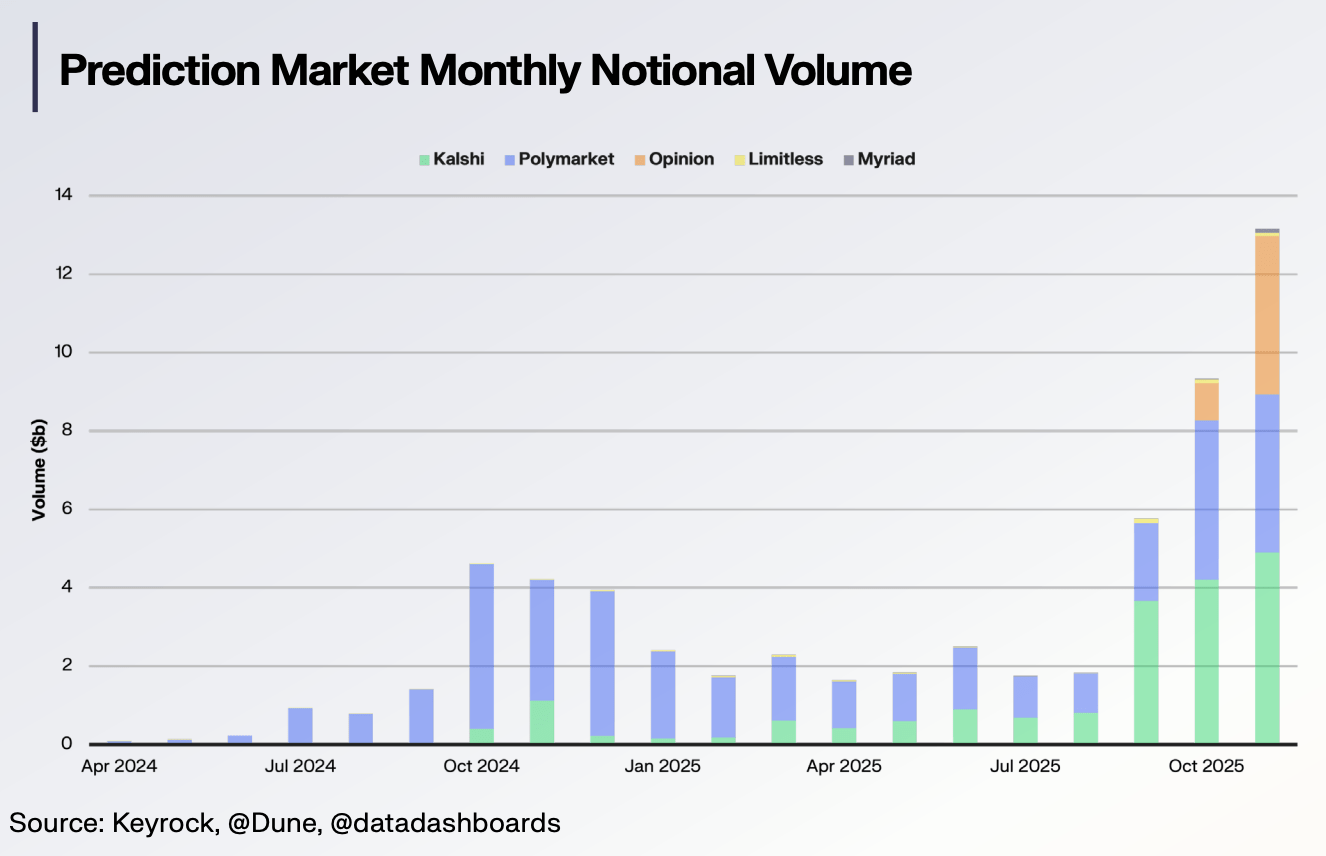
Since early 2024, monthly notional volume has surged from under $100 million to over $13 billion. A 130x increase. That places prediction markets among the fastest-growing sectors in the world.
Here is what that growth looks like:`
- Transactions: from 240,000 to over 43 million monthly — a 180x increase
- Unique users: from 4,000 to 612,000 monthly — a 150x increase
- Total 2025 volume: over $44 billion across major platforms in eleven months
- Institutional validation: ICE pledged up to $2B for Polymarket at an $8B valuation; Kalshi raised $1B at an $11B valuation
These are not speculative projections. This is capital voting with conviction.
Frequently Asked Questions
Are prediction markets legal?
In the U.S., Kalshi operates as the first CFTC-approved financial exchange for event contracts. A landmark 2024 court ruling affirmed that political event contracts do not constitute “gaming” under the Commodity Exchange Act. Polymarket re-entered the U.S. market in late 2025 through regulated infrastructure. Regulation continues to evolve at the state and international level.
How accurate are prediction markets compared to polls?
Prediction markets achieve Brier scores around 0.09, significantly outperforming polls (0.27–0.31), expert judgement (0.20–0.25), and weather forecasting models (0.14–0.15). During the 2024 U.S. presidential election, Polymarket proved far more reactive to shifting dynamics than traditional polls.
What can you trade on prediction markets?
Any clearly defined outcome: elections, economic indicators (inflation, GDP, interest rates), sports events, technology milestones, crypto prices, corporate earnings, cultural events, and more. The fastest-growing categories in 2025 were Economics (905% volume growth) and Tech & Science (1,637% growth).
What is the difference between Polymarket and Kalshi?
Polymarket is a crypto-native platform built on Polygon with onchain settlement and decentralised resolution via UMA. Kalshi is a CFTC-regulated centralised exchange with funds held in segregated U.S. bank accounts. Both use Central Limit Order Books. Polymarket leads in politics and crypto markets; Kalshi leads in sports volume.