

The Great Tokenization Shift: 2025 and the Road Ahead
Tokenized US Treasuries: How Blockchain Is Reshaping the $29T Market
The U.S. Treasury market is the bedrock of global finance. Over $29 trillion in outstanding securities. The benchmark for risk-free rates worldwide. And it runs on infrastructure that still settles in T+1, routes through layers of intermediaries, and shuts down on weekends.
That disconnect is not sustainable. It is an opportunity.
The Legacy Problem: Why $29 Trillion Deserves Better Plumbing
U.S. Treasuries sit at the centre of global capital allocation. Central banks hold them. Pension funds depend on them. Money market funds are built around them. Yet the infrastructure supporting this market has barely evolved since the 1980s.
Four structural inefficiencies define the status quo:
- Settlement delays: Even after the move to T+1 in 2024, trades still take a full business day to settle. In a market where billions change hands hourly, that lag creates counterparty risk, ties up collateral, and adds operational complexity that scales with volume.
- Excessive intermediation: A single Treasury trade can touch broker-dealers, clearing firms, custodians, transfer agents, and central securities depositories before it reaches final settlement. Each layer adds cost. Each layer adds latency. Each layer adds a potential point of failure.
- Fragmented access: Retail investors and smaller institutions face barriers to direct Treasury market participation. Access flows through fund wrappers, brokerage accounts, and intermediary structures that dilute returns and limit flexibility.
- Limited operating hours: The Treasury market operates during U.S. business hours on business days. Global capital does not keep those hours. Events that move markets on a Saturday — geopolitical shocks, central bank announcements — cannot be priced until Monday morning.
These are not minor frictions. In a $29 trillion market, basis points of inefficiency translate to billions in deadweight cost.
What Tokenisation Solves
Tokenised Treasuries move the entire lifecycle — issuance, trading, settlement, custody — onto blockchain rails. The result is not a marginal improvement on existing infrastructure. It is a re-architecture.
Near-Instant Settlement
Blockchain-based settlement compresses the trade-to-settlement cycle from T+1 to near real-time. Atomic settlement — where the exchange of cash and securities happens in a single transaction — eliminates the counterparty risk that exists during the settlement window. Capital is freed immediately. Collateral requirements drop.
For repo markets, this is transformative. Overnight Treasury repo volume exceeds $4 trillion daily. Faster settlement means more efficient collateral recycling, tighter spreads, and reduced systemic risk in the plumbing that underpins short-term funding.
Intermediary Reduction
Smart contracts automate functions that currently require dedicated intermediaries. Clearing, custody, corporate actions, and compliance checks can be encoded directly into the token. The chain becomes the clearinghouse, the custodian, and the transfer agent — simultaneously.
This does not mean all intermediaries disappear. It means the ones that remain add genuine value rather than extracting rent from a position in the settlement chain.
24/7 Market Access
Tokenised Treasuries trade around the clock, seven days a week. A portfolio manager in Singapore can rebalance their Treasury allocation at 3 AM local time without waiting for U.S. markets to open. A fund in London can respond to a weekend central bank announcement in real time rather than queuing an order for Monday.
Always-on markets do not just add convenience. They improve price discovery by allowing information to be incorporated continuously rather than in bursts at market open.
Programmable Compliance
Regulatory requirements — KYC checks, investor accreditation, transfer restrictions, tax withholding — can be embedded directly into the token’s smart contract logic. Compliance becomes automated and continuous rather than manual and periodic.
This is the feature that matters most to institutional adopters. Tokenisation without compliance is a toy. Tokenisation with programmable compliance is infrastructure.
Who Is Building Tokenised Treasuries
The market has moved past proof-of-concept. Major asset managers are deploying real capital.
BlackRock’s BUIDL fund — launched in partnership with Securitize — brought institutional-grade tokenised Treasury exposure to Ethereum. Franklin Templeton’s BENJI fund tokenised U.S. government money market holdings on Stellar and Polygon. Ondo Finance built a permissionless wrapper that gives DeFi protocols direct access to Treasury yields.
These are not experiments. They are products with real AUM, real investors, and real compliance frameworks.
Centrifuge, our partner on “The Great Tokenization Shift” report, has been building the infrastructure layer since 2017. Their work on the ERC-7540 standard is shaping how tokenised funds — including Treasury products — handle subscriptions, redemptions, and composability across DeFi protocols.
The Liquidity Challenge
Tokenised Treasuries solve structural problems. But scaling to meaningful market share requires deep, reliable liquidity.
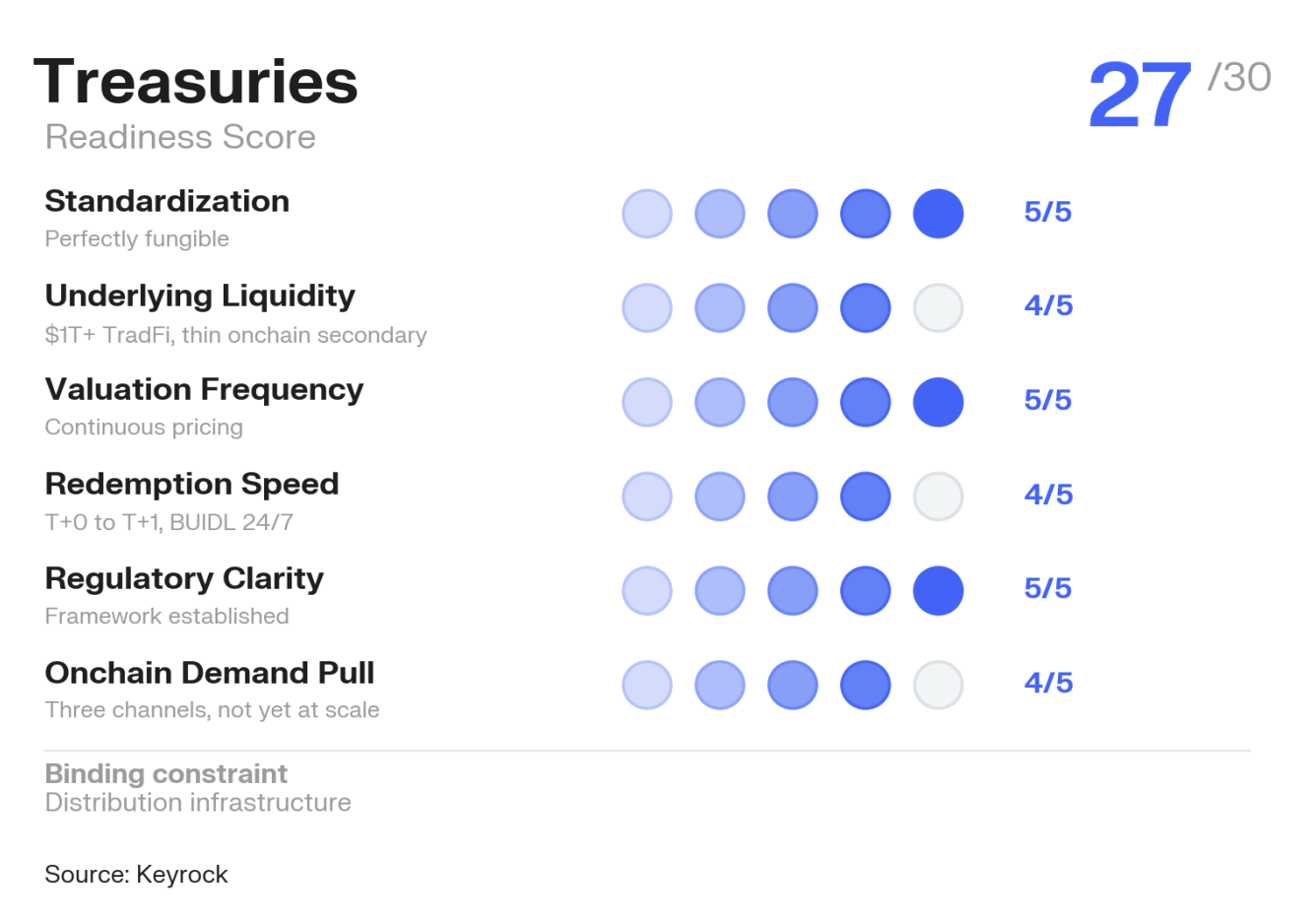
Today, most tokenised Treasury products operate as primary-market instruments. You subscribe and redeem through the issuer. Secondary market trading — where price discovery and liquidity depth live — remains nascent. That is the gap we are working to close.
Keyrock operates as a market maker across 85+ venues in 37 countries. Our infrastructure is built to provide continuous liquidity for tokenised assets, including Treasuries. Deep order books. Tight spreads. The mechanics that turn a tokenised product into a tradeable market.
Without liquidity, tokenised Treasuries are just a more efficient way to hold an illiquid position. With it, they become a genuine alternative to the $29 trillion legacy market.
Regulation: The Enabling Constraint
Regulatory frameworks determine the pace of adoption. Not technology. Not demand. Regulation.
The U.S. SEC has maintained a securities-law framework that applies equally to tokenised and traditional instruments. That consistency provides clarity but also imposes constraints around custody, broker-dealer registration, and investor qualification. The EU’s MiCA regulation and the UK’s Financial Market Infrastructure Sandbox offer alternative models that explicitly accommodate blockchain-based settlement.
Singapore’s MAS has been the most forward-leaning, running Project Guardian in partnership with JPMorgan and DBS to test tokenised bond issuance and cross-border settlement on public blockchains.
The jurisdictions that build workable frameworks first will attract the infrastructure, the talent, and the capital. That race is well underway.
What the Data Shows
Tokenised Treasury products have grown from near-zero AUM in early 2023 to over $2 billion by late 2025. That figure is a rounding error against the $29 trillion outstanding market. It is also the steepest adoption curve for any new Treasury market structure in decades.
The broader tokenised asset market is projected to reach hundreds of trillions in the coming decade. Treasuries — as the most liquid, most regulated, and most widely held asset class — will anchor that growth. When tokenised Treasury infrastructure proves it can handle institutional scale with full regulatory compliance, every other asset class follows.
The foundation is set. The plumbing is being rebuilt. And the $29 trillion market will never look the same.
Frequently Asked Questions
What are tokenised US Treasuries?
Tokenised US Treasuries are blockchain-based representations of U.S. government bonds. Each token is backed by actual Treasury securities held in custody, giving holders equivalent economic exposure with the added benefits of near-instant settlement, 24/7 trading, and programmable compliance. Major issuers include BlackRock (BUIDL), Franklin Templeton (BENJI), and Ondo Finance.
How does tokenisation improve Treasury settlement?
Traditional Treasury settlement operates on a T+1 cycle, meaning trades take a full business day to finalise. Tokenised Treasuries settle in near real-time through atomic transactions on blockchain rails. This eliminates counterparty risk during the settlement window, reduces collateral requirements, and enables more efficient capital deployment — particularly in the $4 trillion daily repo market.
Are tokenised Treasuries regulated?
Yes. Tokenised Treasury products must comply with the same securities laws as their traditional counterparts. In the U.S., this means SEC oversight, registered custody, and investor qualification requirements. The EU’s MiCA regulation and Singapore’s MAS frameworks provide additional regulatory pathways. Programmable compliance — embedding KYC, accreditation, and transfer restrictions directly into smart contracts — is a core feature of institutional-grade tokenised Treasury products.
How large is the tokenised Treasury market?
Tokenised Treasury products grew from near-zero to over $2 billion in AUM between early 2023 and late 2025. While that represents a fraction of the $29 trillion outstanding Treasury market, the growth trajectory is the steepest for any new Treasury market structure in decades. As infrastructure matures and regulatory frameworks solidify, this market is positioned for significant expansion.