

Stablecoin Payments, The Trillion Dollar Opportunity
Stablecoin FX: Disrupting the $7.5 Trillion Daily Market
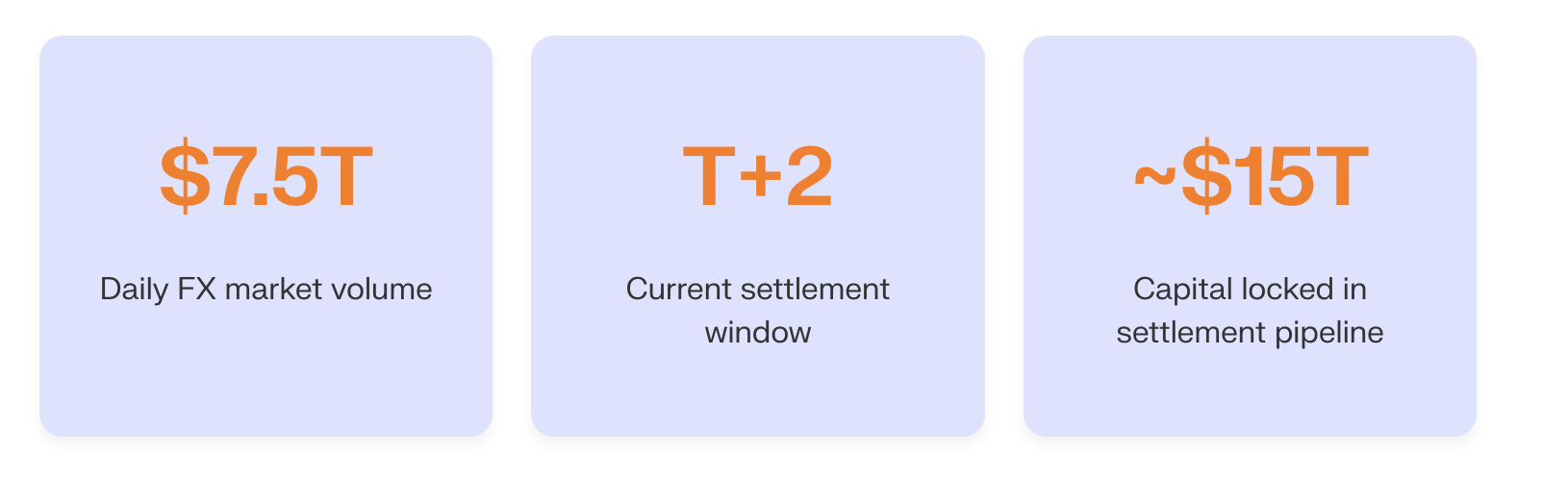
$7.5 trillion moves through the foreign exchange market every single day. It is the largest financial market on the planet. And it still settles on a T+2 basis, a two-business-day window that locks up capital, creates counterparty risk, and costs the industry billions in operational overhead.
Onchain FX with stablecoins eliminates that window entirely. Atomic settlement. Instant finality. Zero gap between trade and delivery.
The T+2 problem
When a bank trades euros for dollars, the agreement happens in milliseconds. The actual exchange of currencies takes two business days. During that window, both parties carry the risk that the other might fail to deliver.
This is not a hypothetical concern. It has a name.
Herstatt risk, named after the German bank that collapsed mid-settlement in 1974, describes the danger of one counterparty delivering its side of an FX trade while the other defaults. Fifty years later, the fundamental structure that created Herstatt risk remains in place.
With $7.5 trillion settling daily on a T+2 cycle, roughly $15 trillion sits in the settlement pipeline at any given moment. That is capital doing nothing. Not earning. Not deployed. Simply waiting for confirmation that both sides of a trade have been honoured.
Atomic PvP: the stablecoin solution
Atomic payment-versus-payment (PvP) settlement is the architectural answer to Herstatt risk. Both legs of a trade execute simultaneously in a single onchain transaction. If one side fails, both fail. There is no window. No gap. No risk.
Smart contracts enforce the conditionality. The dollar leg and the euro leg swap in the same block. Settlement finality is measured in seconds, not days.
Atomic means indivisible. You cannot have half a settlement. Both parties receive their currencies simultaneously, or neither does. This is the fundamental breakthrough that stablecoins bring to FX markets.
The implications for capital efficiency are enormous. If you no longer need to pre-fund two days of settlement risk, that capital is freed for productive use. For institutions managing billions in daily FX flow, the savings are measured in the hundreds of millions annually.
Why the FX market is ripe for disruption
FX is the financial market most obviously mismatched with its infrastructure. Trades execute electronically in microseconds. Settlement relies on correspondent banking networks built in the 1970s.
90% of international trade is invoiced in dollars. That creates enormous demand for USD/local currency pairs. Today, accessing those pairs requires bank accounts, credit lines, and intermediary relationships. Stablecoins make dollar liquidity programmable and accessible to anyone.
The market structure also creates concentrated risk. CLS Bank, the primary FX settlement utility, handles about $6 trillion daily. But not all currencies and not all counterparties have access. Emerging market currencies, where the demand for dollar access is most acute, are often excluded from CLS. Stablecoin FX has no such restrictions.
The spread problem
Traditional FX involves opaque pricing. The spread between buy and sell rates varies by institution, by corridor, and by client. Retail customers face wider spreads than institutional ones. Cross-border payments bundle FX costs into the transfer fee, making it nearly impossible for senders to know how much they are losing on the conversion.
Onchain FX operates with transparent pricing. Automated market makers and onchain order books provide visible liquidity and consistent spreads. The market determines the price. Not the intermediary.
Stablecoins as FX primitives
Today, the most liquid stablecoin pairs are USD-denominated: USDT, USDC, and their variants. But the landscape is expanding. Euro-denominated stablecoins, GBP stablecoins, and emerging market currency stablecoins are entering the market.
As the variety of fiat-referenced stablecoins grows, onchain FX becomes a fully functional market. Any stablecoin pair can trade 24/7 with instant settlement. No banking hours. No cut-off times. No weekend gaps.
This is the infrastructure that powers the trillion-dollar stablecoin payment opportunity. Every cross-border stablecoin payment involves an implicit or explicit FX transaction. The efficiency of onchain FX directly determines the efficiency of the entire stablecoin payments ecosystem.
The institutional adoption curve
Banks and asset managers are not blind to this opportunity. The great tokenisation shift is already pushing traditional institutions to build onchain capabilities. FX is a natural entry point because the pain of T+2 settlement is felt daily.
“We want to be the bridge between digital and traditional financial systems.”
— Kevin de Patoul, Keyrock
Market makers like Keyrock already provide liquidity across both traditional and onchain FX venues. This bridge function is critical during the transition period. Institutions need partners who understand both worlds and can facilitate seamless movement between them.
The volume tells the story. Stablecoins are on track to capture 12% of global cross-border flows by 2030. A meaningful portion of that flow involves FX conversion. The firms providing onchain FX liquidity will sit at the centre of the new payments architecture.
What the $7.5 trillion opportunity looks like
Even capturing a single percentage point of daily FX volume would represent $75 billion in daily onchain FX settlement. That dwarfs the current DeFi ecosystem in scale.
The path there is not speculative. It follows the same trajectory as electronic trading in equities: start with the most liquid pairs, prove the infrastructure, expand to new currencies, attract institutional flow, and eventually become the default.
The FX market moved from open-outcry to electronic in a decade. The move from T+2 to T+0 with stablecoins could be faster. The technology already exists. The DeFi infrastructure powering onchain FX is battle-tested with billions in daily volume.
$7.5 trillion a day. Settling in seconds instead of days. The maths speaks for itself.