

The $400T Future of Tokenised Assets
RWA Perpetuals: 40x Growth to $67B Monthly Volume in Onchain Derivatives
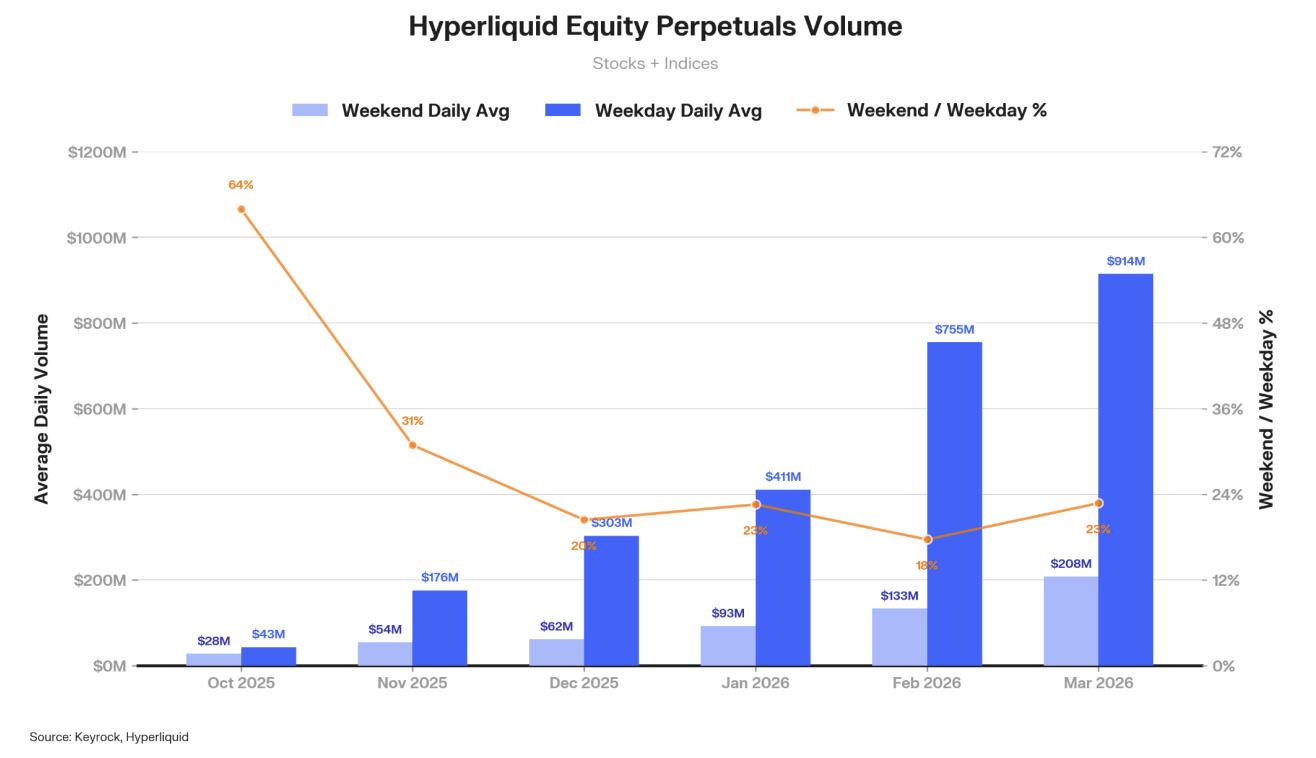
From 0.1% to 10% of all onchain derivatives in six months. RWA perpetuals are the fastest-growing segment in decentralised finance.
The numbers that redefine the narrative
RWA perpetuals grew 40x in six months. Monthly volume reached $67 billion. That is not an incremental expansion. It is a structural shift in what onchain derivatives markets trade.
In October 2025, RWA-linked perpetuals represented 0.1% of all onchain derivatives volume. A rounding error. By early 2026, that figure reached 10%. One hundred times more market share in half a year.
The derivatives layer is moving faster than the spot market. And it is revealing something profound about where onchain demand actually lives.
Why derivatives lead spot
Spot tokenisation requires regulatory clarity, custodial infrastructure, issuance frameworks, and redemption mechanics. Every step involves coordination between traditional finance and blockchain-native systems. It is necessary work. But it moves slowly.
Perpetual contracts sidestep most of that complexity. They are synthetic instruments that track price without requiring custody of the underlying asset. An RWA perpetual on tokenised gold does not need a vault. It needs an oracle and a matching engine.
This is why the derivatives layer consistently leads adoption. Lower barriers. Faster iteration. The same pattern played out with crypto-native assets. Bitcoin perps preceded Bitcoin ETFs by years. RWA perps are following the same playbook.
What traders actually want
First, hedging. Holders of tokenised treasuries or commodities need efficient tools to manage duration and price risk. Onchain perpetuals provide that without leaving the blockchain settlement layer.
Second, leveraged access. Not every participant can access the tokenised spot market directly. Regulatory constraints, capital requirements, and jurisdictional limitations push demand toward synthetic exposure.
Third, arbitrage. Price discrepancies between tokenised spot instruments and their perpetual counterparts create opportunities. This arbitrage activity deepens both markets and tightens spreads.
The 50% thesis by 2028
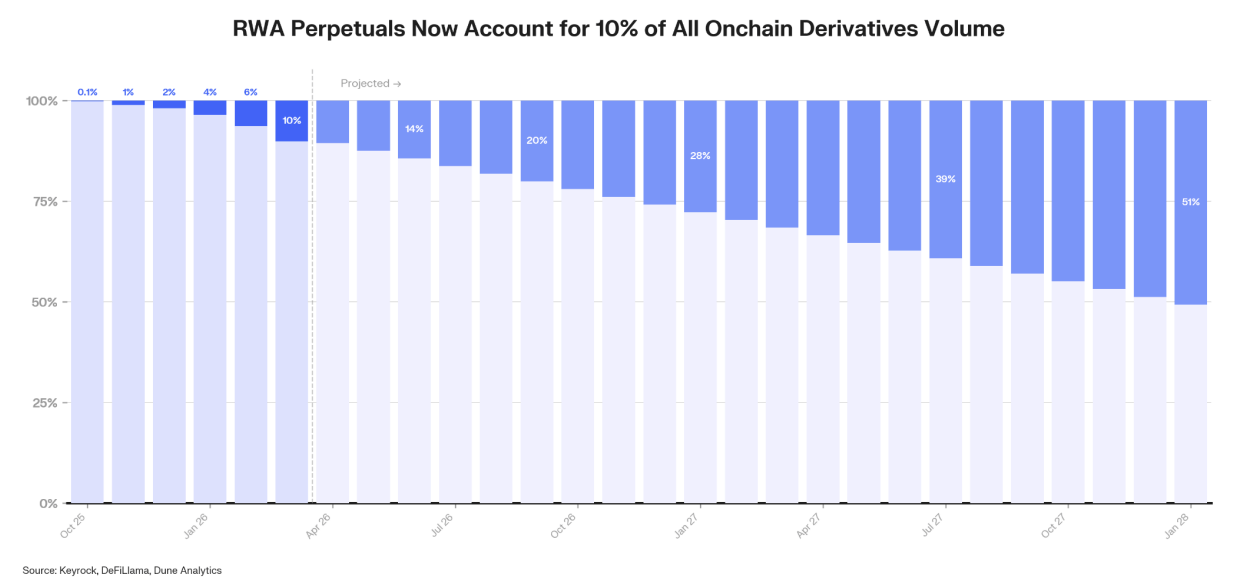
We project RWA perpetuals could reach 50% of onchain derivatives volume by 2028. That projection rests on three pillars.
Asset coverage expansion. Today, RWA perps primarily track treasuries, major equities, and commodities. As tokenisation scales across more asset classes, the universe of tradeable RWA perps grows proportionally. Each new asset class unlocks hedging and speculative demand.
Oracle infrastructure improvement. Reliable price feeds are the backbone of perpetual contracts. The oracle ecosystem is maturing rapidly, with multiple providers delivering institutional-grade data for real-world asset prices. Better oracles mean tighter markets and more confident participation.
Crypto-native asset saturation. The onchain derivatives market has historically been dominated by BTC, ETH, and a handful of altcoins. As that market matures, growth migrates to new asset classes. RWAs are the next frontier.
The connection to spot market development
RWA perpetuals do not replace spot tokenisation. They accelerate it. Active derivatives markets build price discovery infrastructure that spot markets benefit from. They generate trading data that informs liquidity provision strategies for the underlying assets.
The relationship is symbiotic. More spot tokenisation means more assets for derivatives to reference. More derivatives activity means better price discovery for spot markets. The flywheel compounds.
Commodities illustrate this dynamic most clearly. Their 147% monthly AUM turnover in the spot market is partially driven by the derivatives infrastructure that has built around them. Spot and derivatives reinforce each other.
What makes this different from the last cycle
Crypto derivatives have surged before. The difference now is what is being traded. Previous cycles were dominated by leveraged bets on volatile crypto-native assets. The current expansion adds a fundamentally different product category.
RWA perpetuals bring traditional asset class dynamics onchain. Treasury yield curves. Commodity term structures. Equity risk premia. These are the building blocks of global finance. When they trade onchain, the derivatives market matures from a crypto-centric playground into a genuine financial marketplace.
Dean Khan Dhillon of RWA.xyz describes it precisely: “There is a collision of two worldviews.” The derivatives market is where that collision is most visible and most productive.
The prediction market parallel
RWA perpetuals share a structural similarity with onchain prediction markets. Both allow participants to express views on real-world outcomes using blockchain infrastructure. Both grew explosively once product-market fit was established.
Prediction markets proved that onchain participants want exposure to real-world events and prices. RWA perpetuals extend that thesis to financial assets. The demand curve is the same. The instruments are different.
The 40x growth in RWA perps mirrors the trajectory prediction markets followed. Slow start. Product refinement. Then vertical adoption once the experience clicks.
Where this goes
The trajectory from 10% to 50% of onchain derivatives volume is not guaranteed. It depends on oracle reliability, protocol security, and regulatory treatment of synthetic instruments. But the demand signal at $67 billion monthly volume is too large to dismiss.
Builders are already responding. New protocols focused exclusively on RWA derivatives are launching. Existing platforms are adding RWA-linked perpetuals to their product suites. The infrastructure race is underway.
We are watching a new derivatives market emerge in real time. Six months ago, it barely existed. Today, it moves $67 billion a month. The speed tells you everything about the underlying demand.
Frequently asked questions
How fast are RWA perpetuals growing?
RWA perpetuals grew 40x in six months, reaching $67 billion in monthly volume. They represent 10% of all onchain derivatives volume, up from 0.1% in October 2025.
What percentage of onchain derivatives volume is tied to RWAs?
Approximately 10% as of early 2026, up from 0.1% in October 2025. A 100x increase in market share in roughly six months.
Could RWA perpetuals reach 50% of onchain derivatives by 2028?
We project they could, driven by expanding asset coverage, improved oracle infrastructure, and growing demand for hedging exposure to tokenised assets.
What are RWA perpetual contracts?
Perpetual futures that track real-world asset prices onchain. They allow leveraged exposure to assets like treasuries, equities, commodities, and forex without holding the underlying tokenised instrument.