

Prediction Markets: The Next Frontier of Financial Markets
Prediction Markets vs Sportsbooks: Odds, Fees & Structural Differences (2026)
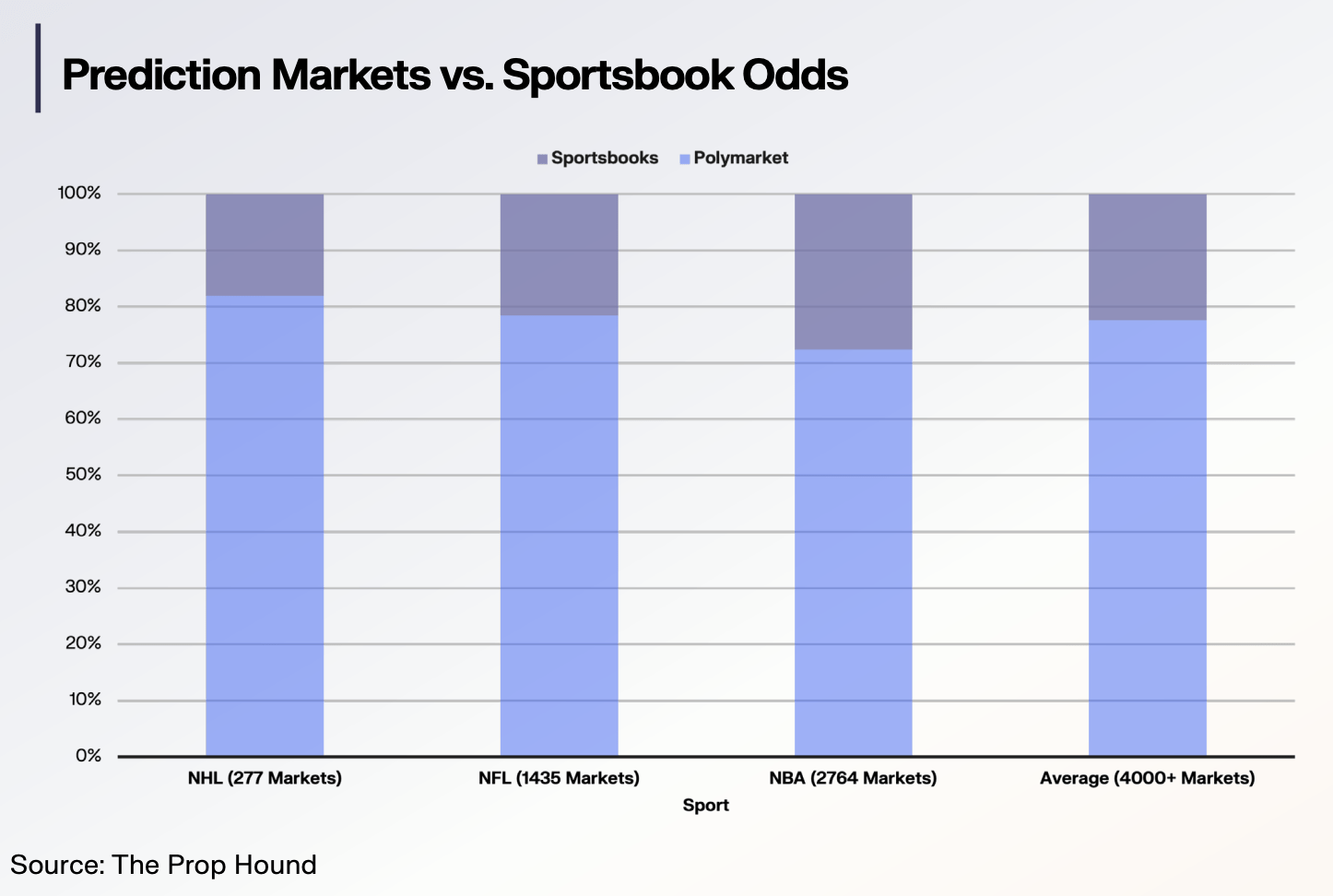
77% better odds. That is what prediction markets deliver over sportsbooks — not on cherry-picked examples, but across more than 5,000 identical markets analysed in the Keyrock-Dune research report. Kalshi. Polymarket. Both consistently outprice traditional books. This is not a marginal edge. It is a structural advantage built into the architecture of how each model works.
The question is not whether prediction markets offer better value. The data settles that. The question is why — and what it means for anyone still paying the vig.
The House Model vs. The Exchange Model
One distinction defines everything: who takes the other side of your trade.
Sportsbooks: You Bet Against the House
On a sportsbook, you are betting against the house. The sportsbook is your counterparty. When you win, they lose. When you lose, they profit. This conflict of interest is not a flaw in the system — it is the system.
To guarantee profitability, sportsbooks embed a margin into every line. The “vig” — vigorish, juice, whatever you call it. On a standard NFL game, implied probabilities from both sides sum to 108–115% rather than 100%. That extra 8–15% is extracted from every bettor on every wager, win or lose.
The sportsbook does not need to predict outcomes correctly. It needs to balance its book and collect the vig. And if you start winning consistently? Your account gets limited or closed. The model is structurally adversarial to its most skilled customers.
Prediction Markets: You Trade Against Other Traders
Prediction markets flip this entirely. They operate as peer-to-peer exchanges. When you buy a Yes contract, another trader sells it to you. The platform takes no position. It matches buyers with sellers and charges a small transaction fee. Polymarket: 0.01% taker fee. Kalshi: variable by contract price, always disclosed.
No conflict of interest. No incentive to shade odds. No reason to limit winning traders. Prices are set by traders competing in an open order book — not by a risk desk protecting the house.
As Travis McGhee of Crypto.com puts it directly: “prediction markets are not wagering or betting.” The structural difference changes the fundamental economics of every trade you make.
Odds Comparison: The Numbers Across 5,000+ Markets
The Keyrock-Dune report delivers the most comprehensive empirical comparison to date. Over 5,000 identical markets. Prediction platforms vs major sportsbooks. The headline — 77% better odds on average — tells one story. The breakdown tells a richer one.
For outcomes with implied probabilities above 30%, prediction markets consistently deliver better pricing. The advantage peaks in the 40–70% range, where sportsbook vig is widest and prediction market spreads are tightest due to higher liquidity.
One caveat. Kalshi can be slightly more expensive for long-shot bets — very low implied probability. Sportsbooks deliberately offer attractive long-shot odds as a loss leader. Recreational bettors chase high-payout wagers. The house expects to win those overwhelmingly.
But for the vast majority of markets — anything above 30% implied probability — the exchange model delivers materially better value. It is not close.
Fee Structure: Transparent vs. Hidden
Both models extract revenue. The difference is whether you can see it happening.
Sportsbooks hide their fees in the odds. A bettor seeing -110 on both sides of a football game does not register that they are paying a 4.5% fee on every bet. The cost is real. It is buried in the gap between true probability and offered probability. Invisible to most. Devastating over thousands of trades.
Prediction markets charge explicit, visible fees. Polymarket’s 0.01% taker fee is stated upfront. Kalshi’s fees vary but are always disclosed before execution. You know exactly what you are paying. No reverse-engineering required.
For sophisticated users, this transparency is non-negotiable. For casual users, the difference compounds over time — whether they notice it or not.
User Composition: Who Trades Where
The user bases tell you everything about what each model optimises for.
Sportsbook Users: Small Stakes, Entertainment-Driven
More than 70% of sportsbook users wager between $0 and $50 per bet. The typical user is entertainment-driven — placing bets to make a game more interesting, not to express a considered probability view. Casual sizing. No price shopping. Repeat engagement driven by the sports calendar.
This composition supports the business model perfectly. A large base of small, recreational bettors generates consistent vig revenue and rarely threatens the house. In iGaming more broadly, 2% of players account for more than half of total earnings. An extreme Pareto distribution that sportsbooks depend on.
Prediction Market Users: Higher Stakes, Information-Driven
On Polymarket, the largest user category by wager size is “More Than $100” at 33%. The complete inverse of the sportsbook distribution. Users are crypto-native, conviction-based, and information-driven. They trade because they believe they have an edge.
This creates a virtuous cycle. More informed traders produce better prices. Better prices attract more sophisticated participants. Deeper liquidity tightens spreads further. The model rewards its best users rather than penalising them.
Liquidity and Market Making: Professional Desks Change Everything
The quality of odds on any exchange depends on its market makers. On sportsbooks, the “market maker” is the house — one risk desk setting all lines, managing all exposures.
On prediction markets, multiple professional desks compete to provide liquidity. The impact is dramatic. When Susquehanna — one of the world’s largest options market-making firms — was onboarded by Kalshi, order book depth increased 30x in the markets where they participated.
30x is not a rounding error. It translates directly into tighter spreads, better execution, and more efficient price discovery. When competing desks fight for flow, the resulting odds more accurately reflect true probabilities. The cost of trading shrinks.
Sportsbooks cannot replicate this. They do not operate as open exchanges. There is no mechanism for competing liquidity providers to tighten the house’s odds. The vig is set by one party. Accepted by bettors. End of story.
Long-Term Dynamics: Margin Compression Is Coming
Here is what the sportsbook industry does not want to hear. If prediction market platforms continue to grow in liquidity and user adoption, they will compress sportsbook margins. The logic is inescapable.
When bettors can easily compare odds — and consistently find better pricing on the exchange — sportsbooks face a binary choice. Lose their most price-sensitive customers. Or compress the vig to compete. Neither outcome is attractive for an industry built on embedded margins.
This dynamic already played out in the UK, where Betfair’s exchange model pushed traditional bookmakers to sharpen pricing over two decades. The prediction market generation — blockchain settlement, global participation, growing media integration — will accelerate this shift in the U.S. and beyond.
Prediction markets will not replace sportsbooks tomorrow. Sportsbooks excel at user experience for casual bettors, comprehensive sports coverage, and distribution through league partnerships. But the exchange model’s structural superiority in pricing will force margin compression over time. Every participant benefits from that pressure.
Why This Distinction Matters
This is not academic. The structural differences between prediction markets and sportsbooks determine who profits and who pays. How information is reflected in prices. Whether a platform’s incentives are aligned with yours — or set against you.
On a sportsbook: the house always has an edge. Odds are shaded. Winning players get limited. The business model depends on a large base of losing recreational bettors.
On a prediction market: the exchange has no position. Prices are set by competition among informed traders. Fees are transparent. The platform benefits from activity regardless of outcomes.
For anyone who seeks better odds, transparent pricing, and a platform that does not penalise you for being right — prediction markets offer a fundamentally superior model. And the data from 5,000+ compared markets makes the case with precision: 77% better odds on average. Measurable. Verifiable. Structural.