

Onchain Asset Management: Designing the Future of Investment Strategies
Onchain vs Traditional Asset Management: Performance, Fees, and Transparency Compared
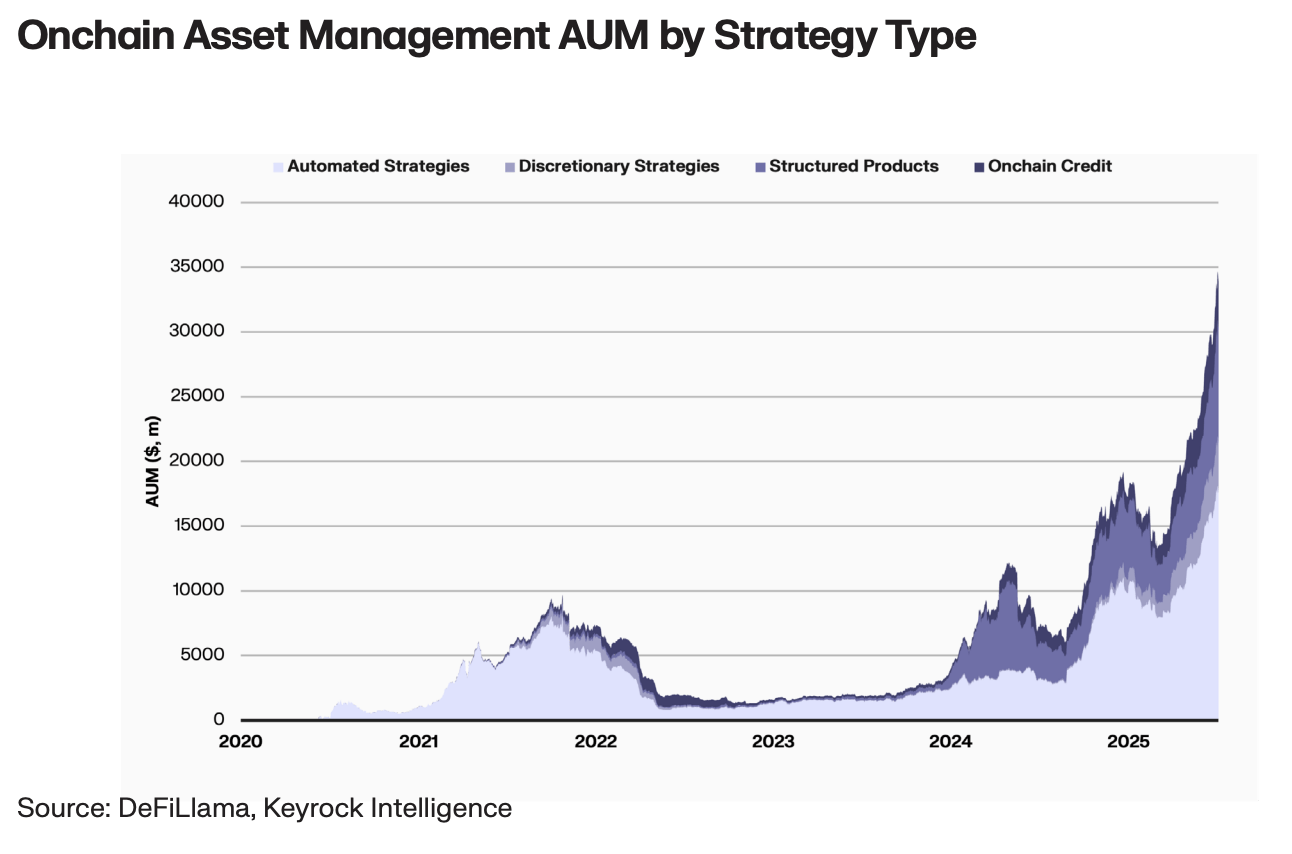
Two systems. Same goal. Radically different architectures. Onchain asset management now holds $35 billion. It grew 118% in a single year. Traditional asset management holds trillions but moves at the pace of fax machines and quarterly board meetings.
The question is no longer whether onchain can compete. It is how long traditional infrastructure can justify its overhead.
Performance: The Numbers Speak
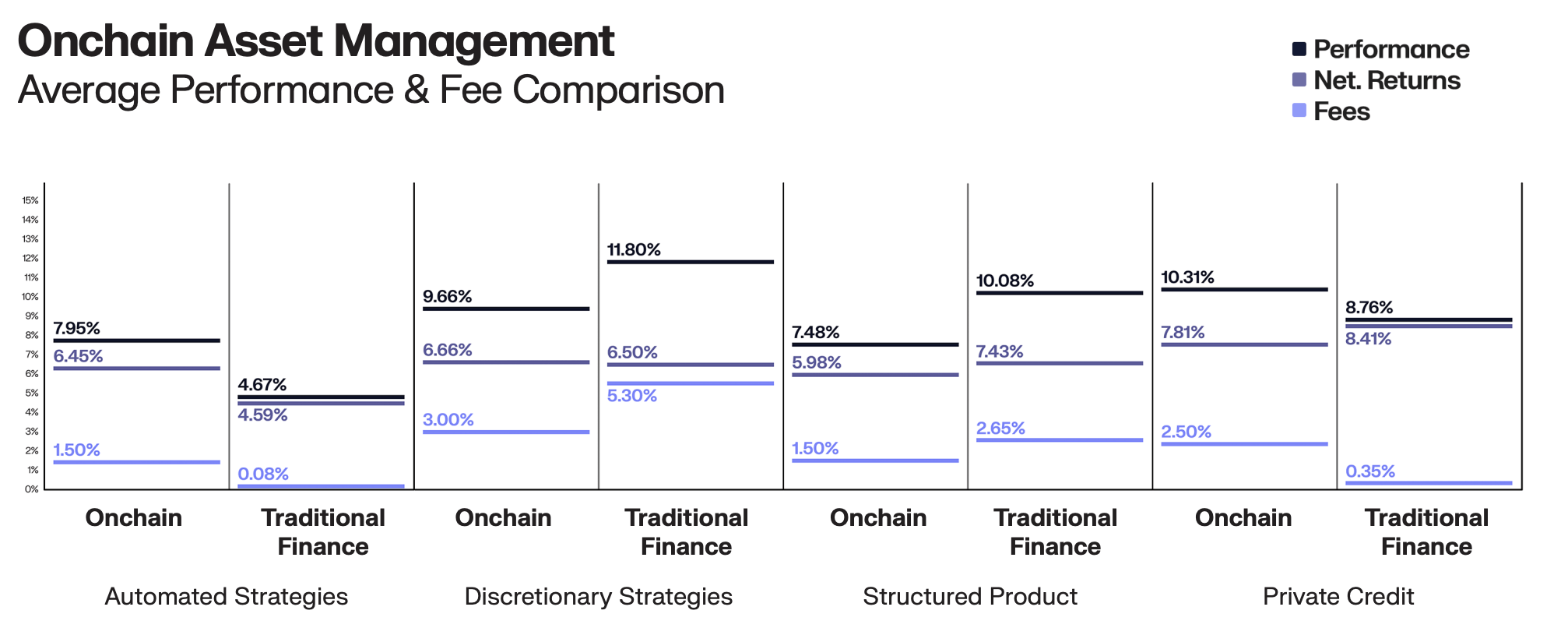
Automated yield vaults — the largest onchain category at $18 billion — outperform comparable traditional products by approximately 186 basis points after fees. That is not a cherry-picked comparison. It is the aggregate, fee-adjusted performance gap between onchain and off-chain yield strategies serving the same risk profile.
Discretionary onchain strategies tell a different story. Teams like Gauntlet and MEV Capital deliver returns net of fees that align with traditional hedge fund performance. Comparable returns. But delivered with full transparency, instant redemption, and no multi-year lock-ups.
The edge is clearest in passive yield strategies. Where code replaces human intermediaries, the savings flow directly to the investor.
Fee Structures: Layer by Layer
Traditional asset management fees stack in layers most investors never fully unpack:
- Management fee — typically 1–2% of AUM annually, charged regardless of performance
- Performance fee — 10–20% of gains above a hurdle rate
- Administrative fee — 0.05–0.25% for fund accounting, compliance, reporting
- Custody fee — 0.02–0.10% for holding assets in segregated accounts
- Transaction costs — brokerage, settlement, and clearing fees on every trade
Total cost: often 2–3% of AUM before the investor sees a single basis point of return.
Onchain fee structures collapse this entire stack:
- Vault fees — typically 0–20% of generated yield (not AUM). No flat management fee.
- Gas costs — transaction fees for onchain execution, often subsidised by the protocol
- No custody fee — self-custody eliminates the charge entirely
- No admin fee — smart contracts handle accounting and reporting automatically
The structural fee advantage is not 10 or 20 basis points. It is often 100+ basis points. Compounded over years, that gap produces dramatically different outcomes for investors.
Transparency: Quarterly Reports vs Real-Time Verification
In traditional finance, you trust. You wait for quarterly statements. You hope the auditor catches discrepancies. You accept that the portfolio’s actual composition between reporting dates is a black box.
Onchain strategies invert this model completely.
Every allocation is onchain. Every trade is timestamped. Every fee is calculated and collected transparently. You do not request information. You verify it yourself, at any moment, with no intermediary’s permission required.
This is not incremental transparency. It is a category shift. The FTX collapse demonstrated what opacity costs. Onchain verification makes that class of failure structurally impossible for non-custodial protocols.
Redemption: Days vs Seconds
Traditional hedge fund redemption typically requires:
- 30–90 day notice periods
- Quarterly or monthly redemption windows
- Gate provisions allowing the manager to restrict withdrawals
- Settlement periods of T+2 to T+5 after the redemption date
Total time from decision to capital-in-hand: 45–120 days. Sometimes longer.
Onchain redemption: one transaction. Seconds to minutes. No notice period. No gates. No settlement delay. Your capital moves when you decide it moves.
For institutional allocators managing liquidity across multiple portfolios, this difference is not a convenience. It is a strategic advantage that changes portfolio construction at the structural level.
Risk: Different, Not Absent
Traditional asset management risks are well-catalogued: market risk, credit risk, operational risk, counterparty risk. Investors have decades of data and regulatory frameworks to price them.
Onchain strategies introduce different risks:
- Smart contract risk — code vulnerabilities that audits reduce but cannot eliminate
- Composability risk — cascading failures across interconnected protocols
- Oracle risk — mispriced data feeds triggering incorrect execution
- Regulatory risk — evolving legal frameworks that could restrict certain activities
The crucial distinction: onchain risks are visible. You can inspect the contracts. You can model the dependency graph. You can monitor in real time. Traditional risks hide behind NDAs, complexity, and information asymmetry.
Visible risk is priceable risk. Hidden risk is where catastrophic losses originate.
Scalability: Who Can Access What
Traditional hedge funds require minimum investments of $250,000 to $5 million. Accredited investor status. Subscription agreements. KYC processes lasting weeks. Geographic restrictions.
Onchain strategies are permissionless by default. Any wallet. Any amount. Any jurisdiction (subject to frontend restrictions, not protocol-level limitations). The same strategy that a whale deploys $10 million into accepts $100 from a first-time user.
This democratisation does not dilute quality. The $35 billion ecosystem is dominated by institutional capital — 70–99% from whales and dolphins. But access is not gatekept. Permission is the default, not the exception.
The Convergence Thesis
The future is not purely onchain or purely traditional. It is convergence.
Tokenised assets bring traditional instruments onchain. Institutional DeFi protocols bring compliance frameworks to permissionless infrastructure. The great tokenisation shift blurs the boundary between these worlds.
What remains constant: the structural advantages of programmable, transparent, composable infrastructure do not diminish as traditional capital migrates onchain. They amplify. Every new asset class that arrives expands the opportunity set for onchain strategies.
By end-2026, the base case forecast projects $64 billion in onchain AUM. Not by replacing traditional finance. By rebuilding its plumbing from first principles.
Who Wins in Each Category
The comparison is not binary. Each system wins in specific contexts:
- Passive yield — onchain wins decisively (186 bps edge, lower fees, instant redemption)
- Active alpha generation — roughly equivalent returns, but onchain offers superior transparency
- Credit strategies — onchain lags slightly after fees but offers faster origination
- Structured products — onchain offers permissionless access and composability; traditional offers regulatory clarity
- Regulatory certainty — traditional wins, for now
The gap narrows on regulatory certainty with each passing quarter. The gap widens on cost and transparency with each new protocol deployment.
Frequently Asked Questions
How does onchain asset management performance compare to traditional?
Automated yield vaults outperform traditional peers by approximately 186 basis points after fees. Discretionary onchain strategies (Gauntlet, MEV Capital) deliver returns net of fees in line with traditional hedge funds but with full transparency and instant redemption. The edge is strongest in passive yield strategies where smart contracts replace human intermediaries.
What fees do onchain strategies charge compared to traditional funds?
Traditional funds typically charge 2–3% of AUM through stacked management, performance, administrative, and custody fees. Onchain vaults charge 0–20% of generated yield only, with no flat management fee, no custody charges, and no administrative overhead. The structural savings often exceed 100 basis points annually.
Can you withdraw from onchain funds instantly?
Yes. Onchain redemption executes in one transaction, taking seconds to minutes. No notice periods, no quarterly windows, no gates. Traditional hedge funds typically require 30–90 day notice with quarterly redemption windows, resulting in 45–120 days from decision to capital in hand.
Is onchain asset management safer than traditional?
The risk profiles differ rather than rank. Onchain strategies carry smart contract, composability, and oracle risks. Traditional strategies carry counterparty, operational, and opacity risks. The key distinction is that onchain risks are fully visible and auditable in real time, making them easier to price and monitor.