

Onchain Asset Management: Designing the Future of Investment Strategies
DeFi Yield Vaults: $18B AUM, 186 bps Outperformance vs TradFi
Automated yield vaults are the largest category in onchain asset management. $18 billion in assets. 186 basis points of outperformance over traditional peers after fees. These are not marginal gains. They represent a structural advantage built into the architecture of programmable finance.
No fund managers deciding which call to make on Monday morning. No quarterly board meetings. Just code that allocates capital to the highest risk-adjusted opportunity, continuously, transparently, and without negotiation.
What Automated Yield Vaults Actually Do
A yield vault accepts deposits and deploys them across lending protocols, liquidity pools, staking contracts, and other yield-generating opportunities. Smart contracts handle the allocation logic. Rebalancing happens automatically as rates shift across the ecosystem.
The process is simple:
- You deposit capital into a vault
- The vault’s strategy contract allocates across multiple yield sources
- As rates change, the contract rebalances to optimise returns
- You withdraw at any time. No lock-ups. No gates.
Protocols like Yearn pioneered this model. Morpho scaled it with modular risk parameters that let vault curators fine-tune exposure. The result: an institutional-grade product accessible to anyone with a wallet.
186 Basis Points: Quantifying the Edge
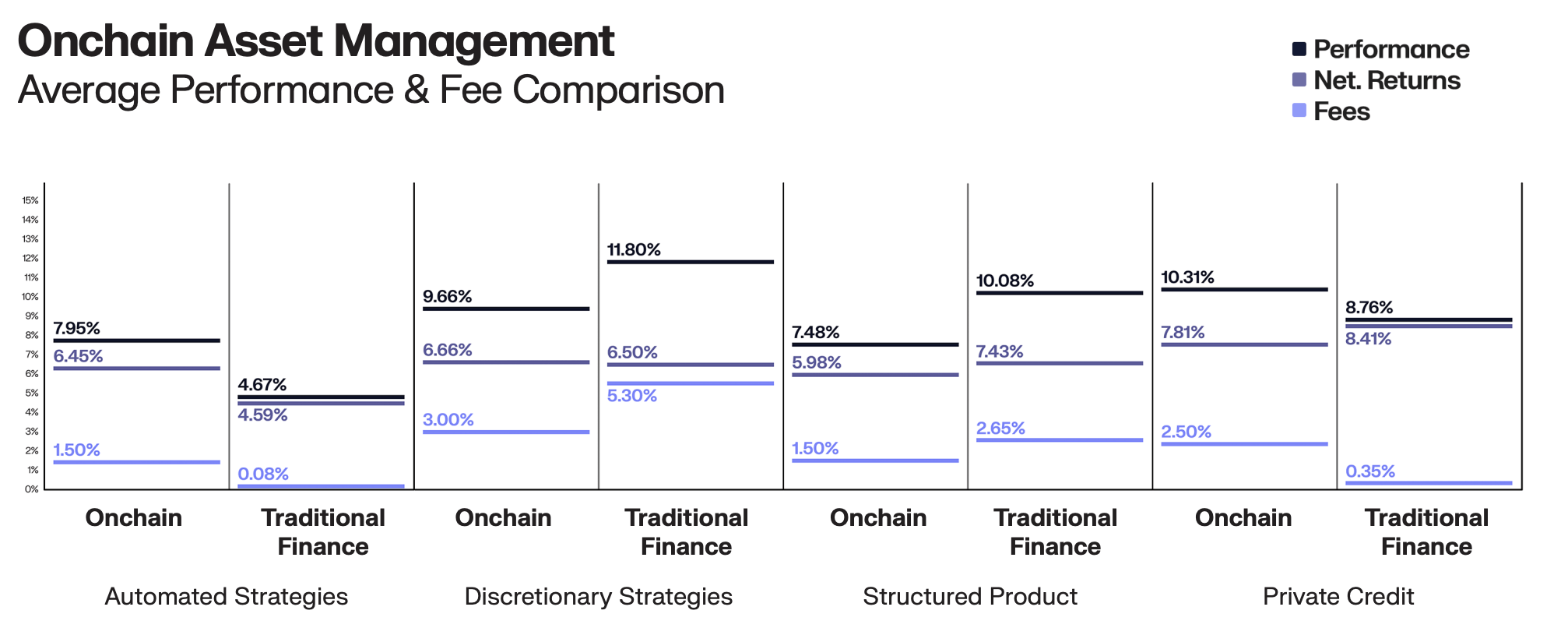
After fees, automated yield vaults outperform their traditional asset management peers by approximately 186 basis points. That figure deserves scrutiny.
Where does the edge come from?
- Lower operational costs — no fund administrators, no custodians, no transfer agents. Smart contracts replace entire layers of financial plumbing.
- Continuous optimisation — traditional managers rebalance periodically. Vaults rebalance whenever gas economics permit. Every hour of suboptimal allocation costs yield.
- Composability — vaults can stack strategies across protocols. A single deposit might simultaneously earn lending yield, liquidity fees, and staking rewards.
- No redemption friction — capital moves instantly. There is no waiting for a quarterly redemption window while your money sits idle.
The comparison is not theoretical. The Keyrock-Maple report benchmarks onchain vaults directly against comparable TradFi products. Same risk profile. Same asset class. Different infrastructure. The infrastructure wins by 186 bps.
Who Supplies the Capital
Large allocators. The data is clear and consistent.
Whales — wallets exceeding $1 million — and dolphins — wallets above $100,000 — account for 70–99% of AUM in automated yield vaults. This is not speculation-driven retail capital cycling through the latest narrative. It is patient, yield-seeking capital that has found a better mousetrap.
Why do sophisticated allocators prefer vaults over traditional yield products?
Transparency. Every allocation is onchain. Every fee is verifiable. Every historical return is auditable without requesting quarterly statements from a fund admin. When you can verify everything in real time, you allocate with more confidence.
The Protocol Landscape: Morpho, Yearn, and Beyond
Morpho has emerged as the dominant infrastructure layer for yield vaults. Its permissionless lending markets let vault curators build strategies with precise risk parameters. No governance votes needed. No committee approvals. Just deploy.
Yearn remains the category pioneer. Its v3 architecture introduced modular strategies that vault creators compose like building blocks. The protocol’s long track record — surviving multiple market cycles — gives institutional allocators the confidence history demands.
Together with peers across the ecosystem, these protocols form a competitive landscape where the best risk-adjusted returns attract capital and underperformers see deposits leave in hours rather than quarters.
That speed of capital reallocation is itself a source of market efficiency traditional finance cannot match.
Risk Profile: What Can Go Wrong
Outperformance does not mean risk-free. Automated yield vaults carry specific risks that allocators must price:
- Smart contract risk — code vulnerabilities can lead to partial or total loss. Audits reduce but do not eliminate this risk.
- Composability risk — when vaults stack strategies across multiple protocols, a failure in one layer can cascade.
- Oracle risk — mispriced feeds can trigger incorrect rebalancing or liquidations.
- Liquidity risk — in extreme market conditions, underlying yield sources may become illiquid, delaying withdrawals.
These risks are real. But they are also transparent. Unlike traditional funds where risk disclosures hide in footnotes, onchain vaults expose their full dependency graph for anyone to inspect. Risk that you can see is risk that you can price.
Performance Comparison: Vaults vs Discretionary Strategies
Within onchain asset management, automated vaults and discretionary strategies serve different purposes.
Automated vaults optimise yield mechanically. They excel at capturing basis-level opportunities across lending and staking markets. Discretionary strategies — run by teams like Gauntlet and MEV Capital — layer human judgement on top of onchain execution. Their returns net of fees align with TradFi hedge fund performance.
The comparison:
- Automated vaults — higher AUM ($18B), lower fees, 186 bps edge over TradFi peers, passive management
- Discretionary — lower AUM, higher fees, TradFi hedge fund-equivalent returns, active management
Most institutional allocators blend both. Vaults for the core yield allocation. Discretionary for alpha. The $35 billion ecosystem supports both approaches.
The Fee Advantage
Traditional yield products carry layers of fees. Management fees. Performance fees. Administrative fees. Custody fees. Each basis point extracted from the investor reduces compounding potential.
Onchain vaults compress the entire fee stack into a single, transparent smart contract parameter. Most charge between 0–20% of generated yield. No management fee on assets. No hidden administrative costs. No custody charges.
When you compound at a lower fee drag over years, the difference becomes substantial. 186 basis points of annual outperformance, compounded over a decade, represents a meaningful divergence in terminal wealth.
This is not speculation. It is arithmetic.
Integration with Broader DeFi
Yield vaults do not exist in isolation. They are composable building blocks within the broader DeFi ecosystem.
Vault shares can serve as collateral in lending markets. They can be tokenised and traded on secondary markets. They can be split into principal and yield components via protocols like Pendle. Each integration multiplies the utility of deposited capital.
This composability creates a flywheel. More integrations attract more capital. More capital creates deeper markets. Deeper markets enable new integrations. The tokenisation shift accelerates this cycle by bringing traditional assets onchain where they can plug into the same infrastructure.
What Comes Next
The base case forecast projects $64 billion in total onchain AUM by end-2026. If automated vaults maintain their current share, that implies roughly $33 billion in vault AUM within 18 months.
The catalysts are clear: institutional onboarding infrastructure, regulatory clarity, and continued protocol maturation. Each one removes friction for the next wave of capital.
We are still early in the compounding curve.
Frequently Asked Questions
How do DeFi yield vaults outperform traditional asset managers?
Automated yield vaults beat traditional peers by approximately 186 basis points after fees. The edge comes from lower operational costs (smart contracts replace fund administrators and custodians), continuous rebalancing, composable strategies that stack yield sources, and the elimination of redemption friction that costs traditional funds time and money.
Are DeFi yield vaults safe for institutional capital?
Automated vaults carry smart contract risk, composability risk, oracle risk, and liquidity risk. However, all risks are transparent and verifiable onchain. Institutional allocators — whales and dolphins — supply 70–99% of vault AUM, indicating that sophisticated capital has priced these risks and found them acceptable relative to the return premium.
How much is invested in DeFi yield vaults?
As of 2025, automated yield vaults hold approximately $18 billion in AUM, making them the largest category within the $35 billion onchain asset management ecosystem. This represents the dominant share of all onchain managed assets.
What protocols power DeFi yield vaults?
Morpho leads with its modular, permissionless lending infrastructure that enables customised vault strategies. Yearn pioneered the category with its v3 modular architecture. Together with other protocols in the ecosystem, they serve as the infrastructure layer for the $18 billion vault market.