

Prediction Markets: The Next Frontier of Financial Markets
How DeFi Composability Is Unlocking Prediction Market Growth (2026)
$177M in cumulative volume. Generated not by Polymarket’s own team — but by third-party builders who plugged into its infrastructure. Meanwhile, 6,500+ users already trade Kalshi contracts via Jupiter on Solana. This is what composability does. It transforms prediction markets from isolated trading venues into building blocks of a broader financial ecosystem.
The Keyrock and Dune research report calls it “information as an onchain financial primitive.” We call it the structural unlock that changes how prediction markets scale.
What DeFi Composability Means for Prediction Markets
In traditional finance, a prediction market position is static. You buy a contract. Wait for resolution. Collect or lose your payout. No capital efficiency beyond the position itself.
DeFi composability changes this fundamentally. Because prediction market outcomes are tokenised — typically as ERC-1155 tokens on Ethereum or equivalent standards on other chains — they slot directly into existing DeFi infrastructure. Three categories of activity that were previously impossible become standard:
- Borrowing against positions: A trader holding a contract at $0.90 (90% implied probability) sits on an asset with near-certain value. In a composable DeFi environment, that position serves as collateral for a loan. Liquidity unlocked without closing the trade. Capital efficiency that traditional prediction markets cannot offer.
- Staking for rewards: Prediction market positions can be staked within DeFi protocols to earn additional yield. Compound returns on event-driven views. This transforms prediction markets from pure information-trading venues into yield-generating asset classes.
- Structured exposures: Traders combine multiple positions into structured products — onchain “parlay” positions where multiple event outcomes are bundled. Richer risk/reward profiles. Strategies that single-contract platforms cannot support.
The underlying insight: tokenisation makes information fungible. A prediction market position is not just a view on an event. It is a transferable, collateralisable, composable financial asset participating in the same ecosystem as stablecoins, lending protocols, and decentralised exchanges.
Wallet Integration: The Distribution Breakthrough
The most significant distribution development: prediction trading embedded directly into cryptocurrency wallets. Meeting users where they already are rather than asking them to navigate elsewhere.
MetaMask: The Wallet Becomes a Prediction Terminal
MetaMask — tens of millions of users, the most widely used Ethereum wallet — launched in-wallet Polymarket trading. Browse, trade, manage prediction market positions without leaving the MetaMask interface. The wallet transforms from a passive asset-holding tool into an active prediction terminal.
The significance goes beyond convenience. MetaMask’s distribution reach is orders of magnitude larger than any prediction market platform’s standalone user base. By embedding prediction trading into the wallet experience, MetaMask channels its existing users into prediction markets — a distribution shortcut that accelerates adoption faster than any standalone app launch or marketing campaign.
Trust Wallet and Mobile Access
Trust Wallet took a similar approach, embedding Myriad Markets for mobile users. Mobile integration matters because prediction market trading is inherently event-driven — you want to trade when news breaks, and news breaks on phones. A mobile-native experience embedded in a wallet users already check daily creates ambient access that drives habitual engagement.
Kalshi on Solana: Regulated Predictions Meet Permissionless Infrastructure
In December 2025, Kalshi tokenised its predictions on Solana. A bridge between regulated prediction market infrastructure and permissionless blockchain distribution. Through integrations with DFlow and Jupiter (Solana’s leading aggregator), Kalshi’s contracts became accessible to any Solana user.
The early numbers validate it: over 6,500 users trading Kalshi contracts via Jupiter. Accessing regulated prediction markets through the same interface they use for token swaps and DeFi activity. For Kalshi, this bypasses the traditional user acquisition funnel entirely — contracts appear alongside other Solana assets within tools traders already use.
Kalshi also launched KalshiEco Hub, linking to the Solana and Base ecosystems for third-party development. The strategy: leverage DeFi composability without abandoning regulatory compliance. Regulated contract creation and settlement. Permissionless distribution and integration. A hybrid model that serves both worlds.
Polymarket's Builders Programme: The Ecosystem Approach
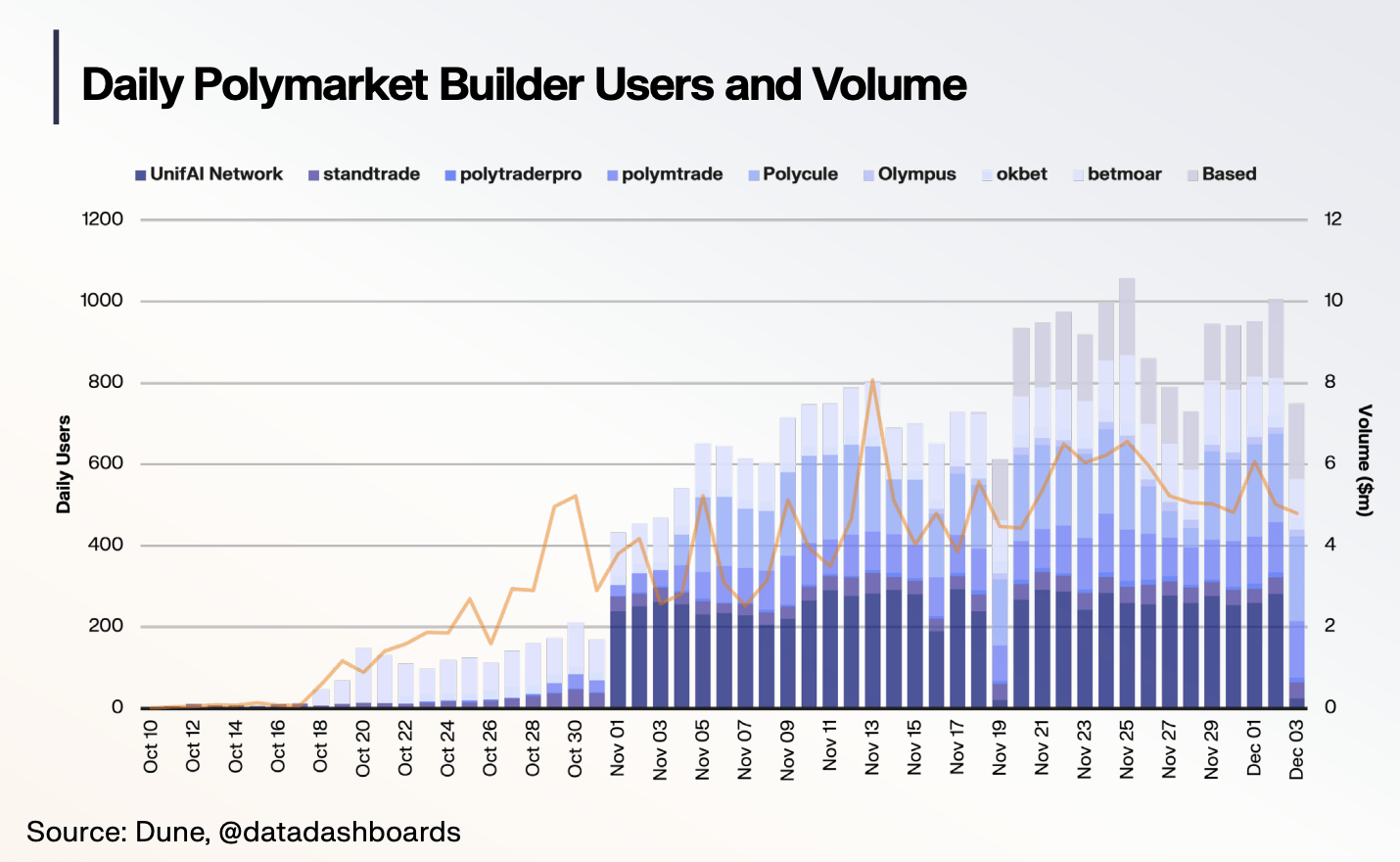
Polymarket has taken the most aggressive approach to composability through its Builders Programme — an ecosystem of third-party applications extending its reach into distribution channels the core platform cannot serve directly.
The numbers are remarkable.
Builder Ecosystem by the Numbers
- betmoar: $121M cumulative volume, operating through Discord. Proof that prediction market distribution can happen entirely within chat platforms where communities already discuss the events they want to trade.
- standtrade: $19M in volume through whale-tracking copy-trading. Identifies high-performing traders and allows others to replicate their positions automatically — importing copy-trading from traditional crypto exchanges into prediction markets.
- polytraderpro: $14M in volume through an AI-guided web terminal. Surfaces trading opportunities, analyses mispricings, guides users through strategies. Different distribution targeting sophisticated traders seeking edge.
- Polycule: $12M in volume through a Telegram bot, 200 daily active users. Zero app downloads required. Integrates directly into existing messaging workflows.
- okbet: $6M in volume through a casual, social interface. Targets users who may not consider themselves “traders” but enjoy expressing views on events with friends.
- Based: $5M in volume, 140-190 daily active users. As Edison, CEO of Based, noted — these bottom-up signals from builder applications reveal demand patterns that top-down platform analytics cannot capture.
Collectively: over $177M in cumulative volume from interfaces Polymarket’s own team did not build or operate. This is composability as distribution strategy. By making infrastructure open and integrable, Polymarket outsourced market expansion to dozens of independent builders — each targeting different user segments and channels.
Why Composability Matters More Than Features
The traditional approach to growing a prediction market platform is feature-driven. Better interface. More markets. Improved speed. Lower fees. These operate within a linear growth model — each feature attracts incremental users, but the platform remains a single point of access.
Composability enables exponential growth. It allows prediction markets to be distributed through every touchpoint in the onchain ecosystem.
When a wallet integrates prediction trading, its entire user base becomes potential participants. When a Telegram bot offers copy-trading, every crypto community becomes a distribution channel. When contracts are tokenised on Solana, every DEX, aggregator, and portfolio tracker becomes a potential interface.
As Lee Poettcker of UMA observed, distribution is the biggest opportunity in prediction markets. The technology for creating and resolving markets is largely solved. The challenge is getting them in front of the hundreds of millions of people who would use them if access were frictionless. Composability solves this by making prediction markets a feature that can be embedded anywhere — not a destination users must deliberately seek out.
The Onchain Financial Primitive Thesis
The deeper implication: prediction markets transform information into a financial primitive.
In traditional markets, information flows through news outlets, research reports, social media, expert commentary. These produce narratives. Not prices. Prediction markets produce prices — precise, continuously updated, financially-backed probability estimates for specific outcomes.
When those prices are tokenised onchain, they become composable building blocks any application can reference. A DeFi lending protocol uses prediction market prices as oracle inputs for risk assessment. A portfolio management tool incorporates positions alongside traditional crypto assets. An insurance protocol references event contract prices to calibrate premiums.
This is “information as an onchain financial primitive” in practice. Prediction market outputs become inputs for the rest of the financial system. Better information produces better pricing across the entire ecosystem. The value of a prediction market extends far beyond the traders within it — to every application and protocol that consumes its price feeds.
What Comes Next: The Builder Economy
The trajectory points toward an increasingly builder-driven ecosystem. Several trends are already visible:
- AI-powered interfaces: Applications like polytraderpro suggest a future where AI agents analyse markets, identify mispricings, and execute trades on behalf of users. Lower knowledge barriers. Wider participation.
- Cross-chain expansion: Kalshi’s Solana integration and KalshiEco Hub linking to Base indicate composability will span multiple blockchains. Interoperable markets accessible from any ecosystem.
- Social trading as default: betmoar on Discord and Polycule on Telegram demonstrate that social channels may drive more volume than dedicated trading interfaces. Prediction markets are inherently social — people trade on the same events they discuss. Composability lets trading happen where discussion already is.
- Institutional DeFi integration: As regulated platforms tokenise contracts, institutional participants gain access within DeFi frameworks that comply with their regulatory requirements. Bridging institutional demand and the infrastructure that enables capital efficiency.
The builder economy for prediction markets is still early. $177M+ in volume from Polymarket’s ecosystem and 6,500+ users on Kalshi via Jupiter are initial proof points, not mature markets. But the trajectory is unmistakable. Composability turns prediction markets from standalone platforms into embedded features of the broader onchain economy. The builders who connect these markets to users will capture significant value in the process.
Frequently Asked Questions
What is DeFi composability for prediction markets?
DeFi composability means that tokenised prediction market positions (typically ERC-1155 tokens) integrate directly with existing DeFi infrastructure. Users can borrow against positions, stake holdings for rewards, or combine multiple wagers into structured onchain exposures. Information becomes an “onchain financial primitive” — a building block that other protocols and applications can integrate without permission.
Can I use prediction market positions as DeFi collateral?
Yes. Because tokenised prediction market positions are standard onchain assets, they can serve as collateral in DeFi lending protocols. A position trading near certainty (e.g., $0.90+) represents an asset with predictable value, making it suitable collateral. This unlocks capital efficiency that traditional, non-tokenised prediction markets cannot offer.
How does Kalshi work on Solana?
Kalshi tokenised its predictions on Solana in December 2025, enabling permissionless access through integrations with DFlow and Jupiter. Over 6,500 users have traded Kalshi contracts via Jupiter. Kalshi also launched KalshiEco Hub, linking to Solana and Base ecosystems for third-party development. This hybrid model combines regulated contract creation with permissionless blockchain distribution.