

Store of Value to Digital Oil: How Ussage Differs Between BTC to ETH
Crypto Exchange Balance Decline: Why BTC and ETH Are Leaving Exchanges (2026)
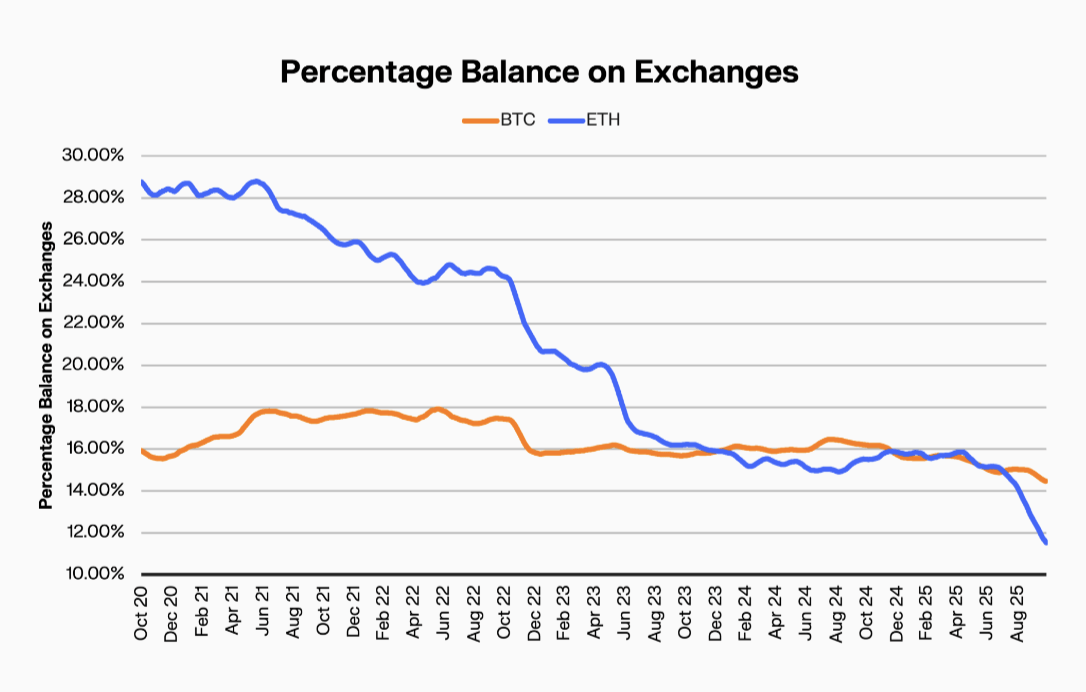
ETH exchange share has collapsed from 29% to 11.3%. BTC exchange balances have declined 1.5%, with exchange share now at 14.3%. Two different speeds. Same direction. And neither is reversing.
The era of exchanges as the default holding layer for crypto is ending. What replaces it reshapes how we think about liquidity, price discovery, and the entire market structure of digital assets.
The Numbers: BTC vs ETH Exchange Exodus
Start with the raw figures.
BTC exchange balance has declined by 1.5%. The current exchange share sits at 14.3%. The movement is steady, persistent, and has been running since 2020. Every quarter, a little more bitcoin migrates from exchange hot wallets into custody structures designed for the long term.
ETH’s decline is in a different category. An 18% drop in exchange balances. Exchange share has cratered from 29% to 11.3%. In percentage terms, that is one of the most dramatic structural shifts in crypto history.
The direction is identical. The magnitude is worlds apart.
Where Is the Supply Going?
Crypto leaving exchanges does not vanish. It migrates. The destinations differ by asset, and those differences reveal everything about the evolving role of BTC and ETH in the broader financial system.
BTC: Cold Storage and ETFs
Bitcoin leaving exchanges flows primarily into three destinations: self-custody cold storage, ETF wrappers, and institutional custody platforms. BTC ETFs now hold 6.7% of total supply. Strategy securitises bitcoin for traditional financial markets, pulling further supply off exchanges. JPMorgan’s “debasement trade” thesis, grouping bitcoin alongside gold, reinforces the institutional rationale for long-term custody.
The bitcoin exodus is a dormancy play. Supply moves from liquid, tradeable exchange positions into structures that prioritise security and duration. Bitcoin’s store-of-value identity drives the pattern. Holders want ownership, not convenience.
ETH: Staking, DeFi, and Productive Structures
ETH’s exchange exodus is more complex. One in four tokens are locked in staking contracts or ETFs. ETH ETFs hold 5.24% of supply. But the real story is DeFi.
A full 16% of ETH supply is deployed in DeFi, liquid staking, and collateralised structures. This is supply that has left exchanges not to sit idle but to work. It earns yield. It provides liquidity. It backs loans and synthetic assets.
ETH’s exchange decline is driven by demand from the onchain economy. Every new lending protocol, every liquid staking derivative, every restaking layer creates incremental demand for ETH outside exchange custody.
What This Means for Liquidity and Price Discovery
Exchange balances serve as the liquid supply pool for spot markets. When that pool shrinks, the dynamics shift.
Less supply on exchanges means tighter order books. Price impact per unit of buying or selling pressure increases. Volatility can amplify in both directions. For bitcoin at 14.3% exchange share, the liquid supply is still substantial but declining. For ETH at 11.3%, the thinning is already acute.
Consider what happens during a demand shock. If institutional buyers enter the market and only 11.3% of ETH sits on exchanges, the supply available to absorb that demand is constrained. The same dynamic played out with bitcoin during the post-ETF approval period, when exchange reserves dropped as ETF inflows surged.
Thinner exchange balances do not automatically mean higher prices. But they do mean that when directional pressure arrives, the market moves further and faster than it would with deeper reserves.
The Institutional Custody Revolution
This decline is not retail-driven. The biggest force pulling supply off exchanges is institutional custody infrastructure that did not exist five years ago.
BTC ETFs represent the clearest example. From zero to 6.7% of bitcoin supply in regulated ETF custody within two years. Each ETF inflow removes coins from the exchange-accessible float and deposits them with custodians like Coinbase Prime and BitGo.
ETH ETFs at 5.24% follow the same pattern but compound it with staking. A staked ETH in ETF custody is doubly locked. It cannot be traded and it cannot be unstaked quickly. The withdrawal queue mechanism adds a time constraint that exchange-held ETH does not face.
DATs add another layer. BTC DATs hold 3.6% of supply. ETH DATs hold 4.9%. These are addresses associated with institutional-grade custody solutions outside ETF wrappers. Combined with ETF holdings, over 10% of each asset’s supply now resides in institutional custody.
The Exchange Model Under Pressure
If the trend continues, exchanges face a structural challenge. Their revenue model depends on trading volume, which depends on supply being available to trade. As more supply migrates to staking, DeFi, and institutional custody, the pool of tradeable assets shrinks.
Some exchanges are adapting. Staking-as-a-service products keep ETH on-platform while meeting holder demand for yield. Institutional prime brokerage services aim to capture the custody layer rather than just the trading layer. OTC desks serve large buyers who operate outside the order book.
But the fundamental shift is clear. Exchanges are transitioning from being the primary custody layer to being one option among many. Self-custody, institutional custody, DeFi protocols, and ETF wrappers all compete for the same supply.
Cross-Asset Context
The behavioural differences between BTC and ETH explain why their exchange declines look so different.
BTC at 0.61% daily turnover is a slow-moving asset. Its exchange decline is correspondingly gradual. Holders buy, withdraw to cold storage, and wait. The 1.5% decline reflects patience, not urgency.
ETH at 1.34% daily turnover moves faster. Its exchange decline is steeper because the destinations are more compelling. You do not just hold ETH off-exchange. You stake it, lend it, provide liquidity with it, and use it as collateral. The onchain economy offers returns that exchange custody cannot match.
This difference has implications for market microstructure. BTC’s exchange balance will likely decline slowly for years, creating a gradual tightening. ETH’s balance could compress rapidly if DeFi demand accelerates, creating sudden liquidity shifts.
What Comes Next
The exchange balance decline is not a temporary cycle. It is a one-way structural migration driven by superior custody options, regulatory infrastructure, and the growth of onchain finance.
For BTC, the trajectory points toward single-digit exchange share within a few years as ETF inflows continue and self-custody culture deepens.
For ETH, the exchange share could compress further as staking participation grows and DeFi protocols absorb more collateral. The dual nature of ETH means every new onchain application creates another reason to hold it off-exchange.
The question is no longer whether exchange balances will decline. It is how thin they can get before market structure adapts.
Frequently Asked Questions
Why are crypto exchange balances declining?
Supply is migrating to superior custody alternatives: ETFs (BTC ETFs hold 6.7% of supply, ETH ETFs hold 5.24%), self-custody, staking contracts (one in four ETH locked), and DeFi protocols (16% of ETH supply deployed). Institutional infrastructure that did not exist five years ago now offers better security and, in ETH’s case, yield. Exchanges no longer serve as the default holding layer.
How much bitcoin is still on exchanges?
BTC exchange share sits at 14.3%, down 1.5%. The decline has been steady since 2020, driven by self-custody, ETF inflows (6.7% of supply), and institutional custody. The trajectory points toward continued decline as regulatory infrastructure matures and ETF adoption expands.
Why has ETH left exchanges faster than BTC?
ETH exchange share collapsed from 29% to 11.3%, an 18% decline versus BTC’s 1.5%. Three factors drive the gap: staking absorbs ETH for yield, DeFi protocols demand ETH as collateral, and the onchain economy offers productive returns that exchange custody cannot match. BTC primarily moves to cold storage, a slower migration pattern.
Does declining exchange supply affect crypto prices?
Lower exchange balances tighten the available supply for spot trading. This can amplify price movements in both directions during demand or selling shocks. With ETH exchange share at 11.3%, the liquid supply available to absorb buying pressure is significantly constrained. The effect is structural, not speculative.