

Defining Automated Onchain Yield Strategies
While there are a variety of automated strategies onchain, they generally fall into three camps; those centered around DEXes with liquidity provision to capture trading fees, those that deposit into money markets with lending and borrowing strategies, and those that deposit into staking protocols to center strategies around staking yield. Of course, we also often see strategies that leverage a mixture of the many flavours of onchain yield on offer. There is one distinctive feature that defines automated onchain yield strategies, and that’s that these are generally integrators rather than originations, i.e. these protocols plug into existing infrastructure that others provide in order to offer a DeFi lego of yield optimisation.
History and Evolution of Automated Onchain Yield Strategies
Automated onchain yield strategies emerged during the 2020 ‘DeFi Summer’ when protocols like Yearn Finance pioneered automated yield aggregation across lending markets and liquidity pools. Instead of users manually moving capital between Aave, Compound, or Uniswap to chase the highest rates, Yearn vaults encoded these strategies into smart contracts, reallocating funds programmatically. This marked the first time that fund-like structures operated natively onchain, accessible to anyone with a wallet, no intermediaries required. Beefy and others quickly followed, extending the model across multiple chains and ecosystems, building an early template for passive yield products.
The model matured as infrastructure deepened, with vaults growing to become composable building blocks, integrated directly into lending protocols, DEXs, and later real-world asset pools. Passive strategies went from opportunistic farming to more predictable allocations into stablecoin lending, liquid staking derivatives, and even tokenised treasuries. We then saw a wave of ‘DeFi 2.0’ protocols that built on the predecessors innovations, with aggregation layers like Morpho and Sommelier pushing the design further, optimising routing between protocols to maximise net yield and reduce risk through adaptive vault structures. Today, automated onchain yield strategies represent one of the most established pillars of onchain asset management with its transparent, programmatic, and increasingly institutionalised nature.
This article is a part of a series on Onchain Asset Management.
Shifting Dominance; The AUM Growth of Automated Onchain Yield Strategies
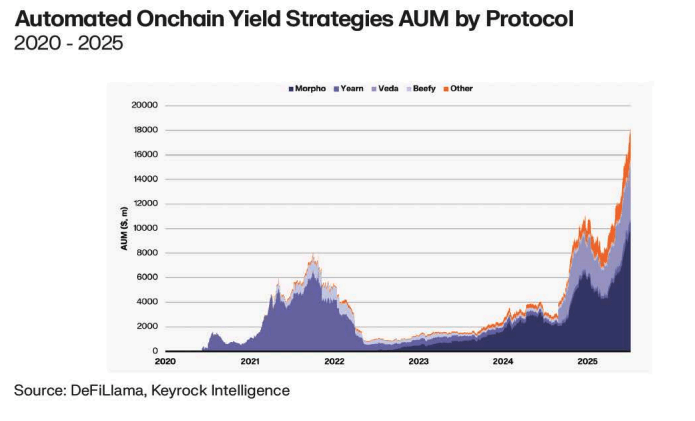
The primary driver of growth in this strategy has been Morpho, a protocol that’s emerged as a clear leader with ~$9.6 billion in AUM. Yearn remains a significant contributor at around $4.5 billion, leveraging its track record, while a long tail of protocols like Beefy and Veda capture niche segments.
Comparing Onchain Yield Strategies to Traditional Finance Counterparts
Throughout this report, we will make comparisons between onchain strategies and traditional finance offerings. What’s important to note here is that the nature of the rails on which these products are built means we aren’t able to make direct comparisons. At no point are we comparing apples to apples, though in drawing similarities between select strategies, we’re able to better frame the advantages and drawbacks of onchain asset management strategies to existing traditional offerings. Specifically, this will allow us to evaluate risk, returns, liquidity and fees in a familiar, but not identical, frame.
In doing so, we choose comparators based on each strategy’s:
- Economic Function: What the strategy is designed to achieve from an economic perspective.
- Risk Profile: The market(s) in which the strategy operates, the duration of the strategy, and any credit or leverage considerations.
- Cash-Flow Mechanics: How yield is generated and paid to the investors.
- Liquidity: The capacity of strategies, and any lock-up considerations associated.
Where an onchain strategy is novel, as is the case with the majority of the strategies we assess, we explicitly note the gaps by pairing the strategy with a primary comparator, the best fit for purpose equivalent, and a secondary comparator, to bracket the differences in risk or structure.
The intent here is clarity, as opposed to direct equivalence. Onchain strategies inherently carry properties, such as programmability, composability, and real-time transparency, that do not exist in most traditional finance wrappers. Conversely, traditional vehicles offer far greater liquidity, scale, and regulatory oversight.
To ground this strategy sub-sector, we note again that automated onchain yield strategies are the foundational layer of onchain asset management, designed to generate steady, low-risk returns. Their primary goals are to preserve capital, offer near-instant liquidity, and generate modest but reliable yield.
Onchain vaults typically generate yield from lending stablecoins into money markets, staking liquid assets like stETH, or strategies derived from these, such as leveraged looping, with rewards compounding programmatically. In contrast, their traditional finance equivalents, that we explore below, derive yield from instruments like Treasury bills, commercial paper, and repurchase agreements.
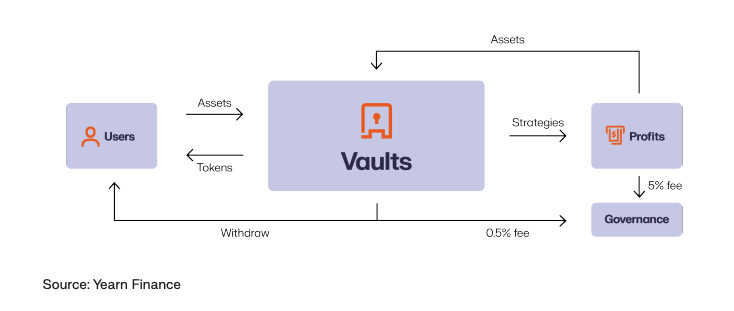
To select the fairest comparators, we considered a range of short-term yield products in traditional finance, including Cash & Short-Duration Fixed Income funds (SDFIs), Money Market Funds (MMFs) and ultra-short duration bond ETFs (USDBs). Each of the strategies mentioned share some overlap in mandate and cash-flow mechanics, but they differ in risk profile and yield potential compared to onchain vaults.
| Potential Comparator | Comparative Relevance | Comparative Shortcomings | Overall Suitability |
| Cash & Short-Duration Fixed Income Funds (SDFIs) | Seeks low-risk yield from short-term lending and high-grade bonds, similar to stablecoin lending. | Traditional assets, not programmable. | Primary comparator |
| Money Market Funds (MMFs) | Daily liquidity, capital preservation mandate. | Traditional assets, settlement dynamics, e.g. T+2 versus instant onchain. | Secondary comparator |
| Ultra-Short Duration Bond ETFs (USDBs) | Balances liquidity with modest yield in a transparent structure. | Traditional assets, settlement dynamics, lack of composability. | Reasonable comparator |
Arguably, the closest traditional finance equivalent strategy to automated yield strategies is SDFIs. Fundamentally, the purpose of both strategies is the same, and that’s to deliver low-risk yield on idle capital, thus making this the best benchmark. Automated onchain vaults achieve this goal by deploying capital to stablecoins in lending markets, liquid staking, or short-duration onchain credit. Fixed income funds do so through government Treasuries, short-term corporate debt instruments such as commercial paper, or secured financing transactions like repurchase agreements.
Both products serve as a base layer for portfolios, designed for capital preservation while generating steady income. Perhaps the strongest parallels though, are on risk profile and cash-flow, with both strategies being low duration, low credit risk and allowing for frequent reinvestment. Liquidity is also similar across the strategies, with both offering rapid, relative to their structural limits, redemptions, with SDFIs offering T+1, relative to monthly or quarterly for other strategies. Of course, there are distinct differences, particularly when it comes to risk, with onchain offering additional risks such as smart contract risk and de-peg risk on derivative assets.
As a secondary comparator, money market funds are a close equivalent, in which again, we see ultra-low risk and daily liquidity. Throughout this report we opt to use SDFIs in combination with MMFs as an equivalent to onchain automated strategies. This is because MMFs introduce the lower end of the risk spectrum, which automated vaults can resemble in function. Of course MMFs are not a perfect comparison, with the key caveat here being risk. MMFs are tightly regulated and nearly risk-free, while onchain vaults carry smart contract, asset and custody risks.
The combination of SDFIs and MMFs will be compared with automated onchain strategies by leveraging weighted averages for fee and performance comparisons, in conjunction with qualitative assessment.
Benefits and Drawbacks of Automated Onchain Yield Strategies
Onchain execution of automated strategies offers a series of unique advantages that differentiate them from their traditional finance counterparts. The obvious benefit is accessibility, in that passive DeFi vaults are permissionless and globally available, with no minimum investment size beyond gas costs. This means anyone with an internet connection is able to spin up a wallet and deposit funds into these strategies, without the necessity of third-party account set-ups and approvals.
This also works when exiting these strategies. Liquidity is instant, as deposits and withdrawals can be executed in real time, with vault tokens updating immediately to reflect accrued yield. Should an allocator wish to switch strategies, or liquidate funds, there’s no delay or lock-up period associated. What ties into this is another benefit of onchain rails, transparency. Transparency is also radically different onchain to traditional finance, with every allocation, performance metric, and underlying asset visible onchain, updated block by block, in stark contrast to the closed ledgers of traditional funds.
Beyond accessibility and transparency, the programmability of onchain vaults allows strategies to be encoded directly into smart contracts. This removes the need for active oversight or intermediaries, and ensures that capital can flow automatically into the most competitive venues. For depositors, this delivers efficiency and consistency, while for protocols it significantly reduces costs compared to traditional funds that require teams of managers to oversee asset selection, performance monitoring, and infrastructure maintenance.
Composability adds another dimension to these strategies, making vault tokens powerful building blocks within the broader DeFi ecosystem. Tokens representing passive positions can be rehypothecated into lending protocols, staked as collateral, or paired in liquidity pools, creating a yield-on-yield dynamic that is structurally more complex and laborious in traditional markets. This layering effect extends the impact of liquidity and has been one of the core innovations driving the growth of automated DeFi vaults year to date.
Recent onchain technical innovations have further strengthened these advantages. The ERC-4626 standard has introduced plug-and-play composability for yield-bearing vaults, while adaptive routing layers such as Morpho have enhanced efficiency and safety by dynamically matching lenders and borrowers. Taken together, these developments highlight how onchain strategies can compete with traditional structures through technical innovation by enabling value-adding product features that prove complex in the bureaucratic traditional finance architecture.
While we have explored the benefits of onchain execution of automated strategies, given the nascency of the industry, there remain core drawbacks relative to its traditional finance counterparts. One of the primary risks cited often by those criticising the onchain DeFi industry is smart contract and infrastructure risk. Specific to automated strategies, this applies to the smart contracts to which the vaults deposit capital to, that can be exploited, and to a lesser extent malfunction. These vaults will deposit capital to smart contracts that if not properly audited, become honeypots of capital for malicious actors. A recent example of this is Yearn Finance’s exploit in July 2024, in which Yearn’s DAI v1 vault lost $11 million as a result of a complex attack in which the hacker sent 160 nested transactions that resulted in extraction funds. Traditional finance equivalents have the benefit of decades of operational history, and layers of heavily regulated protection through established custodians that prevents such exploits.
On the adoption side, onchain strategies are capacity constrained by the size of the underlying markets to which they can deposit to generate yield. While core lending markets, for example, have managed to accumulate tens of billions of dollars worth of capital, outside of the top 25 markets by AUM we see capacity rapidly drop off from the $1 billion mark. This, of course, is an issue traditional finance doesn’t face, particularly for passive strategies, though the trend of capital influx onchain is rapidly addressing this issue.
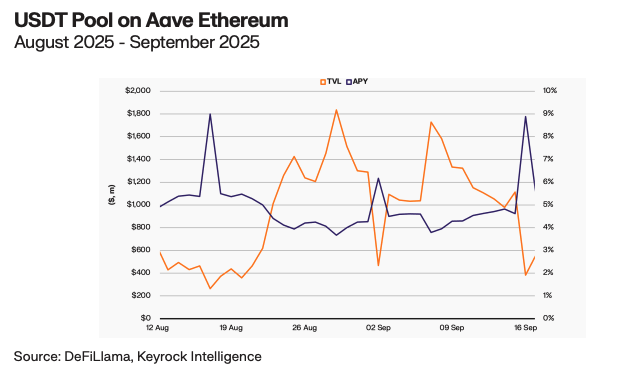
Another drawback is the yield volatility, and the predictability issues that arise from this. Yields in DeFi lending and staking are highly variable, often at the whim of market sentiment. Yields are typically higher onchain than for passive offchain strategies, but the threat of sudden inflows or outflows of capital degrading yield causes issues for investors in onchain automated strategies. An example of this is the USDT pool on Aave’s Ethereum implementation, where huge AUM spikes in recent months have seen yields fluctuate between ~3% and ~9%. Short-term fixed income products often used in passive, low-risk traditional finance strategies typically offer more predictable returns tied to central bank policy rates.
Aside from product drawbacks, we then have the reputational risks associated with depositing to all onchain asset management strategies, stemming from a regulatory uncertainty. Automated vaults in particular operate in a regulatory grey area. Despite major regulatory progress in the US, including SEC clarification that staked assets are not securities, which is particularly relevant given their prominence in automated onchain strategies, there are next to no investor protections or deposit insurances onchain. This is where allocators can participate in traditional finance with peace of mind, given they’re regulated, insured in some jurisdictions, and have transparent reporting standards.
Automated Onchain Yield Strategies Fees and Performance
As mentioned in our previous sections, when comparing onchain automated yield strategies to traditional finance, we’ve opted to compare to Cash & Short-Duration Fixed Income Funds and Money Market Funds as the most similar traditional strategies.
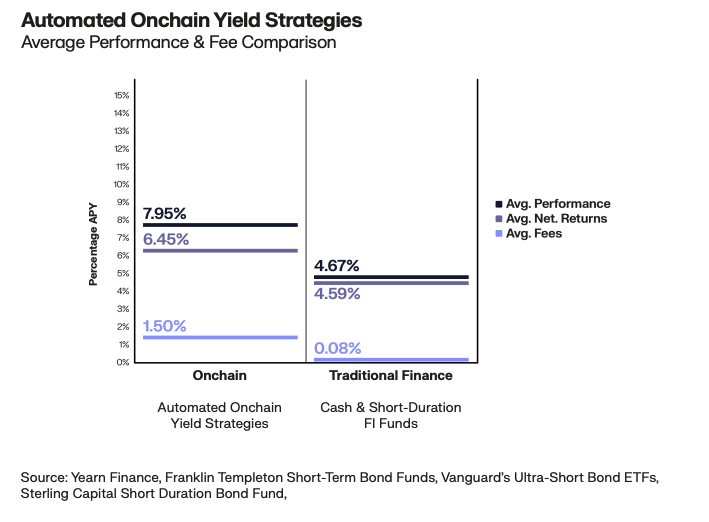
Fees remain a headwind for onchain passive strategies. The average cost of DeFi vaults is 1.50%, a reflection of layered management, withdrawal, and operational charges for capital deployment across protocols. Traditional products, by comparison, run on razor-thin margins with the Vanguard money market fund charges 0.11%, while the SPDR and iShares ETFs have gross expense ratios of just 0.04% and 0.07% respectively, for an average of 0.08%. The sheer scale of these funds, measured in tens to hundreds of billions of dollars, enables cost efficiencies that DeFi cannot yet replicate. In effect, investors in DeFi are paying a premium for access to higher yields, global permissionless infrastructure, and composability.
Even accounting for higher fees, onchain vaults retain a performance edge. Net yields averaged 6.45% across the Yearn vault sample, compared to 4.59% across the traditional benchmarks, a spread of roughly 186bps. This suggests that while DeFi is still niche in terms of scale, allocators are compensated with structurally higher returns. The forward-looking question is how this dynamic evolves. Traditional rates may drift upward, narrowing the spread, while DeFi fees are likely to compress as competition intensifies and larger allocators demand institutional terms. For now, however, onchain passive vaults remain compelling as high-yield, transparent, and programmable alternatives to some of the largest but lowest-cost funds in traditional finance.
Allocator Profiles to Automated Onchain Yield Strategies
Given the simplicity of automated onchain yield strategies, and the nature of their origination within the early wave of DeFi, the majority remain permissionless, and with low deposit thresholds. The result is that a large segment of their depositor count, 63% to be specific, is retail, defined as addresses with deposits under $10k. These users represent the long-tail of DeFi users seeking passive yield.
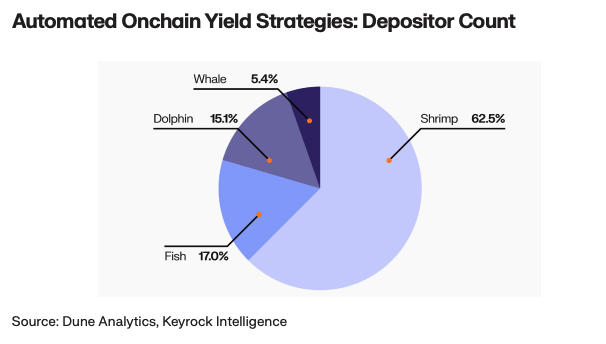
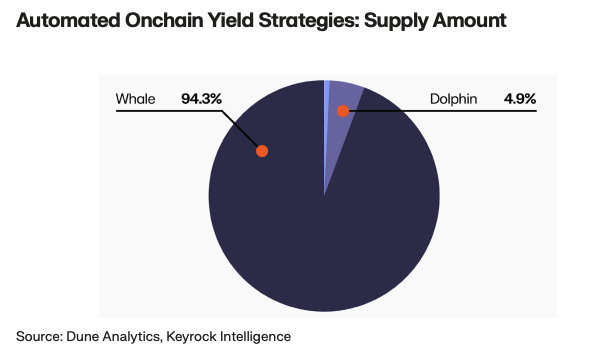
That said, these retail depositors account for only 6 bps of the capital supplied to onchain passive strategies. Instead, from a capital supplied perspective, a far better measure of the allocators to this strategy, onchain passive strategies are dominated by large players. Whales and Dolphins, defined as those supplying over $1 million per transaction and $100k-$1 million per transaction respectively, account for 99.2% of capital in these strategies. This represents the emerging trend of institutional allocators within automated onchain yield strategies, with allocators typically being crypto-native funds and family offices experimenting with permissionless yield strategies at scale.
Catalysts for Automated Onchain Yield Strategies Growth
The future catalyst for automated onchain yield strategies stems from standardisation and adoption at scale. ERC-4626 has transformed vaults from siloed strategies into composable building blocks, enabling funds-of-funds and treasury managers to plug into them with minimal friction. DAO treasuries such as MakerDAO, Frax, and others have become core depositors that have led the growth to date, and we expect this to continue. This programmatic flow provides predictable, sticky inflows that compound over time.
Stablecoin and liquid staking integrations are another driver. Vaults now package stETH, cbETH, and tokenised T-bills, producing yields that are competitive with traditional markets while retaining instant liquidity. This has broadened the allocator base beyond yield-chasing retail into more risk-averse institutions looking for transparent, dollar-denominated products.
User experience, long a bottleneck, is also being addressed. EY’s Digital Assets in the Mainstream survey (2024) found 51% of non-DeFi investors cited lack of expertise as their top barrier, but vault UX has improved drastically since the first Yearn vault deployment. Aggregators like Morpho and Sommelier abstract away complexity, letting allocators treat passive vaults more like digital ETFs than experimental protocols. As interfaces converge on simplicity, automated onchain yield strategies are positioned as one of the most accessible gateways for new capital entering onchain markets.
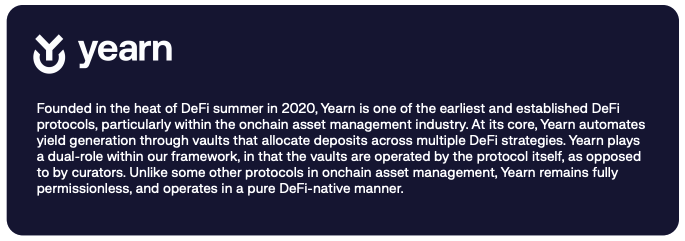
Founded in the heat of DeFi summer in 2020, Yearn is one of the earliest and established DeFi protocols, particularly within the onchain asset management industry. At its core, Yearn automates yield generation through vaults that allocate deposits across multiple DeFi strategies. Yearn plays a dual-role within our framework, in that the vaults are operated by the protocol itself, as opposed to by curators. Unlike some other protocols in onchain asset management, Yearn remains fully permissionless, and operates in a pure DeFi-native manner.
To this end, Yearn refers to itself as the backend yield layer for DeFi, a product that curators of strategies, particularly discretionary strategies, can leverage, “Yearn has always seen itself as the backend yield layer of DeFi. If a wallet, DAO, or Traditional Finance product needs yield exposure, we want them to plug into us permissionlessly.”
Yearn’s particularly important to the onchain asset management landscape in that it pioneered the concept of automated passive strategies. This is through the pivotal role it played in designing and developing the ERC-4626 vault token standard that’s leveraged by the majority of onchain asset management protocols today. The standard unlocks composability and reduces integration costs for all of DeFi.
“standards like ERC-4626 aren’t just technical conveniences, they’re what make institutional-scale integration possible. You can’t have onchain asset management without safe, composable vaults.” – Corn, Head of Business Development, Yearn Finance
The long track record means that it represents a protocol that’s been battle tested through several market cycles, essentially proving the sustainability and reliability of these onchain strategies.
Beyond standardisation, Yearn also demonstrated the power of composability in practice. By aligning its vault architecture with ERC-4626, Yearn ensured that vault tokens could plug into other parts of the DeFi stack, from money markets like Aave to liquidity venues like Curve. This turned Yearn vaults into building blocks that could simultaneously serve as collateral elsewhere, be rehypothecated, or integrated into more complex strategies. This creates the yield-on-yield effect that’s core to onchain asset management’s key value add.
Yearn have stated they believe the next step to improve onchain asset management is to bolster UX upgrades, including showing APY impact before deposit, auto-harvesting options and transparency into rebalancing activity. While this information is, for the most part, available onchain, Yearn believes that the bridge between those uneducated in onchain forensic analysis and gaining transparency insights is to bolster UI, “the bridge between DeFi-native transparency and mainstream usability is UX. Everything is already visible onchain, the job now is surfacing it in ways allocators and users actually understand.” This is believed to be a core improvement required to harness the inherent benefits of onchain strategies.
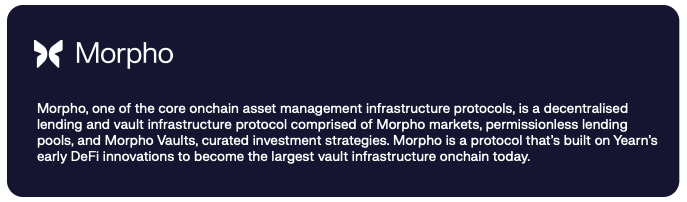
Morpho, one of the core onchain asset management infrastructure protocols, is a decentralised lending and vault infrastructure protocol comprised of Morpho markets, permissionless lending pools, and Morpho Vaults, curated investment strategies. Morpho is a protocol that’s built on Yearn’s early DeFi innovations to become the largest vault infrastructure onchain today.
Looking at Morpho’s fundamentals growth, we can see they’ve exhibited near-continuous growth since inception in 2024, pushing to new ATHs of over $9.4 billion in recent weeks. This growth, albeit with a minor pullback in H1 2025, demonstrates sustained demand for both passive vaults and lending markets, even through periods of wider market volatility.
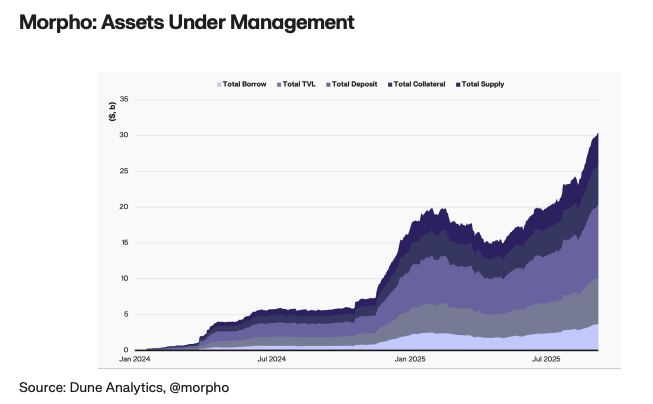
Morpho functions as a dual-role platform, in which it houses both a base-layer infrastructure for lending and borrowing, and as a distribution layer for passive vault strategies. It’s the latter that we’re primarily focusing on in this report. It also features a fully permissionless design, allowing anyone to spin up a market or vault with their chosen collateral, oracle, and parameters, making it one of the most flexible frameworks in DeFi.
Morpho was the pioneer of the concept of a ‘curator’, which is akin to onchain asset managers, who design and manage vault strategies deployed to the Morpho platform. In automated strategy fashion, Morpho vaults provide investors with ‘set-and-forget’ products, while it’s the curators who handle asset allocation and risk management. Simon Crotty of Morpho Labs noted, “Curators are like the fund managers of DeFi. They’re the ones designing risk frameworks, allocations, and strategy, while Morpho provides the rails to deploy them permissionlessly.”
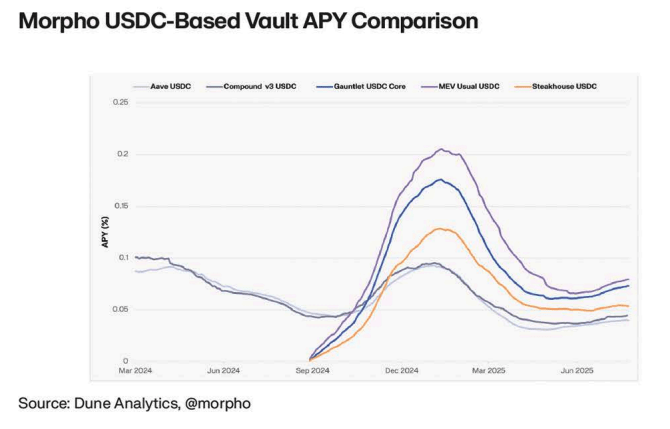
Across USDC markets, curated vault strategies on Morpho have consistently outperformed relative to vanilla lending on Aave v3 or Compound v3 directly. As you can see below, MEV Capital and Gauntlet have consistently provided APY of ~2x that seen in these USDC lending protocols via their active management of positions. Morpho as a protocol doesn’t see itself as competing with Aave or Compound but rather facilitating a permissionless free market in which users of their infrastructure are able to create strategies that provide yields on similar assets offered by these protocols. As noted by Simon Crotty, Marketing Lead at Morpho Labs, “We’re not trying to replace base lending protocols. We want to make them more efficient by creating a marketplace where yield can be actively curated.” This framing is crucial, as it positions Morpho as complementary to the broader DeFi ecosystem. Ultimately, this outperformance reflects the ability of vault curators to dynamically allocate liquidity, while optimising for MEV rebates and incentive schemes, versus the entirely static allocation to lending protocols.
Morpho’s Vaults V2 implementation marks a shift from incremental optimisation to becoming genuine infrastructure for institutional allocators. The upgrade focuses on modularity, allowing curators to design bespoke strategies that can draw from multiple lending markets at once, reducing fragmentation and improving capital efficiency. Risk frameworks have also been overhauled from V1, introducing more granular collateral parameters and automated circuit breakers that make vaults more resilient under stress. The user experience has also been redesigned with institutions in mind, lowering the friction for DAOs or treasuries to launch strategies without needing to fork existing infrastructure.
Taken together, these changes position Morpho as a neutral fund infrastructure layer, as opposed to merely a yield optimiser.